Renewed war in Ethiopia and the threat of regional conflict
The resumption of war in Ethiopia, four years on, was the result of the collapse of the 2022 Pretoria Agreement between the federal authorities and the rebellious Tigray region, as well as changes in the international situation, including the reorganisation of regional alliances. The new conflict threatens to spread to neighbouring states, particularly Sudan and Eritrea, which EU diplomacy is seeking to prevent.
 Obtained by REUTERS / Reuters / Forum
The origins of the conflict
The Tigrayan minority (around 4.5 million people, or 6 per cent of Ethiopia’s population), represented by the Tigray People’s Liberation Front (TPLF)—a party rooted in the guerrilla movement—dominated Ethiopian politics and the economy between 1991 and 2018. Its reluctance to submit to central authority following Prime Minister Abiy Ahmed’s rise to power triggered the previous phase of the war between 2020 and 2022. The hostilities claimed around 600,000 lives, making it the deadliest armed conflict in the world at the time, and were accompanied by the use of starvation as a weapon of war. The fighting was halted by a cessation of hostilities agreement signed in Pretoria under the auspices of the African Union (AU) and supported by the US. This was not followed by proper peace negotiations, and key provisions (such as disarmament) remained unimplemented. Nor did the compromise on power-sharing in Tigray hold. In March 2025, the hardline faction of the TPLF ousted its moderate rivals from power, and unilaterally elected its leader, Debretsion Gebremichael, as regional president in the spring of 2026. He was then responsible for preventing nationwide Ethiopian elections from being held in the province in June.
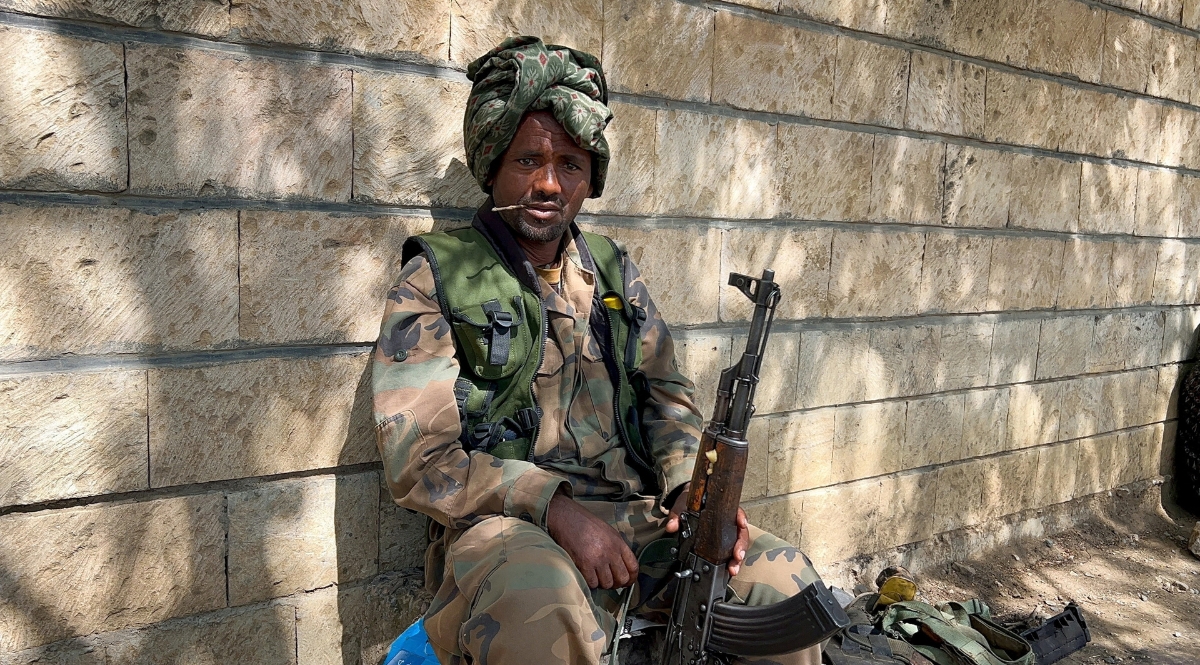
Both sides had been escalating their rhetoric and preparing for an armed confrontation. In recent months, federal forces had been massing near the Tigray border and attacking selected targets with drones, whilst the Tigrayan authorities had been carrying out forced mobilisation. The outbreak of open fighting was triggered on 23 September when TPLF forces seized the province’s key airports, blocking the expected deployment of Ethiopian special forces. The rebels also seized part of the neighbouring Afar province. However, after a few days, the Ethiopian army went on the offensive and, on 3 October, captured the Tigrayan capital, Mekelle. TPLF forces withdrew into the mountains, preparing for a guerrilla war. Meanwhile, on 1 October, the first attacks took place on military targets in the Ethiopian capital, Addis Ababa, located far from the front line, likely using drones.
A new balance of power
The current conflict cannot be classified solely as a struggle between the central government and a region. The outbreak of fighting was preceded by the formal establishment of the Alliance for Survival by seven rebel groups (from the provinces of Tigray, Amhara, Oromia, Benishangul-Gumuz, Afar and Somali). The Alliance declared its intention to work together to overthrow Abiy Ahmed’s federal government. However, it quickly proved to be rather disorganised. Only the TPLF, the Amhara guerrillas of the Fano movement, and the Afar Revolutionary Front for National Unity appear to be coordinating their actions, presumably under a joint command structure. The other groups have distanced themselves from active engagement in the fighting. The TPLF’s greatest support comes from the Amhara forces, numbering around 20,000 fighters, led by former officers of the regional special forces disbanded by Prime Minister Abiy Ahmed.
Whilst cooperation—even on an ad hoc basis—with allies from other parts of Ethiopia strengthens the Alliance, internal divisions amongst the Tigrayans weaken it. Between 2020 and 2022, they were largely united, and their armed movement (the Tigray Defence Forces, TDF) was non-partisan. Today, leaders critical of the TPLF’s hardline stance are being sidelined or arrested, including the former commander-in-chief of the TDF, General Tedesse Werede. Some Tigrayan leaders are cooperating with the federal authorities, and a splinter faction of Tigrayans entered Mekelle alongside Ethiopian forces.
Another key difference from the previous phase of the conflict is the stance of Eritrea, which at previously provided substantial support to Ethiopian forces and was also responsible for numerous crimes against Tigrayan civilians. Eritrea is currently supporting the Alliance and the TPLF, following announcements by Abiy Ahmed’s government regarding Ethiopia regaining access to the sea and the Eritrean port of Assab. Consequently, shortly after the fall of Mekelle, its forces crossed the border with Ethiopia and entered the towns of Adigrat and Idaga Hamus in the northern part of Tigray.
The war and the region
Whilst the previous war in Tigray unfolded largely in isolation, it is now influenced by regional rivalries. This applies both to links with the conflict in Sudan and to changes in the security architecture of the wider Middle East. As a result, a new configuration of regional alliances overlaps with the axis of the dispute in Ethiopia. The Ethiopian authorities, who have directly supported Sudanese rebels from the Rapid Support Forces (RSF) over the past year, are also cultivating close relations with the United Arab Emirates (the RSF’s main patron) and Israel. For their part, the Ethiopian rebels—some of whom have cooperated with government forces in Sudan—are counting on support from states in conflict with Ethiopia: in addition to Eritrea, these include Sudan, Egypt and Somalia. The leaders of these four countries—which Ethiopia directly accuses of conspiring against it (hence its expulsion of the Egyptian diplomat and severing of diplomatic ties with Eritrea)—met on 4 October in Al Alamayn, Egypt. There, they indirectly criticised the policies of the UAE and Israel in the region, and agreed to exchange intelligence in the event of a threat from Ethiopia to neighbouring countries. For Egypt, this is also an opportunity to reassert its regional influence following its defeat in the dispute over the Grand Ethiopian Renaissance Dam (GERD) on the Blue Nile, which Ethiopia built and inaugurated despite Egyptian opposition driven by the perceived risk of reduced water flows. This bloc enjoys the support of Saudi Arabia, which is seeking to limit the influence of the UAE and has recently formed a defence alliance with Turkey and Pakistan.
Outlook
The course of the new war in Ethiopia will depend both on the state of the forces and morale on both sides (which is difficult to verify at present) and on regional ties and the possible involvement of third countries. Access to combat drones will be key to gaining the upper hand in the war; these proved decisive in halting the rebels’ advance towards Addis Ababa during the 2020–2022 conflict. Ethiopian forces currently possess them, and the rebels will attempt to seize them. If Ethiopian forces quickly bring Tigray under control, they may attempt to attack Eritrea—a risk indicated both by the rhetoric of the Ethiopian authorities and by the redeployment of troops near the border. It is also possible that the conflicts in Ethiopia and Sudan could merge into a single, complex regional war, in which Sudanese and Ethiopian forces would face off against one another, each cooperating with rebels on the other’s territory. The European Union is seeking to prevent both of these scenarios; its Special Envoy to the Horn of Africa, Annette Weber, is leading a dialogue on de-escalation with the countries of the region. Further escalation could also scupper the plans of the US, which recently lifted sanctions on Eritrea in the hope of economic cooperation.
Paradoxically, internal political fragmentation in Tigray may alleviate the suffering of the province’s civilian population. Whilst between 2020 and 2022 Ethiopian and Eritrean forces waged a war of attrition at great cost for ordinary Tigrayans, this is now unlikely given the significant involvement of Tigrayan factions on the government side.
US involvement in Iran and the EU’s prioritisation of defending Ukraine against Russia’s aggression—which are consuming the resources and attention of the world’s major players—reduce the likelihood that they will be inclined to apply decisive pressure to halt a new war in Ethiopia and the region. In this context, it would be desirable for the UN Security Council to push for an end to the fighting, as well as for diplomatic efforts involving the leaders of the most important states. This could reduce tensions in the region and help to work out a new compromise on the governance of Tigray, whilst avoiding the mistakes made in Pretoria. The recent session of the UN General Assembly provided a good opportunity for this, but this opening was not exploited. Nor will the AU play such a role, as Ethiopia—which hosts the AU’s main institutional headquarters in Addis Ababa—will not allow it to do so. Consequently, the stance of the Middle Eastern powers will now be critical in shaping further development of the situation, even though they view Ethiopia—much like Sudan—as an arena for rivalry rather than cooperation for peace.