Drones and microchips: new areas of Poland-Taiwan cooperation
Over the past two years, cooperation between Poland and Taiwan has strengthened. This is due to Taiwan’s push for more intensive economic diplomacy, as well as Poland’s greater willingness to develop relations that extend beyond purely economic exchanges. The main area of cooperation is technologies that may help both Poland and Taiwan to build resilience (e.g., by reducing dependence on undemocratic and threatening states) and deter their respective main adversaries: Russia and China.
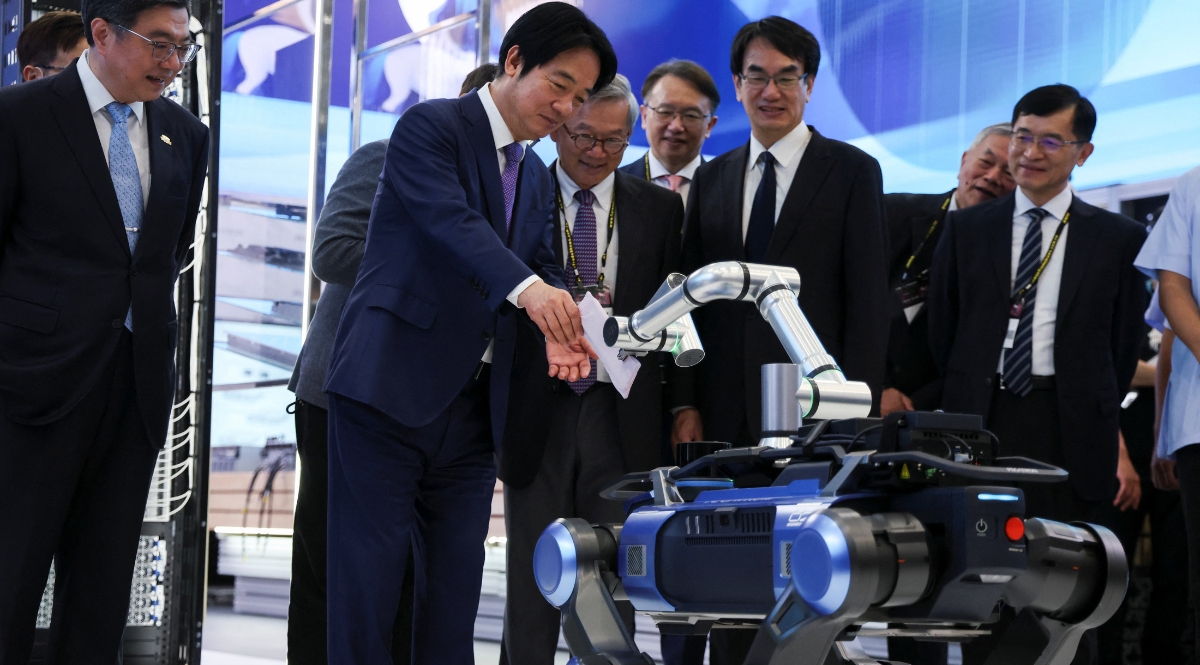 Tsai Hsin-Han / Reuters / Forum
From values to interests
Contacts between Poland and Taiwan have been growing closer since 2017. This process began with the signing of a double taxation agreement in December 2016, following more than 20 years of negotiations. Despite the intensification and institutionalisation of contacts within business circles (e.g. the establishment of chambers of commerce) and between the administrations (e.g. dialogues between various ministries and the formation of committees and working groups), both parties were dissatisfied with the outcomes of their cooperation.
Taiwan had hoped for greater support from Poland in strengthening its international standing. This included the expectation that meetings between high-ranking officials and politicians would be made public. However, due to the potential negative response from China, the Polish authorities were not willing to take this step. Nevertheless, the Polish authorities hoped that contacts with Taiwan would generate tangible economic benefits, particularly in the form of investment to boost the country’s development and create jobs, following the example of Japanese and South Korean investment in Poland.
Following the January 2024 elections in Taiwan, the new administration introduced adjustments to its policies, including those relating to Europe. As Foreign Minister Lin Chia-lung emphasised, the island is shifting from ‘values-based diplomacy’ to ‘value-added diplomacy’. While strengthening Taiwan’s international standing by promoting Taiwanese democracy and the rule of law together with foreign partners—a priority for the previous minister, Joseph Wu—remains an important counterweight to the PRC, economic and security gains are now the primary considerations. This shift in approach was most likely influenced by the dissatisfaction of European countries, including Poland, with the lack of tangible economic benefits from cooperating with Taiwan; the uncertainty of Taiwanese authorities regarding the policies of Donald Trump’s administration; and the lessons drawn from the war in Ukraine, including the growing importance of asymmetric defence capabilities. Consequently, the interests of Taiwan and Poland have begun to converge.
Trade and drones
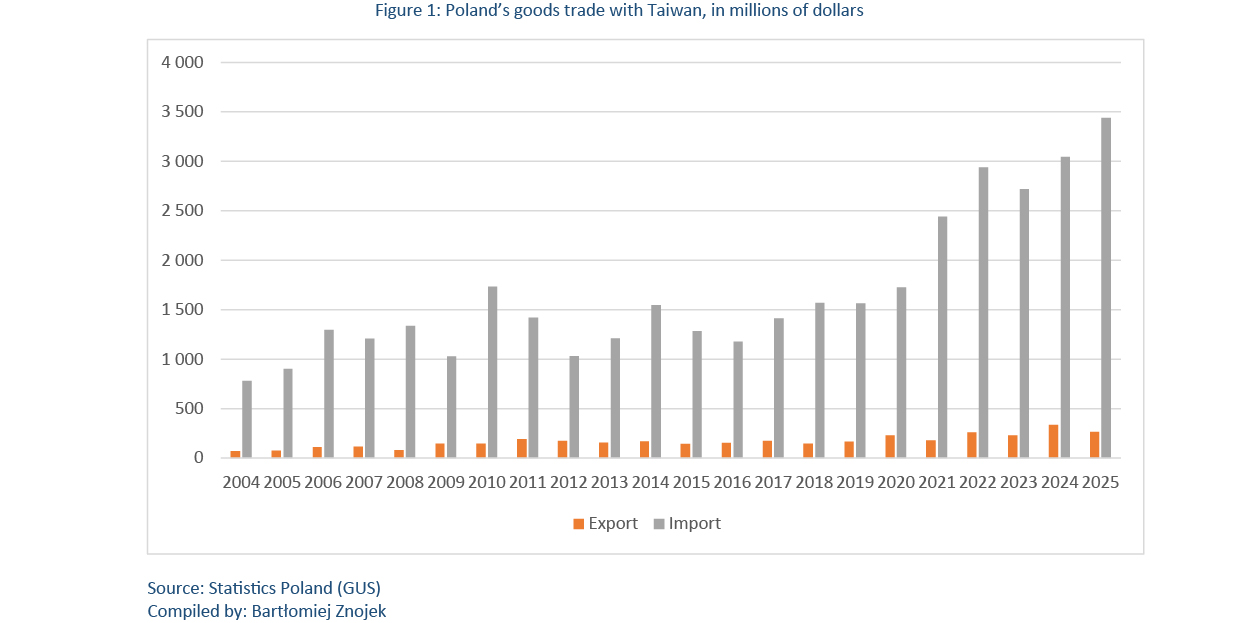
The bilateral economic cooperation is characterised by a significant Polish trade deficit, resulting from high import levels, primarily of high-tech products with a high added value. In 2024, semiconductors, LCD panels and other electronic components accounted for around 60% of imports from Taiwan. The difficulty in balancing the deficit stems from the relatively closed Taiwanese market, which has numerous legal regulations and does not recognise many international standards (including those of the EU). This makes it difficult for goods and services to enter the market, with the ICT sector being the only exception.
According to Statistics Poland (GUS) data, there have been no changes in recent years – the deficit is growing proportionally with the increase in imports from Taiwan and Polish exports to the island (Figure 1) – but new goods such as drones and drone parts are worth noting. In November 2024, the Polish-Taiwanese Chamber of Commerce signed a memorandum of understanding on drone cooperation with the Taiwan Excellence Drone Alliance (TEBIDOA). According to Taiwanese data, Poland was Taiwan’s largest export market for drones in 2025 (this product category is not listed in Polish and EU data). This year’s report by the Taiwanese institute DSET suggests that Poland imports drone parts (sub-assemblies and components) that are then assembled and transferred to Ukraine.
Most of the drones that Ukraine is using in its fight against Russia are either Chinese-made or contain Chinese components. Notably, China supplies both Ukraine and Russia with drones and parts. By contrast, Taiwanese drones supplied to Ukraine do not contain any Chinese components (“non-red supply chain”), and the island’s authorities are keen to learn from Ukraine’s experience of producing and using these devices in preparation for a potential crisis with the PRC. Taiwan is considering investments by its drone companies in Poland. One reason for this may be that, despite the island’s efforts, the Ukrainian authorities are reluctant to cooperate directly with Taiwan, fearing China’s reaction.
Technology investments
From the perspective of the Polish authorities, the scale and nature of Taiwanese investments, particularly in the technology sector, have for many years failed to meet expectations. Representatives of the Polish administration were reluctant to demonstrate political backing for projects (such as attending the project's launch ceremony, as Taiwan had hoped) that fell short of these expectations, such as Chimei Foods’ 2024 investment in a frozen food factory near Łódź.
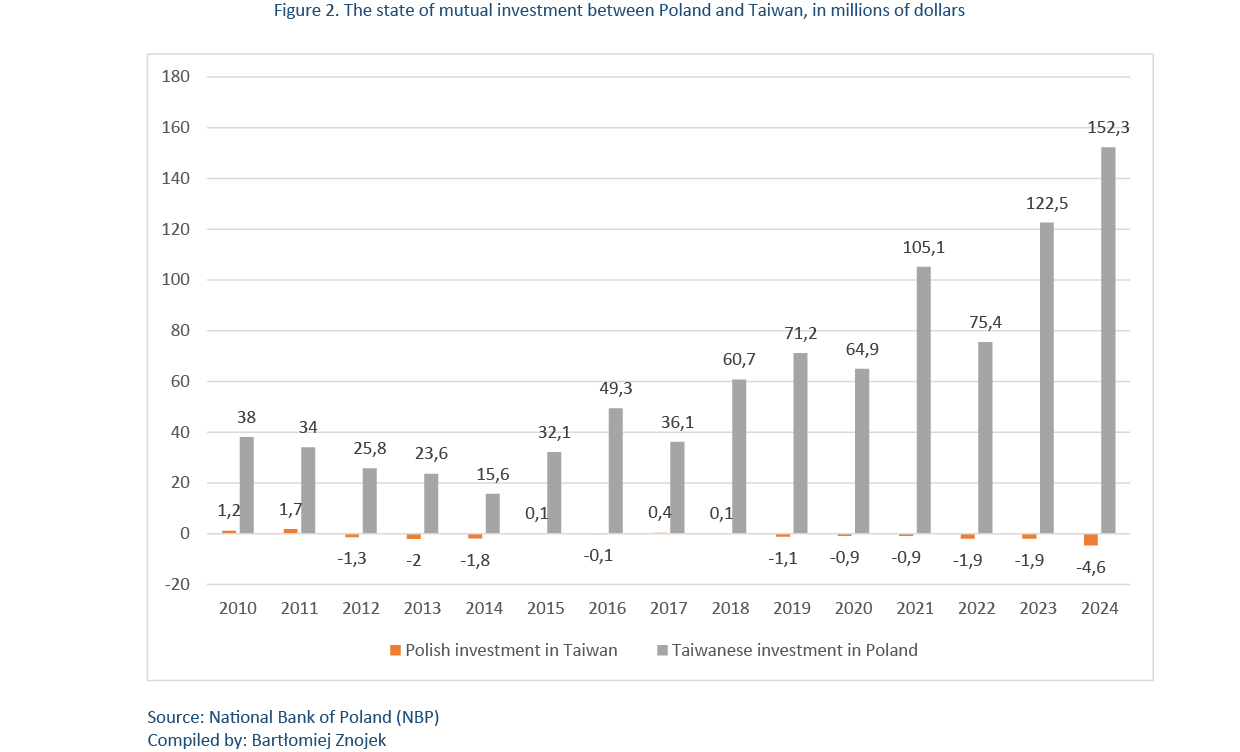
Over the last two to three years, Taiwan has shown increased interest in investing in Poland, as reflected in part by data from the National Bank of Poland (Figure 2). The first indication that Poland might benefit from Taiwanese technological investment in Europe came with the start of construction of a semiconductor manufacturing plant in Dresden in 2024. This project, known as the European Semiconductor Manufacturing Company (ESMC), is a joint venture between the German firms Bosch and Infineon, the Dutch firm NXP (each holding a 10% stake), and the Taiwanese firm TSMC (holding 70%). The ESMC plant will primarily produce semiconductors for the automotive industry, and given Dresden's proximity to the Polish border, the project offers an opportunity to integrate Polish logistics and component manufacturers into the ESMC supply chain. Since 2018, the Taiwanese company Universal Scientific Industrial (USI) has operated a facility in Kobierzyce, near Wrocław, producing printed circuit boards (PCBs) onto which finished chips are mounted. Two years ago, USI opened a second production plant in Poland. In 2023, the Taiwanese semiconductor design company MediaTek opened a research and development centre in Warsaw.
In May this year, Electromobility Poland (EMP), which is set to establish a Polish electromobility hub, welcomed the Taiwanese company Foxconn as a strategic partner, having previously considered a partnership with the Chinese company Geely. A joint venture with Foxconn is likely to be established. Meanwhile, at Poland’s first Taiwan Expo in June, an investment was announced by TEEMA (the Taiwan Electrical and Electronic Manufacturers’ Association), of which Foxconn is a member, in a technology park located near Wrocław. The park will specialise, among other things, in producing AI servers and electronic components for electric cars. Together with TSMC’s investment in Dresden, Germany, this investment is set to incorporate Wrocław and the surrounding area into the “European semiconductor triangle”. This idea emerged when TSMC announced its investment in Germany, given the proximity of the Czech Republic and Poland creates the potential for three-way cooperation in this sector.
Conclusions and perspectives
Over the past two years, the scope of Polish-Taiwanese cooperation has expanded. This is evident in the shift from increasing market share to prioritising security considerations. This development reflects the considerable flexibility of the ‘One China policy,’ on which Poland’s approach to Taiwan is based, as the only de facto limitation is the non-recognition clause—the refusal to establish diplomatic relations with Taiwan.
Poland’s participation in the semiconductor triangle could strengthen Europe’s economic security by shifting the value chain to the continent and excluding Chinese participants (the “non-red supply chain”). There is potential for synergy between the ESMC chip manufacturing facility in Dresden and USI’s mounting facilities in Poland, as well as with MediaTek (design) and the TEEMA technology park (testing and packaging of finished chips and production of components for the electromobility hub), all of which could contribute to building Europe’s technological sovereignty. This has the potential to encompass the automotive, industrial, robotic and telecommunications sectors.
Drone cooperation would offer similar benefits to Poland. Thanks to Taiwan, Ukraine can reduce its dependence on China, and investments by Taiwanese companies in Poland could provide an additional boost to the development of the Polish drone industry, with production capacity increasing. This would benefit both Poland, which is facing growing hybrid threats from Russia, and Ukraine, which would be able to source drones directly from Polish factories.
The semiconductor and drone sectors may contribute to building state resilience and deterring potential aggressors; thus, cooperation can be mutually beneficial. Taiwan is diversifying its partnerships. This provides economic benefits not only from production, but also from external financing. For instance, Germany financed half the value of the investment in ESMC through public aid. Beyond this, Taiwan can leverage this cooperation politically to strengthen its international standing, primarily against China. Given Taiwan’s economic presence in Europe, it is reasonable to assume that it will expect greater involvement from European countries in deterring China from taking hostile action in the Taiwan Strait. This expectation may manifest as Europe presenting a consistent narrative about maintaining the status quo in the area. By collaborating with Taiwan, Poland could reduce its dependence on China, as well as the risk of Chinese coercion, and at the same time, participate in the reindustrialisation of Poland and Europe.
However, Taiwan is not an easy partner to work with. The island uses its technological advantages to secure more favourable terms of cooperation, which often prolongs and complicates negotiations, and takes political considerations into account alongside commercial gains. This may present difficulties for countries reluctant to confront the PRC. Consequently, it is crucial for the state administration to maintain consistent engagement with Taiwan and provide support for negotiations with Taiwanese partners.


.png)