Strategic Opportunism: North Korea's Alliance with Russia and Its Implications for Europe
· Russia’s full-scale invasion of Ukraine in 2022 created conditions conducive to the formation of an alliance in 2024 between North Korea and Russia. This relationship is characterised by North Korean military assistance in exchange for Russian political, economic, and military support to the Democratic People’s Republic of Korea (DPRK).
· Although the mutual benefits sustain ongoing cooperation, the alliance exhibits vulnerabilities in several domains. Its long-term sustainability is also uncertain. A ceasefire or conclusion of the conflict in Ukraine could diminish or end North Korean-Russian cooperation in its current form.
· The DPRK-Russia alliance presents a significant threat to European security and requires a more decisive response from European states, in coordination with the United States and Asian partners. Beyond enhancing political and intelligence cooperation, sustained military assistance to Ukraine remains essential. Diplomatic efforts to resolve the war in Ukraine should also address North Korean-Russian cooperation. Furthermore, the European Union should reconsider its approach to the DPRK.
 AA/ABACA / Abaca Press / Forum
North Korea’s relations with Russia before 2022
After the collapse of the Soviet Union in 1991, relations between the DPRK and the Russian Federation became strained, particularly from Pyongyang’s perspective. This tension originated in the late Soviet era, when the USSR established diplomatic relations with the Republic of Korea in 1990, an act the DPRK perceived as a betrayal. Although the Russian Federation maintained diplomatic ties with North Korea, its primary focus shifted to cooperation with South Korea. DPRK relations began to improve in the late 1990s, as evidenced by President Vladimir Putin’s visit to Pyongyang in 2000 and the signing of a treaty on friendship, good-neighbourliness, and cooperation, which replaced the 1961 DPRK–USSR treaty that had expired in 1996.[1] Kim Jong Il, the leader of the DPRK, visited Russia in 2001, 2002, and 2011. Russia also participated in the six-party talks from 2003 to 2008 on the DPRK’s nuclear programme. It officially supported inter-Korean dialogue, proposing the development of infrastructure and energy links among the two Koreas and Russia. Concurrently, Russia was unable to maintain its role as North Korea’s primary economic partner, a position subsequently assumed by China. Russia’s deteriorating economic conditions and the termination of preferential pricing for energy exports to North Korea led to a significant decline in bilateral trade. In 1990, the USSR accounted for 53.3% of the DPRK’s foreign trade; by 2000, the Russian Federation accounted for only 2%, and by 2022, just 0.2%.[2] Russia’s ambitious investment projects in the DPRK’s energy and rail infrastructure were not implemented due to high costs, United Nations sanctions on North Korea, and the DPRK’s totalitarian governance, which entailed risks of nationalisation and restrictions on movement.[3]
Russia’s involvement largely mirrored China’s policy toward the DPRK. This alignment was evident in Russia’s support for UN Security Council resolutions between 2006 and 2017, which condemned North Korea and imposed sanctions in response to nuclear and missile tests. For several years, Russia appeared to acknowledge China’s predominant influence on the Korean Peninsula and accepted a secondary or tertiary role. Although North Korea did not consider Russia a principal partner, it provided clear support, such as recognising the annexation of Crimea in 2014. In exchange, North Korea obtained the cancellation of 90% of its Soviet-era debt, amounting to $11 billion. In 2019, Kim Jong Un made his first visit to Russia since assuming power in 2011. During his meeting with Putin in Vladivostok, no agreements were signed; instead, the meeting served to enhance the DPRK’s negotiating position in talks with the United States and South Korea.[4]
The invasion of Ukraine by Russia in February 2022 marked a turning point in DPRK-Russia relations, resulting in increased contact and cooperation across political, economic, and military domains.
The development of cooperation between the DPRK and Russia after 2022
Political cooperation
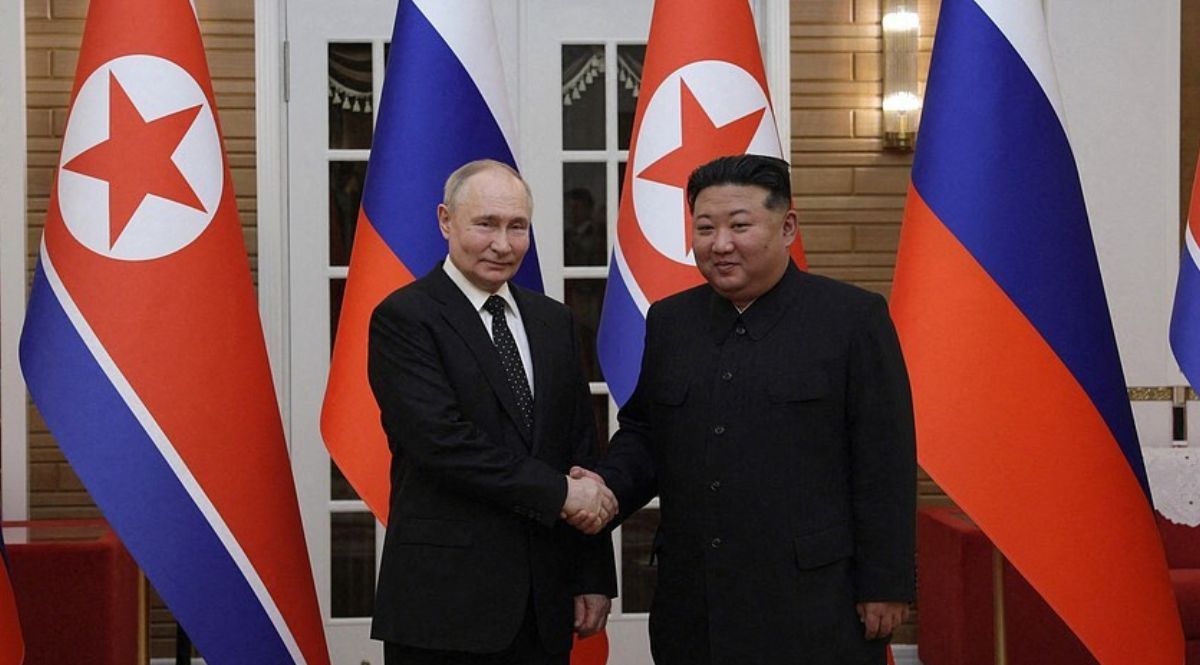
In the political sphere, North Korea has unequivocally supported Russia’s aggression against Ukraine, voting on 2 March 2022 in the UN General Assembly—one of only five countries—to oppose a resolution condemning Russia. North Korea also recognised the Donetsk and Luhansk People’s Republics, established by Russia in eastern Ukraine under occupation. In return, the DPRK expected Russia to give its consent to the further development of its nuclear and missile capabilities, to undermine Western sanctions policy, and to strengthen political cooperation against the US.[5] The lack of expected successes on the front line and the depletion of ammunition stocks prompted Russia to step up its political dialogue with the DPRK in the hope of securing military support. High-level contacts resumed, beginning with Minister of Defence Sergei Shoigu’s visit to Pyongyang in July 2023, the first such visit since 1991, coinciding with the 70th anniversary of the Korean War armistice. This visit facilitated the supply of ammunition and weapons from the DPRK. In September 2023, Kim Jong Un met with Vladimir Putin in Russia during his longest foreign visit since assuming power.[6] In June 2024, the Russian president travelled to Pyongyang, marking the first visit by a Russian leader to the DPRK since 2000.[7] The Comprehensive Strategic Partnership Treaty, signed during this visit, elevated bilateral relations to a treaty-based alliance.[8] Article 4 contains a clause obliging the parties to provide each other with all necessary assistance, including military assistance, in response to armed aggression in accordance with Article 51 of the United Nations Charter, which concerns the right of self-defence. Although the treaty does not mandate automatic military assistance, its provisions are more extensive than those of the 1961 North Korean–Soviet treaty, including commitments to consult in the event of conflict (Article 3) and to jointly strengthen defence capabilities, such as through joint exercises (Article 8).[9]
Russia has extended political support to North Korea, effectively recognising it as a nuclear state and endorsing the advancement of its nuclear and missile programs. Since 2022, alongside China, Russia has vetoed US draft resolutions in the UN Security Council that proposed additional sanctions on the DPRK. In March 2024, Russia vetoed a UN Security Council resolution that would have extended the mandate of the expert panel monitoring sanctions on North Korea, effectively removing the sanctions regime’s monitoring mechanism.[10] Additionally, Russian authorities have repeatedly emphasised the DPRK’s sovereign right to develop any defence capabilities and have rejected calls for its denuclearisation.[11]
Military cooperation
Military cooperation has emerged as a central component of North Korea’s relations with Russia, and especially beneficial for the latter. According to South Korea’s Military Intelligence Agency, between August 2023 and February 2026, the DPRK delivered approximately 33,000 containers to Russia, which may have contained up to 15 million rounds of 152 mm artillery ammunition. The deliveries also included 122 mm and 130 mm artillery shells, 122 mm and 107 mm rockets, and 120 mm, 60 mm, 82 mm, and 140 mm mortar rounds. Additionally, the DPRK supplied Russia with M-1989 Koksan 170 mm self-propelled guns, M-1991 240 mm multiple rocket launchers (a total of 220 units), Hwasong-11 short-range ballistic missiles (at least 248), Bulsae-4 anti-tank guided missiles, and older models such as D-20, D-30, M-30, M-46, D-74, and hand-held anti-tank grenade launchers.[12] Reports from South Korean military intelligence are consistent with those from other institutions for 2025–2026, although estimates of the scale of support differ.[13]
Artillery and mortar ammunition was shipped by sea from the North Korean port of Rajin to the Russian ports of Vostochny and Dunay using four Russian vessels: Angara, Maria, Maia-1, and Lady R. The ammunition was then moved by rail to depots near the border with Ukraine. Heavier platforms, such as artillery systems, were delivered from the DPRK by rail, while ballistic missiles were transported by Il-76 and An-124 transport aircraft. Approximately 70% of 122 mm and 152 mm ammunition supplies are estimated to have originated from North Korean reserves. After 2022, the DPRK is believed to have expanded its production capacity, facilitated in part by material supplies from Russia and China, which enabled the delivery of newly manufactured missiles.[14]
Artillery ammunition supplies from North Korea have played a critical role for Russia due to its declining reserves and production limitations within its defence industry. The conflict in Ukraine illustrates that large-scale artillery barrages continue to be a primary operational strategy for the Russian military.[15] Ukrainian intelligence reports, supported by non-governmental organisations, estimate that the DPRK provided between 40% and 70% of the artillery ammunition used by Russia against Ukraine.[16]
Beyond ammunition and military equipment, the DPRK has deployed 16,000 troops to Russia since October 2024, primarily in the Kursk Oblast. This force expanded from an initial deployment of 12,000 personnel. Since September 2025, 1,000 North Korean military engineers have participated in demining operations, and 5,000 workers have contributed to infrastructure reconstruction. Ukrainian and South Korean sources from February and March 2026 confirm that North Korean troops remain in the Kursk Oblast, although the current troop numbers are unspecified.[17]
Cooperation in cyber operations between Russian and North Korean hacker groups has likely increased. In 2025, reports documented coordinated activities and the use of shared infrastructure and tools by the North Korean groups Lazarus and Moonstone Sleet alongside the Russian groups Qilin, Medusa, and Gamaredon. These operations may involve attacks on foreign institutions, information theft, and the illicit acquisition of financial resources.[18]
Economic cooperation
The true scale and scope of North Korean-Russian economic cooperation remain difficult to determine due to the absence of reliable data. The DPRK does not release macroeconomic statistics, and since 2022, Russia has also limited the publication of economic data. Available figures may be inaccurate, as they often exclude trade in goods subject to sanctions, and some transactions may occur through barter. In light of the restrictions imposed on the DPRK by UN Security Council resolutions in 2016 and 2017, a significant proportion of North Korea’s economic exchanges with Russia are likely to be illicit. Official Russian data indicate that bilateral trade increased from $3.78 million in 2022 to $34.4 million in 2023 and $52.9 million between January and May 2024, suggesting a return to pre-pandemic levels.[19] However, these amounts remain negligible compared to North Korea’s trade with China ($2.64 billion), which constituted 98% of the DPRK’s foreign trade in 2024.[20]
In December 2022, Russia resumed oil exports to the DPRK following a two-year suspension resulting from the closure of North Korea’s borders during the COVID-19 pandemic. The UN Panel of Experts on the Implementation of Sanctions against the DPRK reported that in 2023, the Russian Federation exported 105,845 barrels of crude oil to North Korea.[21] Evidence suggests that in 2024, Russia increased maritime shipments of petroleum products to the DPRK without reporting these deliveries to the UN panel. According to the Open Source Centre, between March and November 2024, nearly 1.17 million barrels of Russian oil were delivered to North Korea, exceeding the annual limit of 500,000 barrels established by the UN Security Council.[22] Other estimates indicate that North Korea may have received up to 2.37 million barrels of oil from Russia between March 2024 and June 2025.[23] In addition, Russia supplied the DPRK with food products; official Russian data show that from 2024 to mid-2025, 32,600 tonnes of agricultural goods, primarily wheat flour, sugar, sunflower oil, pork, soya, and corn, were delivered.[24] South Korean intelligence sources suggest that the true volume may be several times higher.[25]
Since 2023, cross-border movement between Russia and North Korea has increased. Data from the Russian Federal Security Service (FSB) indicate that in 2023, 1,117 North Koreans visited Russia, while 1,238 Russians travelled to the DPRK.[26] In 2024, a substantial influx of 13,221 North Korean citizens entered Russia, including 7,887 on student visas.[27] FSB data indicate that this trend continued in 2025, when Russia issued 36,413 visas to North Korean citizens, of which 35,839 were student visas, likely used to circumvent sanctions.[28] This surge appears to be associated with the Russian market’s opening to a greater number of North Korean workers, in violation of UN Security Council Resolutions 2371 and 2397. Estimates place the number of North Korean workers in Russia between 15,000 and 50,000. For example, reports indicate that in 2025 alone, the DPRK may have sent at least 12,000 workers to Russian drone factories in Tatarstan.[29] North Korean companies affiliated with government agencies responsible for nuclear and missile programs, together with Russian firms, have deployed workers for forced labour.[30] The acceptance of workers from the DPRK was consistent with statements by Primorsky Krai authorities, who in November 2023 announced the potential use of arable land by North Korean farmers.[31] Since 2024, tourist exchanges have also resumed, with 1,957 Russian tourists visiting North Korea in 2024 and 5,075 in 2025.[32]
Since 2023, Russia has enabled North Korea to access the international financial system within the limits of its own participation. This facilitation is evidenced by the unfreezing of North Korean assets in Russian banks (previously frozen under UN Security Council Resolution 2094 of 2013), the authorisation of transactions by North Korean financial institutions through rouble accounts, and the permission for the DPRK to establish companies and open bank accounts in Russia. These measures represent a direct violation of UN Security Council Resolution 1718, which requires states to prevent the DPRK from financing proliferation.[33]
Following 2022, contacts between representatives of the economic ministries of Russia and North Korea became more frequent. In November 2023, annual meetings of the intergovernmental commission on trade, economic, scientific, and technical cooperation (established in 1991, last held in 2019) resumed. The Russian delegations were led by Aleksandr Kozlov, Minister of Natural Resources and Ecology, and the North Korean delegations by Yun Jong Ho, Minister of External Economic Relations. Discussions addressed increasing Russian food exports and joint offshore extraction of rare earth metals, gold, iron, and hydrocarbons. In August 2025, Irkutsk National Technical University, in cooperation with the RosGeo holding company, commenced training North Korean geologists in uranium mining. Russia’s interest in North Korea’s mining industry demonstrates its disregard for UN sanctions: UN Security Council Resolution 2270 prohibits the DPRK from exporting gold, titanium, vanadium, and rare earth metals, while Resolution 2375 forbids the establishment of joint ventures with North Korea.
Numerous delegations from North Korea’s economic ministries also visited Russia. In May 2024, a delegation led by Ri Chung Gil, Chairman of the Science and Technology Commission, visited the Skolkovo Innovation Centre, often referred to as Russia’s ‘Silicon Valley,’ and the Russian Academy of Sciences. These visits may indicate North Korea’s interest in acquiring advanced civilian and military technologies. The initiation of university cooperation may have provided a rationale for deploying North Korean IT specialists to Russian technology firms.[34] In October 2025, another delegation led by Energy Minister Kim Yu Il visited Moscow, during which Russian officials expressed interest in modernising the DPRK’s outdated energy infrastructure.[35]
In terms of economic cooperation, the DPRK’s contacts with the neighbouring Russian territory of Primorsky Krai have also been significant. Its governor, Oleg Kozhemyako, visited Pyongyang in December 2023 and March 2024, with discussions focusing on establishing regular rail connections between Ussuriysk in Russia and the North Korean cities of Tumangang and Rajin. North Korea has also reportedly expressed interest in developing maritime links between Vladivostok and the ports of Kosong, Rajin, Chongjin, and Wonsan. Additionally, a road bridge over the Tumen River, under construction since March 2025 near the existing railway bridge, aims to further strengthen these bilateral ties.[36]
The strategic importance of the alliance with Russia for North Korea
Political benefits
Alliance with Russia is both transactional and of strategic importance to North Korea, providing it with benefits it cannot expect from its relations with other countries. Close cooperation with a permanent member of the United Nations Security Council has elevated the DPRK’s status among countries in opposition to United States policies and those of its allies. Russian efforts to dismantle the United Nations sanctions regime have weakened international mechanisms designed to pressure North Korea. Since 2022, Russia’s actions have effectively recognised the DPRK as a nuclear state and have signalled tacit approval, or even support, for its nuclear and missile programmes.[37] These developments have enabled North Korea not only to withstand external pressure and sanctions but also to actively challenge the liberal international order.
Within the framework of bilateral relations, the DPRK has emerged as a significant partner for Russia for the first time since the end of the Cold War. Russia’s prioritisation of ties with North Korea, at the expense of its relationship with South Korea, has reversed a longstanding trend in its Korean policy, which over the past three decades had favoured cooperation with the Republic of Korea. Russian support has strengthened North Korea amid the intensifying inter-Korean rivalry since 2023.[38] Additionally, cooperation with Russia, including involvement in the war in Ukraine, has become central to the DPRK’s internal ideological and propaganda narrative, shaping its current political identity.
The alliance with Russia also reinforces the current trajectory of North Korea’s foreign policy, which shifted after unsuccessful negotiations with the Trump administration in 2018–2019. Following three decades of prioritising dialogue with the United States, North Korea now appears to have abandoned this approach, viewing a comprehensive agreement as unattainable.[39] Through cooperation with Russia, the DPRK has increased its leverage against the United States, both during the current diplomatic impasse and in potential future negotiations aimed at securing favourable terms, such as weakening the US-South Korea alliance.
The DPRK has diversified its foreign policy by securing a further ally in addition to the People’s Republic of China. This diversification enables North Korea to counterbalance Chinese influence, although China remains its primary economic partner, a role Russia cannot fully assume.[40] Strengthened relations with the Russian Federation have facilitated North Korea’s gradual restoration of its international engagement after years of pandemic-related isolation and earlier sanctions. This trend is demonstrated by North Korea’s renewed interest in BRICS, including the participation of the DPRK’s foreign minister in events associated with the 2024 summit in Russia, and involvement in Russian-Belarusian Eurasian formats. Additionally, North Korea has expanded diplomatic relations with Belarus, marked by reciprocal foreign minister visits in 2024 and Alexander Lukashenko’s visit to Pyongyang in March 2026, alongside outreach to selected Southeast Asian countries.[41]
Military benefits
North Korea derives significant military benefits from its cooperation with Russia. The war in Ukraine serves as a testing ground for DPRK ammunition, weaponry, and personnel. North Korean soldiers gain combat experience in modern conflict conditions, particularly in drone operations, electronic warfare, and exposure to Western equipment, which can subsequently inform the training of the Korean People’s Army. Additionally, Russia may serve as an intermediary for the DPRK in its interactions with other states and non-state actors, especially in Africa and the Middle East, where there is interest in North Korean weaponry.[42]
Russia is enhancing the DPRK’s military capabilities through ongoing or planned deliveries of various weapon systems and related technologies. North Korea has received at least one Pancyr-S1 land-based air defence system from Russia, along with between one and three naval variants. These systems have been installed on domestically produced Choe Hyon-class destroyers, likely launched in cooperation with Russia, the first of which was unveiled in April 2024.[43] The DPRK has also likely obtained electronic warfare systems from Russia, and reportedly uses them to jam GPS signals.[44] Russia may have offered MiG-29 and Su-27 fighter aircraft to North Korea, although no deliveries have been confirmed.[45] Additional support may include assistance in developing loitering munitions, reconnaissance drones, and early warning aircraft.[46] Russian involvement was likely instrumental in the successful launch of North Korea’s Mallignyong-1 military satellite in May 2023, indicating potential for further cooperation in this domain.[47]
Russia is also likely providing technological support for the DPRK’s nuclear and missile programmes. For example, the upgrading of Hwasong-11 short-range missiles used in Ukraine suggests such collaboration. Russia may also be supplying expertise, technology, and components for the construction of nuclear-powered submarines.[48] Additionally, cooperation with Russian hacking groups could provide the DPRK with the knowledge and tools necessary to disrupt institutions in states regarded as hostile, particularly South Korea and the United States.
Economic benefits
The alliance with Russia offers clear economic benefits for the DPRK, primarily due to Russia’s disregard for the UN sanctions regime.[49] The deployment of tens of thousands of North Korean workers to the Russian Federation and participation in infrastructure reconstruction in the Donbas is estimated to generate foreign currency earnings amounting to hundreds of millions of dollars annually.[50] Russian supplies of petroleum products and food address the most urgent needs of the North Korean economy. Furthermore, access to the Russian banking system enables the DPRK to circumvent sanctions and finance its arms programs.
The DPRK has likely secured substantial financial gains by deploying soldiers to the Russian-Ukrainian front. With an estimated monthly salary of at least $2,000 per soldier and death compensation ranging from $6,000 to $10,000, total earnings may exceed $500 million.[51] The exact financial returns from supplying ammunition and weapons to Russia are difficult to determine. Though a report by the Korea Institute for Defence Analyses estimates that these exports could have generated up to $19.2 billion for the DPRK,[52] this figure is likely overstated as it is based on market prices for military goods and does not sufficiently account for the probable prevalence of barter transactions between North Korea and Russia.[53]
Regardless of the precise scale of financial benefits, the provision of combat-tested ammunition and weaponry has enhanced the attractiveness of North Korea’s arms exports to other countries. Russian demand for arms is driving North Korean exports and contributing to the expansion of its heavy and chemical industries.[54] Although Russian involvement in modernising North Korea’s energy infrastructure and mining sector could potentially support further economic development, such prospects remain speculative at present.
Strengths and weaknesses of the DPRK-Russia alliance
A primary strength of the alliance between North Korea and Russia lies in its mutually beneficial nature, which motivates both states to maintain the relationship. While China ensures North Korea’s economic survival, Russia currently provides North Korea with the most significant political and military advantages. For Russia, the DPRK remains its largest and most reliable provider of direct military assistance in the conflict with Ukraine. The provision of substantial quantities of artillery ammunition enables Russia to maintain large-scale military operations, while the involvement of North Korean troops contributed to the recapture of the Kursk region from Ukrainian forces. North Korea can meet Russia’s needs due to its considerable ammunition stockpiles and a strong military-industrial base, which likely enables ongoing production for export. Strategically, both states share the objective of limiting the influence of the United States and its allies.
Despite these advantages, Russian-North Korean cooperation faces significant limitations, and its long-term sustainability is uncertain. Since the partnership is largely a product of the war in Ukraine, a ceasefire or conclusion of the conflict could diminish or end cooperation in its current form. In such a scenario, Russia—whose main interest lies in obtaining ammunition and military equipment from North Korea—would likely have reduced incentive to pursue extensive collaboration, although it may continue to seek DPRK supplies to replenish its reserves.
Russia lacks the economic capacity to act as the DPRK’s primary partner for long-term development. North Korean exports of ammunition and military equipment benefit only specific sectors, notably heavy and chemical industries, without stimulating the broader civilian economy. Furthermore, the two economies are not complementary. As Russia possesses commodities that North Korea can also export, such as natural resources and seafood, past investment failures in the DPRK over the last 25 years may discourage Russia from making significant financial commitments.
The true financial gains realised by the DPRK may be significantly lower than the value of the ammunition and military equipment it supplies to Russia. A report from September 2025 indicates that North Korea provided Russia with weapons and ammunition valued between $5.6 billion and $9.8 billion, while receiving food, oil, and military equipment worth between $457 million and $1.19 billion in return.[55] Maintaining such an imbalance could undermine the long-term economic sustainability of the cooperation for the DPRK. Additionally, North Korea likely faces limitations on further arms exports due to uncertain production capacity, inadequate infrastructure, and frequent power shortages. The DPRK may also be reluctant to transfer large quantities of ammunition and weapons, instead choosing to retain sufficient reserves for its own security.
China may seek to constrain North Korean-Russian cooperation by applying political and economic pressure to both states. While China favours a resolution to the war in Ukraine that benefits Russia—an effort supported by DPRK assistance—the Pyongyang–Moscow alliance also presents challenges for Beijing. North Korea is leveraging the Russian support to enhance its position in dealings with China, which prompted the Chinese authorities to restore high-level contacts with the DPRK in 2025 to safeguard their influence.[56] If North Korea, emboldened by Russian backing, escalates regional tensions, it could trigger a crisis in Northeast Asia, an outcome China seeks to avoid.
Cooperation between North Korea and Russia is not unlimited. The DPRK seeks to avoid becoming dependent on its alliance with Russia, which it does not view as a reliable guarantor of security. Russia’s lack of response to the US abduction of the Venezuelan president and the American attack on Iran reinforces North Korea’s belief that Russia would not provide military support in the event of conflict on the Korean Peninsula. Conversely, Russian authorities may be concerned that the DPRK could illegally acquire military technology, as has previously occurred, through expanded access to Russian universities. Russia may also be reluctant to assist in the development of North Korea’s intercontinental ballistic missiles, fearing potential exposure to nuclear coercion in the future.
Implications for Europe
The alliance between North Korea and Russia constitutes a significant threat to the security of both Europe and East Asia. Russia’s capacity to sustain offensive operations against Ukraine after 2023 would have been substantially diminished without the large-scale ammunition supplies provided by North Korea. In 2024, the magnitude of this issue was underscored by the head of Ukrainian military intelligence, Kyrylo Budanov, who identified North Korean ammunition supplies as “the biggest problem.”[57] North Korean support directly enhances Russia’s ability to continue the war in Ukraine, thereby increasing the probability of a Russian victory and posing additional risks to the security of other European states. As a result, the DPRK has emerged as a key actor within an informal anti-Western bloc, demonstrating both the willingness and capability to affect security dynamics beyond its immediate region. The persistently low probability of a near-term resolution to the conflict in Ukraine provides North Korea and Russia with continued incentives for cooperation. Furthermore, there is an escalating risk of coordinated hybrid operations, including cyberattacks, conducted by Russia and North Korea against European targets.
The North Korea-Russia alignment has revealed substantial limitations in European Union ammunition production. North Korea has supplied Russia with more than ten times the number of artillery shells that the entire EU has provided to Ukraine. This cooperation undermines the effectiveness of the United Nations sanctions regime, which has long served as a central instrument in Western policy toward the DPRK. Additionally, it has enhanced North Korea’s leverage for any future negotiations with the United States.
The North Korean-Russian alliance highlights the growing security interdependence between Europe and the Asia-Pacific region. Through expanded cooperation with North Korea, Russia seeks not only to achieve its objectives in Ukraine but also to preserve its destabilising capacity in East Asia. This approach seeks to divert the United States’ attention and resources from Europe, challenge American commitments to Japan and South Korea, and potentially dissuade these countries from offering further assistance to Ukraine. Conversely, North Korea may apply its experiences from the conflict in Ukraine, along with Russian military and technological support, in future actions against regional states.
Given the magnitude of the challenges and threats resulting from North Korea’s cooperation with Russia, NATO, the EU, and European states should recognise the substantive threat to European security posed by the DPRK.
- Enhanced political and intelligence cooperation among NATO, the EU, South Korea, Japan, and Ukraine is critical for analysing and disrupting the transfer of ammunition, weapons, and military technology between the DPRK and Russia. In particular, strengthening security dialogue between the EU, its Member States, and the Republic of Korea is necessary, given the current South Korean government’s non-confrontational approach toward the DPRK and Russia.
- European states should maintain military support for Ukraine, specifically by providing long-range strike capabilities that enable the targeting of depots housing North Korean-supplied ammunition and weapons. NATO’s eastern flank countries should also prioritise the development of comparable strategic capabilities.
- European countries should advocate for the inclusion of Russian-North Korean cooperation as a central topic in negotiations to end the war in Ukraine. Russia’s alliance with North Korea also threatens the interests of the United States, as DPRK support enables Russia to sustain its campaign in Ukraine, while Russian assistance to North Korea could destabilise the Korean Peninsula. In diplomatic engagement with China, European states should emphasise that efforts by the PRC to limit Russian-North Korean military cooperation would constitute a significant contribution to resolving the conflict in Ukraine.
- The EU should revise its approach to the DPRK by moving beyond the outdated ‘critical engagement’ policy established in 1995. Any new policy must address the growing security threats to Europe posed by North Korea. Enhanced information exchange between the EU, NATO, and Member States is essential for countering the supply of ammunition and weapons from the DPRK to Russia, the potential transfer of Russian military technology to North Korea, and cyber threats originating from the DPRK. Given Russia’s support for the DPRK’s nuclear and missile programs, the EU should recognise Russia as a state that facilitates nuclear proliferation. Consequently, the EU sanctions regime should be tightened and expanded to include Russian financial institutions that enable proliferation, supported by improved information-sharing on violations and circumvention by the DPRK and Russia. At the same time, the EU should remain open to resuming political dialogue with the DPRK if it ceases its military support for Russia, maintaining readiness to restore humanitarian, development, cultural, and scientific cooperation.
- Poland should support the proposed changes to the EU’s policy toward the DPRK. If implementation is hindered by insufficient political consensus among Member States, Poland should advance these objectives through coalitions of willing states and bilateral initiatives. Maintaining regular diplomatic engagement with the DPRK serves Poland’s interests, including restoring full functionality to the Polish embassy in Pyongyang and ensuring the continued operation of the North Korean embassy in Warsaw. These diplomatic channels should be used to communicate that DPRK support for Russia contradicts Polish interests, while also indicating Poland’s willingness to develop relations if North Korea ceases its involvement in the European conflict. As a member of the Neutral Nations Supervisory Commission, overseeing the Korean War armistice, Poland is also obligated to address all issues that threaten peace on the Korean Peninsula, including the destabilising actions by Russia.
[1] “Договор о дружбе добрососедстве и сотрудничестве между Российской Федерацией и Корейской Народно-Демократической Республикой” [Treaty on Friendship, Neighbourliness and Cooperation between Russia and North Korea], 9 February 2000, Embassy of the Russian Federation in the DPRK, https://dprk.mid.ru.
[2] Data from: O. Guseinova, “Putin’s Partner. North Korea’s cooperation with Russia amid the war against Ukraine,” FNF Korea, no. 2024/10, pp. 7–8.
[3] J. Benedyczak, “Russia and South Korea: Unsuccessful Attempt at Cooperation,” PISM Bulletin, no. 21 (1267), 13 February 2019, www.pism.pl.
[4] O. Pietrewicz, “Putin-Kim Meeting in Vladivostok: A Summit with Limitations,” PISM Spotlight, no. 22/2019, 30 April 2019, www.pism.pl.
[5] O. Pietrewicz, “North Korea’s Support for Russia’s Aggression against Ukraine,” PISM Bulletin, no. 45 (1962), 23 March 2022, www.pism.pl.
[6] O. Pietrewicz, “North Korea Strengthens Cooperation with Russia,” PISM Bulletin, no. 137 (2256), 28 September 2023, www.pism.pl.
[7] O. Pietrewicz, D. Wnukowski, “Putin’s Visits to North Korea and Vietnam,” PISM Bulletin, no. 89 (2397), 21 June 2024, www.pism.pl.
[8] “조선민주주의인민공화국과 로씨야련방사이의 포괄적인 전략적동반자관계에 관한 조약” [Treaty on Comprehensive Strategic Partnership between the Democratic People’s Republic of Korea and the Russian Federation], 19 June 2024, Korean Central News Agency, www.kcna.kp.
[9] Cha Du Hyeogn, “Implications of the DPRK-Russia “Treaty on Comprehensive Strategic Partnership,” Issue Briefs, no. 2024-19, 8 October 2024, https://asaninst.org/.
[10] O. Pietrewicz, “Sanctions Regime on North Korea Weakens Further,” PISM Bulletin, no. 83 (2391), 6 June 2024, www.pism.pl.
[11] O. Pietrewicz, M.A. Piotrowski, “Russia Supports North Korea’s Nuclear and Missile Programmes,” PISM Bulletin, no. 114 (2615), 28 October 2025, www.pism.pl.
[12] Park Boram, “N. Korea ships 33,000 containers of weapons to Russia: Seoul,” Yonhap, 1 March 2026, https://en.yna.co.kr.
[13] A. Armenzoni, J. Byrne, J. Byrne, H. Macdonald, G. Somerville, N. Hunt, “Brothers in Arms: Estimating North Korean Munitions Deliveries to Russia,” Open Source Centre, 15 April 2025, www.opensourcecentre.org; “Unlawful Military Cooperation including Arms Transfers between North Korea and Russia,” Multilateral Sanctions Monitoring Team, MSMT/2025/1, 29 May 2025, https://msmt.info; Park Yonghan, “Economic Effects of Russia-NK Military Cooperation and Response Strategy,” ROK Angle Korea’s Defence Policy, no. 281, 12 May 2025, www.kida.re.kr; O. Guseinova, “Unequal Partnership. North Korea’s Uneven Bargain with Russia,” FNF Korea, no. 2025/09; Lim Soo-ho, “북한의 대러 파병 및 군수물자 수출의 경제적 효과” [The Economic Effects of North Korea’s Troop Deployment and Military Equipment Exports to Russia], Strategic Report, no. 374, 13 March 2026, https://inss.re.kr/; E. Feoktistov, “Inside the Pipeline: How North Korea Armed Russia,” Important Stories, 16 March 2026, https://storage.googleapis.com/istories/en.
[14] O. Guseinova, “Unequal Partnership…,” op. cit., p. 18.
[15] S. Cranny-Evans, “Brothers in Arms: Assessing North Korea’s Contribution to Russia’s War in Ukraine,” Royal United Services Institute, 6 May 2025, www.rusi.org.
[16] T. Balmforth, M. Zafra, “Thousands of troops, millions of shells,” Reuters, 15 April 2025, www.reuters.com.
[17] A. Sokolin, “Ukraine says North Korean troops are still carrying out strikes from Russia,” NK News, 5 February 2026, www.nknews.org.
[18] “North Korea-Linked APT Moonstone Used Qilin Ransomware in Limited Attacks,” Security Affairs, 10 March 2025, https://securityaffairs.com/; “North Korean Lazarus Group Now Working With Medusa Ransomware,” Security.com, 24 February 2026, www.security.com; “Alliances of convenience: How APTs are beginning to work together,” Gen Digital, 19 November 2025, www.gendigital.com.
[19] Data from: O. Guseinova, “Putin’s Partner…,” op. cit., p. 16.
[20] “2024년 북한 대외무역 규모26억9,611만달러” [The value of North Korea’s foreign trade in 2024 amounted to $2.7 billion], Korea Trade-Investment Promotion Agency, 28 July 2025, https://kotra.or.kr.
[21] “Supply, sale or transfer of all refined petroleum products to the DPRK,” United Nations Security Council, https://main.un.org/securitycouncil.
[22] J. Byrne, J. Byrne, A. Armenzoni, “Refined Tastes. Russian Oil Deliveries to Pyongyang Breach the Million Barrel Mark,” Open Source Centre, 22 November 2024, www.opensourcecentre.org.
[23] O. Guseinova, “Unequal Partnership…,” op. cit., p. 28.
[24] “Russia expands range of agricultural exports to North Korea in 2024 - Agroexport,” Interfax, 7 April 2025, https://interfax.com.
[25] O. Guseinova, “Unequal Partnership…,” op. cit., pp. 54–56.
[26] A. Sokolin, “Hundreds of North Koreans enter Russia in first quarter amid burgeoning ties,” NK News, 9 May 2024, www.nknews.org.
[27] Seo Ji-Eun, “North Koreans entering Russia surge to 13,000, suggests labour deal amid Ukraine war,” Korea JoongAng Daily, 5 February 2025, https://koreajoongangdaily.joins.com/.
[28] A. Sokolin, “Russia issued over 36K visas to North Koreans in 2025, almost all for education,” NK News, 1 April 2026, www.nknews.org.
[29] J.S. Bermudez Jr., V. Cha, J. Jun, “A Closer Look at the Yelabuga UAV Factory,” CSIS Korea Chair Beyond Parallel, 9 March 2026, https://beyondparallel.csis.org.
[30] J. Hosaniak, Lee Ji-yoon, Kim Bitna, “Financing Oppression and Weapons Program: Russia-North Korea Joint Venture Through Military and Security Forces,” Citizens’ Alliance for North Korean Human Rights, March 2026, www.nhkrcampaign.org.
[31] A. Sokolin, “Russia could provide farmland to North Koreans in Far East, governor says,” NK News, 13 November 2023, www.nknews.org.
[32] A. Sokolin, “Record number of Russians visited North Korea in 2025, official data shows,” NK News, 9 February 2026, www.nknews.org.
[33] W. Pawlus, “Russia is Now Actively Funding North Korea’s Nuclear Programme,” Royal United Services Institute, 24 June 2025, www.rusi.org.
[34] A. Sokolin, “North Korean science delegation visits Moscow amid concerns of tech cooperation,” NK News, 14 May 2024, www.nknews.org.
[35] A. Sokolin, “Russia says it will help North Korea modernize outdated power plants,” NK News, 20 October 2025, www.nknews.org.
[36] M. Williams, I. Ragnone, “Russian Bridge Construction Work Meets in the Middle,” 38North, 12 March 2026, www.38north.org.
[37] O. Pietrewicz, M.A. Piotrowski, “Russia Supports…,” op. cit.
[38] O. Pietrewicz, “Inter-Korean Tensions Increase,” PISM Bulletin, no. 14 (2322), 31 January 2024, www.pism.pl.
[39] R.L. Carlin, S.S. Hecker, “Is Kim Jong Un Preparing for War?,” 38North, 11 January 2024, www.38north.org.
[40] Li Jifan, “On cautious footing: Where North Korea-China ties stand after a year of detente,” NK News, 20 January 2026, www.nknews.org.
[41] R.M. Lee, “North Korea’s Embrace of Eurasia,” 38North, 3 November 2025, www.38north.org; G.W. Zhaxi, “How North Korea Is Ranking Southeast Asian Countries,” The Diplomat, 20 February 2026, htpps://thediplomat.com.
[42] E. Guido, E.S. Zhang, C. Green, “Beyond Isolation: The Rising DPRK-Russia Collaboration and Its Global Ripple Effect,” Leiden Asia Centre, November 2025, p. 32.
[43] Chae Yun-hwan, “S. Korea’s military says new N. Korean warship likely requires more time for deployment,” Yonhap, 1 May 2025, https://en.yna.co.kr.
[44] “Unlawful Military Cooperation…,” op. cit., p. 13.
[45] T. Newdick, “Russia Giving North Korea MiG-29s And Su-27s Isn’t That Straightforward,” TWZ, 10 December 2024, www.twz.com.
[46] Jeon Kyung-joo, Kim Hongsuk, “The Increasing Threat of North Korean Drones through Russia-North Korea Cooperation,” ROK Angle Korea’s Defense Policy, no. 286, 29 December 2025, www.kida.re.kr; T. Newdick, “Our Best Look At North Korea’s New Early-Warning Radar Plane,” TWZ, 14 March 2025, www.twz.com.
[47] A. Sokolin, “How Russia could give a major boost to North Korea’s satellite launch plans,” NK News, 25 August 2025, www.nknews.org.
[48] O. Pietrewicz, M.A. Piotrowski, “Russia Supports…,” op. cit.
[49] Kim Dawool, “North Korea’s Economic Strategy Shift amid the Polycrisis: Performance and Outlook,” KIEP Opinions, no. 334, 2 February 2026, www.kiep.go.kr.
[50] A. Lankov, “North Korean Labour Dispatch to Russia: Current Issues and Prospects,” Sejong Policy Briefs, no. 2025-24, Sejong Institute, 12 September 2025, https://sejong.org/.
[51] Lee Sang-yong, “Troop deployment to Russia earns N. Korea $525 million annually,” DailyNK, 12 June 2025, www.dailynk.com.
[52] Park Yonghan, “Economic Effects of Russia-NK…,” op. cit.
[53] O. Guseinova, “Unequal Partnership…,” op. cit., pp. 25–27.
[54] Kim Kyoochul, Nam Jinwook, “North Korea-Russia Alignment: Impacts on the North Korean Economy and Implications,” Research Monograph, no. 2025-02, 31 December 2025, www.kdi.re.kr.
[55] O. Guseinova, “Unequal Partnership…,” op. cit., p. 5.
[56] A.M. Dyner, O. Pietrewicz, M. Przychodniak, “Beijing Showcases Key Relations at Historic Military Parade,” PISM Spotlight, no. 62/2025, 4 September 2025, www.pism.pl.
[57] V. Kushnikov, “Ukrainian intelligence chief calls DPRK’s assistance to Russia essential to the war,” Militarnyi, 15 September 2024, https://militarnyi.com.