China after the Fourth Plenum of the Central Committee: political purges and continuation of the economic model
China`s development plans, approved by the Fourth Plenum of the 20th CPC Central Committee on October 20-23, emphasise the importance of developing modern technologies, strengthening civil-military capabilities, and improving competitiveness vis-à-vis the EU and the U.S. However, personnel changes in the Central Committee during the plenary session may indicate that these concepts are not fully accepted within the CPC apparatus. The dismissals in the armed forces, with only one new appointment, suggest that the problems also concern the success of the armed forces reform. For the EU, the plenary session's decisions mean, above all, the need to further regulate China's presence in the single market.
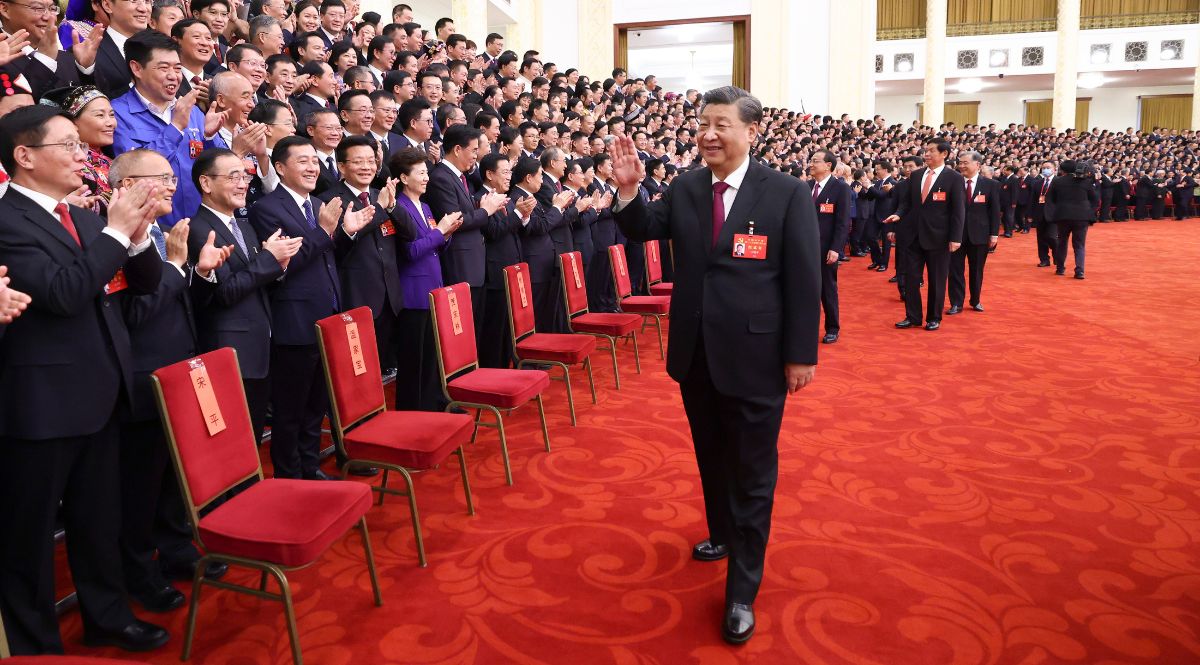 Ju Peng / Xinhua News Agency / Forum
In 2022, the 20th CPC Congress elected a Central Committee (CC) consisting of 205 full members and 167 alternate members. The CC meets at least once a year at a plenary meeting (plenum) to discuss and approve personnel and program decisions. The fourth plenum (of the standard seven during a five-year term) usually dealt with party management issues, but this time special attention was paid to economic development issues. First and foremost, the 15th five-year plan for 2026-2030 was discussed and approved. The document itself will come into force in March 2026, after its adoption by parliament.
The plenary session took place at a time when the authorities were shaping a new model for the development of the Chinese economy. It was influenced by internal problems concerning the real estate sector, negative demographic prospects, and a slowdown in growth. The process was also affected by difficult trade negotiations with the US, especially ahead of the first US-China summit during Donald Trump's second term.
Economic goals
Although the full text of the fifteenth five-year plan will not be disclosed until March 2026, the communiqué following the plenary session and the published recommendations of the Central Committee allow us to identify the most important goals of China`s economic policy. There are no significant changes in these objectives, which are a continuation of the earlier assumptions of the 14th plan (2021-2025) and the concepts from the government report presented during the parliamentary session in March 2025. However, they respond to the change in China's political and economic situation. Hence, the CC's priorities refer to "high-quality development" and not just its "new model," as they did in 2020. Also, unlike 2020, it emphasises the importance of combining "development and security," mentioning, among other things, the goal of completing the reform of Chinese armed forces, thus drawing attention to the fact that economic development alone is not a priority in the current international situation.
According to the Central Committee's recommendations on the implementation of the objectives, the Chinese economy is to be driven by manufacturing and industrial development in specific sectors, supported by a central and local subsidies system. Unlike the 14th plan, where electromobility, battery technologies, and renewable energy were key, this time the priorities are to include quantum technologies, biotechnology, nuclear fusion, robotics, and the 6G standard.
Production for the domestic market and exports of surplus production, including in these industries, will continue to be the most important source of income for the Chinese economy. The leading companies that emerge as a result are expected to increase the production base in China itself, thereby boosting employment and consumption levels among the Chinese population. The plan does not provide for larger-scale direct financial support for consumers than previously. The focus on production and exports means that China will become more dependent on finding new markets in the event of a possible failure of trade negotiations with the US, as well as the imposition of tariffs and blockades on Chinese overproduction in the EU market. This gives the EU, among others, additional opportunities to put pressure on China, also in cooperation with other countries (e.g., India) that are also threatened by overproduction from China.
Cooperation with foreign countries is important for China, especially where there is a dependence on modern semiconductors from the U.S. or machines for their production from the Netherlands. The further development of industries such as robotics, electromobility, and civil aviation requires technological solutions offered by foreign companies, which are to be selectively encouraged by Chinese authorities to operate on the Chinese market. This is also intended to improve competitiveness, as entities supported by the Chinese authorities are expected to expand their own potential over time and take over shares in important sectors of the European economy.
Political challenges
Despite the centralisation of power since 2012 and ideological campaigns promoting loyalty, the central authorities, including Xi Jinping, must maintain strict control over the party apparatus. This means personnel changes in order to maintain discipline and development directions. Indirect confirmation of this mechanism is the unprecedented scale of absences of CC members at the fourth plenum. In the Chinese context, this usually does not mean voluntary absence. Of the 205 permanent members, 168 attended, and of the 167 alternate members, only 147. Of these, the authorities confirmed the removal of 10 people, without giving reasons for the absence of the others. Only 11 new members were promoted to full membership from among the alternate members.
Personnel changes in the CC (where 20 per cent are military personnel) particularly affected the leadership of the armed forces. Of the more than 30 generals in the CC, over 20 did not attend the meeting. Even before the plenary session began, the Ministry of Defence of the People's Republic of China confirmed the formal removal of nine generals (including commanders of military theatres, missile and strategic forces) from the CPC, including General He Weidong (who had not appeared in public since March this year), a member of the Political Bureau and deputy head of the Central Military Commission (CMC), which is superior to the army, and Admiral Miao Hua, another member of the CMC (who was dismissed from his military posts in November last year). No official reason was given for the absence of the other generals. Currently, only four of the seven permanent members of the Central Military Commission appointed in 2022 during the 20th CPC Congress (as Xi Jinping's protégés) remain in office. He Weidong was replaced as vice-chairman by Zhang Shengmin, a former member of the CMC and head of the military Central Discipline Commission. The current defence minister (his predecessor was a CMC member), who has held his role since December 2023, has still not been nominated to this group. This confirms his low rank and the representative nature of his function.
Conclusions and prospects
The Fourth Plenary Session of the 20th CPC Central Committee suggests that there is an ongoing dispute between the leadership and the party apparatus within the party and the armed forces. It may concern both the directions of economic development and foreign policy, including, for example, the October decision on restrictions in the context of Chinese rare earth metals and negotiations with the U.S. The scale of personnel changes shows that the continuation of Xi Jinping's policy still requires disciplining the apparatus, especially the armed forces, where the scale of changes under the army reform carried out since 2013 is significant. However, there is not yet sufficient evidence of the emergence of a group within the party that is competitive with Xi. The scale of the changes (and the failure to fill some of the vacancies, including in the Politburo) may, however, indicate dissatisfaction among some party circles with the CCP leadership's decisions to date on foreign policy and internal affairs.
The 15th Five-Year Plan, which was approved by the plenum, does not mean any changes in economic policy. Income redistribution and increased consumption remain the party's goals, mainly in the realm of rhetoric rather than concrete decisions with measurable significance. Subsidised production on the domestic market and the export of its surpluses in specific sectors that are competitive with the West will continue to be key to economic development. However, economic goals are secondary in nature, serving as a tool for achieving political goals vis-à-vis the EU and the US, both in terms of limiting military capabilities and, especially in the case of EU countries, increasing the ability to influence these countries' actions with regard to limiting cooperation with the US and developing relations with China. In this context, the greater competitiveness of Chinese companies means greater influence on key sectors of the European and American economies, which is intended to strengthen their dependence on China.
Ambitious economic goals remain uncertain, mainly due to slowing economic growth, as well as ongoing technological shortcomings and China's dependence on cooperation with the U.S. and certain EU countries. The success of the plans approved by the plenum will depend on the policies of the U.S. and EU member states towards China. This will be particularly important in the coming year, as, under agreements between the US and China, the West has gained time to strengthen its independence from China, primarily in the area of critical raw materials. Chinese plans that negatively affect the EU's situation should result in the Union using trade policy tools, including anti-coercion instruments, such as imposing tariffs and restrictions on selected goods from China.

(1).png)