"A Strategic Partnership with Borders": Sino-Russian Cooperation in Official Documents
Statements published in the period 2022–2025 after meetings between the leaders of China and Russia confirm the strategic nature of the countries’ relations and their intensification after the start of the full-scale Russian invasion of Ukraine. Discrepancies found in the documents and in the resulting differences in the actions of the two countries indicate the dynamics of their cooperation and allow for the identification of contentious issues between them.
 credit: AA/ABACA / Abaca Press / Forum
The issuing of joint statements[1] by the leaders of China and Russia has a long tradition, notably in 1997, 2005, and 2008.[2] However, these documents took on a special character only under Xi Jinping, who took office as China’s chairman in 2013. They reflect the more assertive nature of China’s foreign policy, part of which is the development of strategic cooperation with Russia. Statements issued after the full-scale invasion of Ukraine in 2022 are important elements of it. The first is from 2022, signed during Russian President Vladimir Putin’s visit to Beijing in early February, before the Russian attack on Ukraine.[3] Subsequent ones, from 2023[4] (Xi’s visit to Moscow), 2024[5] (Putin’s visit to Beijing), and 2025[6] (Xi’s subsequent visit to Moscow) indicate an intensification of relations and their expansion to further political and economic issues. Each document has a similar structure: they present the countries’ general outlook on the current international situation, both China’s[7] and Russia’s approaches to current global challenges, and also—most significantly from their perspective—joint actions aimed at changing the international order.
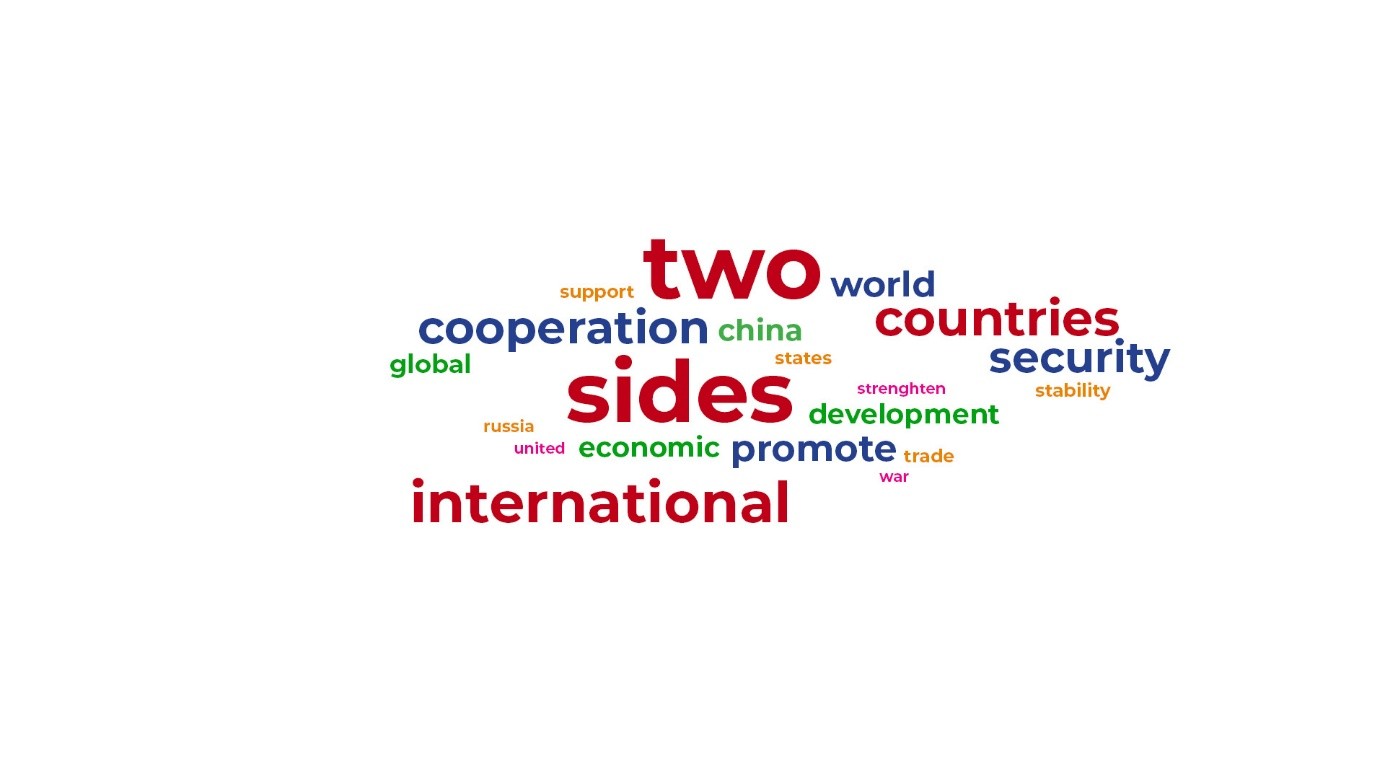
The dynamics of the changes taking place in Sino-Russian relations are reflected in an analysis of the words used in the documents issued in recent years. They are dominated by terms referring to the coordination of Chinese and Russian policies (“international” and “cooperation,” “two states”) and the most important areas of cooperation (“security,” “development”). More often than Russia, China is mentioned by name in the texts. This signals the predominance of the People’s Republic of China in this relationship, both in terms of its ability to impose its vision on their cooperation and later to implement its political plans but also in terms of their shared vision of international relations in which the key threat is the West (i.e., the United States and its partners). This Chinese dominance is also reflected in the frequent use of specifically Chinese rhetoric and numerous references to Chinese policy initiatives.
Bilateral Relations
The most extensive section of each document deals with bilateral cooperation. Its importance is symbolically illustrated by the evolution of the titles, elongated with new elements related to Chinese initiatives in international politics or the current reasons for Xi and Putin’s meeting. In 2022, the title included wording about “international relations and global sustainable development under the new era,” to emphasize “deepening the Sino-Russian comprehensive strategic partnership of the new era” in 2023. In 2024, the title was repeated, adding only a reference to the 100th anniversary of the establishment of diplomatic relations, and in 2025, referring to the 80th anniversary of the end of World War II[8] and the founding of the United Nations.
The documents do not provide a coherent description of Sino-Russian relations and the resulting joint policy toward other countries. Each side describes cooperation as broader than the “Cold War military-political alliance,” and the 2024 statement explicitly states that it is not of a temporary nature driven by current benefits, but derives from the “fundamental interests of both countries and peoples.” An element that strengthens their cooperation is the memory of World War II and their “brotherhood of arms,” which in this context they liken the situation in the 1940s to the current times.[9] Both sides oppose different attempts to present the history of World War II. Characteristic, especially in light of Russian “justifications” for the aggression against Ukraine, is the condemnation by both countries of the “glorification” or attempts to restore Nazism and militarism in the international community, as well as the emphasis on the need to contain them.
An expression of the development of Sino-Russian bilateral cooperation, the economic section of the documents[10] is also becoming more extensive with each passing year. In 2022, prior to the introduction of expanded sanctions on Russia, these issues had not yet been addressed. They appeared only in 2023 when the parties declared the use of local currencies instead of the dollar in mutual settlements. In 2024, in turn, they indicated a desire to streamline dispute resolution procedures between Chinese and Russian companies. The 2024 document already included not only declarations on the development of trade and investment cooperation but also on customs issues, measures to improve competitiveness, protect intellectual property rights, and increase access to both countries’ markets for agri-food products. There is also a passage in it about transport cooperation, including in the context of the simplification of customs procedures and facilitation of rail transport from China to the EU.[11] The document’s provisions also indicate for the first time the need to develop financial cooperation between the two countries, including in the banking and insurance industries. However, in 2025 the economic dimension of bilateral cooperation was significantly reduced in the text of the statement, most likely due to the greater importance of security issues in the current dimension of cooperation between the two countries. Increasing Chinese investment in Russia is an important theme this year, although it still includes mainly declarations rather than specific projects. The same applies to energy cooperation, with China avoiding, among other things, announcements of further development of pipeline infrastructure,[12] especially gas. In none of the documents of recent years has there been any reference to plans for the construction of the Power of Siberia 2 pipeline to transport Russian gas to China. The lack of willingness of Chinese involvement in the project, which would give Russia the opportunity to sell gas from fields originally intended for export to European countries, should be considered an indicator of the low level of energy cooperation between the two countries, especially Chinese willingness to invest in infrastructure and increased gas purchases. The document from this year also contains the response of the Chinese authorities (supported by Russia) to the imposition of high tariffs by the U.S.
International Security
Within the framework of cooperation between the two countries, security issues oriented toward modifying the international order occupy a central place. As late as 2022, the text included Russia’s support for China’s plans[13] to build a “community for the common future of humanity” and China’s support for Russia’s concepts of a “just and multipolar order of international relations.” From 2023 onward, the sections of the documents on security sector cooperation have become increasingly specific. In 2023 and 2024, the documents already enshrined a common (though still general) goal of striving for a “multipolar world and global governance of a more equitable nature.” In 2025, there was a paragraph emphasising no longer only, for example, joint exercises of the armed forces, but also the unique importance of developing military cooperation between the two countries to counter international threats and develop military technology.
Sino-Russian cooperation in the security sphere is a response to common threats, the documents mentioned. In 2022, they pointed to serious challenges, including the influence of external forces that destabilise the situation in China and Russia, in their neighbourhoods and on the global stage mainly by inspiring so-called colour revolutions. Hence the suggestions placed in the documents for both countries to respond to this situation in Europe and Asia. In 2022, the phrase “China understands and supports Russian proposals to build legally binding long-term security guarantees in Europe” was written. In 2023, for the first time in the documents, the concept of “indivisible security,” i.e., the recognition of the link between the security of individual states, which is instrumentally used by Russia,[14] including as a justification for aggression against Ukraine.
The war in Ukraine itself[15] was directly addressed by the two countries in the statements of 2023–2025. In each of them they distributed the accent differently, according to the dynamics of mutual relations, the situation on the front, and the international conditions current for that moment. In 2023 and 2024, there was less emphasis on the possibility of China’s involvement in conflict resolution. In 2025, Chinese efforts for eventual peace became the main element of China’s rhetoric about Ukraine. In all statements, however, the narrative was mainly calculated to strengthen the image of China as an entity stabilising the international situation. In 2023, China emphasised support for “negotiations” (presumably Ukrainian-Russian), but in a way that takes into account the security interests of all parties, as well as refraining from actions by other actors to “prolong hostilities.” The 2024 document goes the furthest in China’s recognition of Russian interests, including a call to refrain from interfering in Russia’s internal affairs and a reference to the “indivisibility of security” as a key principle of China’s Global Security Initiative. In 2025, the remarks were reaffirmed, further adding Russia’s recognition of China’s efforts to settle the conflict, including with regard to the initiative put forward by China with Brazil and the accompanying so-called Group of Friends for Peace.[16]
Although in the 2022–2023 documents the countries vaguely opposed the imposition of sanctions (including against Russia) it was not until 2024 that they described them as illegal, including the possible confiscation of property, funds, and other assets of Russia.[17] This may have been due to Chinese concerns about being subjected to the U.S. secondary sanctions regime and a sign of China’s tightening policy toward the U.S. China and Russia also declared the preparation of mechanisms and procedures for, among other things, the safekeeping of a partner’s assets, for example, in the event of a threat of being subjected to sanctions or their imposition.
Sino-Russian cooperation in the international arena also has a dimension in the documents of Russia’s support for Chinese policy demands, primarily towards Taiwan.[18] In 2022, it was only a general “opposition” of the two countries to any form of Taiwanese independence, but in 2023 and 2024, support was added for “Chinese measures” to safeguard China’s sovereignty and territorial integrity. This unequivocally indicated Russia’s acceptance of possible Chinese military action against Taiwan. Additionally, in 2024, most likely due to increasing Chinese involvement in the dispute with the Philippines (a treaty ally of the U.S.), the document for the first time enshrined Russia’s support for Chinese sovereignty over most of the South China Sea.[19] In each of the documents, Russia supported China’s flagship policy initiatives, namely the Global Development Initiative and the Global Security Initiative. The statements in this regard were general in nature, but Russia’s recognition of Chinese ideological concepts as leading-edge was prestigious both for China and Xi Jinping.
The treatment of the European Union[20] as an important actor from the point of view of Sino-Russian cooperation in the security sphere and efforts to change the international order does not appear from the documents. The EU was sporadically mentioned in them, appearing in the 2023 and 2024 statements only in terms of improving rail transportation from China through Russia to the Union.
Defence of “Democracy” and Values
The joint statements included references to democracy as part of the ideological dispute with the U.S., but these were gradually limited over time. In 2022, China and Russia emphasised the advantages of systemic solutions in both countries, pointing to them as democratic achievements. In 2022 and 2023, they stressed the importance of democracy as a political system, but respecting the socio-economic or political conditions of the respective countries and rejecting as false, in their view, the juxtaposition of “democracy” and “authoritarianism” applied to both countries by the United States. The 2024 document does not mention democracy, possibly due to the declining importance of this issue in U.S. politics, especially in view of Donald Trump’s second term.
The ideological commonality thread also includes China’s and Russia’s positions on culture and “values” promoted internationally. These were mentioned in 2023, but appeared in an expanded form in the 2024 document, where, referring to events in the U.S., a passage was included about the disagreement of both countries on the “politicisation of culture,”[21] as well as to the implementation of “cancel culture.” Russia and China are supposedly focused on promoting “traditional moral values” in this context but also to countering discrimination in culture and sports for political reasons, such as in the context of the disqualification of Russia from the Olympic Games. This message also includes cooperation between the two countries’ media institutions included in each annual statement.
Global Economy and Development
In the signed documents, the context of modern technologies and their global regulation stands out at the forefront of Sino-Russian cooperation in relation to the global economy. In 2022, the document included one general statement on this topic, while in 2023, and similarly in 2024, support for China’s Global AI Governance Initiative and cooperation within international forums and organisations such as the UN, BRICS+, the Shanghai Cooperation Organization (SCO), the International Telecommunications Union, and the International Organization for Standardization is enshrined. The multilateral dimension of cooperation on high-tech issues is specifically highlighted in 2025 in the context of Russia hosting the SCO summit that year. There is also growing Sino-Russian cooperation in international forums regarding cybersecurity, internet regulation,[22] or data protection and the competence of states in this area. A constant in the documents is the support for China’s Global Data Security Initiative. The 2022 document still records a reference to the May 2015 Sino-Russian agreement to ensure international information security. The failure of this initiative due to opposition from the U.S. and other Western countries, however, resulted in it no longer appearing in the 2023 and 2024 documents, instead highlighting the importance of work within the UN on the subject, particularly the drive to develop “a new and responsible set of principles for state conduct in information cyberspace and the work of the Information Security Working Group from 2021 to 2025.”
Each document highlights the synergy between China’s Belt and Road Initiative (BRI) and the Eurasian Economic Union, of which Russia is a member. However, only the 2023–2024 texts explicitly refer to the implementation of the 2018 Sino-Russian agreement on economic and trade cooperation. The annual limited references to the BRI indicate the declining importance of this initiative in Sino-Russian cooperation. Its most prominent role is as a tool for influencing countries in the Global South.[23] In the 2022 document, there was a need to change the G20 and give the forum a new meaning, including support for the African Union representation’s presence there, which was achieved in 2023. In 2024, only a general reference to “strengthening the representation of the Global South” in the international economic system was included, and (as in 2023) sections on the role of African and Latin American countries in the international community were specifically singled out. This was repeated in 2025.
From year to year, passages in the documents about the BRICS platform[24] became longer and longer, in line with the political need of China and Russia to emphasise the role of this forum in opposition to, for example, the G7. The context of relations with developing countries was also part of the Sino-Russian agenda in the context of climate change. Each document emphasised Russia’s and China’s commitment to countering the climate disaster, but stressed the lesser responsibility of developing countries compared to developed ones.
Contentious Issues
The Sino-Russian documents also serve to mitigate potential contentious issues, primarily with regard to global problems. The way these issues are framed illustrates Russia’s growing dependence on China, and thus the gradual abandonment of some Russian demands (but also, for example, in the case of the denuclearization of the Korean Peninsula, Chinese ones). The documents also reflect rapprochement between the two countries’ positions in the name of increasingly advanced cooperation and common challenges in the rivalry with the U.S., overriding existing differences.
A contentious thread in Sino-Russian relations is their positions on nuclear proliferation and missile technology development. Each document includes the two countries’ support for the Treaty on the Non-Proliferation of Nuclear Weapons but also criticism of the U.S. for developing missile technology and transferring it to allies and partners in the Asia-Pacific. The 2023 statement included a declaration that the two countries would not deploy nuclear weapons beyond their borders. Contrary to this declaration, Russia deployed part of its nuclear arsenal to Belarus a few days after signing the document, which did not receive a significant response from China. In 2024, the nuclear provisions were reformulated, and instead of proliferation, the document included an assertion of the need to avoid nuclear conflict, including by opposing any expansion of nuclear-sharing[25] in Europe. Even further in the spirit of the development of Sino-Russian cooperation is the 2025 statement, in which the states explicitly write, among other things, about the need to “quickly eliminate” the strategic risk of the development of nuclear cooperation by “certain nuclear states” in the neighbourhood of other nuclear states. This includes possible U.S. cooperation with Japan and South Korea but also potential changes to the “nuclear umbrella” in Europe, such as under nuclear-sharing arrangements.
In the 2023 and 2024 documents, cooperation between China and Russia was mentioned in the context of support for the aspirations of the Palestinians, policy towards the authorities in Syria (then still the regime of Bashar al-Assad), Lebanon, and Libya. The unity of the two countries’ positions, however, no longer applied to Iran, about which the content of the statements over the years changed, and the declaration of the need to denuclearise the Middle East explicitly appeared only in 2025. Both sides’ belief in Iran’s goodwill on this issue was later confirmed in China’s and Russia’s positions after the Israeli[26] and U.S.[27] attacks on Iranian facilities in June 2025 and the Xi-Putin phone conversation. Most of the joint references to the regional situation reflect the Chinese rather than the Russian approach, such as in the context of the change of authorities in Syria or the easing of disputes between Iran and Saudi Arabia,
The 2023 statement also included declarations of stability on the Korean Peninsula, along with both countries’ support for its denuclearisation. However, this approach had already disappeared by 2024 when China and Russia—considering support for North Korea more important than possible challenges to its nuclear capabilities—placed their primary emphasis on opposing intimidation of North Korea and the imposition of sanctions by the U.S., its allies and partners. Both China and Russia opted to postpone the demand for denuclearisation, which China had particularly advocated, in favour of closer cooperation. At the time, they also enshrined a desire for constructive dialogue with North Korea, including on economic cooperation and the presence of Chinese merchant ships on the border on the Tumen River. Coinciding in content, but even stronger rhetorically (and still not mentioning denuclearisation), is a reference in the 2025 statement expressing opposition to “intimidation” of North Korea by “interested countries,” implicitly the U.S.
The two countries’ approach to cooperation in the Arctic is also ambiguous. The documents take into account the enduring and forward-looking nature of China-Russia cooperation in the region but also differences in interests. Russia’s reluctance to engage more extensively in cooperation with China in the area was illustrated by modest passages in subsequent documents. The Arctic topic was covered in just one sentence in the 2022 and 2023 statements. It was significantly expanded in the 2024 document, which most likely resulted from China’s growing interest in the region. Among other things, it then stipulated the institutionalisation of cooperation through the establishment of a separate subcommittee on the Arctic as part of a regular dialogue at the level of heads of government, as well as the joint development of transportation projects and polar ship technology. This can be read as a concession from Russia, which, among other things, is becoming increasingly dependent on China as a result of the effects of the war in Ukraine. Differences in approaches to the region and Russian concerns about the gradual development of Chinese involvement have resulted in the 2025 statement treating the Arctic topic again in a residual way, only as an example of cooperation between the two countries in improving shipping routes in the region and preventing military and political clashes.
Conclusions and Perspectives
Each of the documents, acting as a determinant of the most important directions for China-Russia interaction, was adopted during a meeting between Xi and Putin. The leaders’ statements guided the actions of their respective administrations, security bodies and armed forces, and carried out in sectoral dialogues, meetings at the governmental or ministerial level, or in other formats.
In recent years, the content of the documents and the increasing range of topics covered, as well as the greater number of statements adopted in 2025, show the significance of the Russian aggression against Ukraine for Chinese policy and its relations with the Russian Federation. Since then, the intensification of these relations has been clear, with a conviction on both sides about the need to strengthen relations. The documents illustrate the special nature of the China-Russia strategic partnership. It does not preclude the existence of differences in the two countries’ approaches to particular issues. Stronger than the contentious issues, however, is the distrust of the West, evident in the documents as a sense of a threat to the power of the regimes in both countries and the resulting strategic, vital need to confront the U.S. and its partners, which bind China and Russia together. Differences in approaches to particular political issues are treated as normal by both countries, and as long as the current regimes are in power in China and Russia, they will not become an obstacle to strategic cooperation.
A new perspective for China and Russia on US policy opened with Donald Trump’s second term. The possibility of another “reset” of relations with Russia, entering into negotiations over the war in Ukraine and the future of U.S.-Russian relations, and Trump’s announcement of the possible lifting of U.S. sanctions on Russia are in the interests of both China and its partner. Such a policy is also conducive to the goals set by China towards the development of its relations with the EU, Russian ambitions towards Ukraine and the security situation in Europe, as well as China’s plans in the Asia-Pacific, including mainly towards Taiwan. Therefore, both countries, after Xi’s visit to Moscow in May 2025, accentuate the accuracy of their previous decisions and plans, as well as the validity of the proposals made by both countries so far, not only bilaterally but also with regard to the Global South. An example of this rhetoric is, for example, the stance on the Israeli and U.S. attacks on Iran. With the issuance of not one (as before) but two security statements in 2025, this confirms that Sino-Russian strategic cooperation has moved to a higher level in the ongoing confrontation with the West. The next stage of strengthening Sino-Russian relations may be signalled by Putin’s visit to China, announced for 3 September 2025, and his participation in a victory parade in Beijing to mark the 80th anniversary of the end of World War II. An opportunity to consolidate cooperation between the two countries would also be the possible participation of the U.S. president in the same celebration, combined with official talks between the three leaders.
The intensification of cooperation between the Russian and Chinese armed forces[28] and hybrid operations indicates that it is the security sphere (including with regard to China’s support of Russia’s war economy) that is increasingly becoming the basis of the two countries’ relationship, the documents reflect. This requires the EU and NATO to pursue a policy of deterrence towards China as a state that assists Russia and enables it to carry out offensive plans not only against Ukraine but also against EU and NATO countries as well.
Most-used words (“word cloud”) in the 2022 document[29]
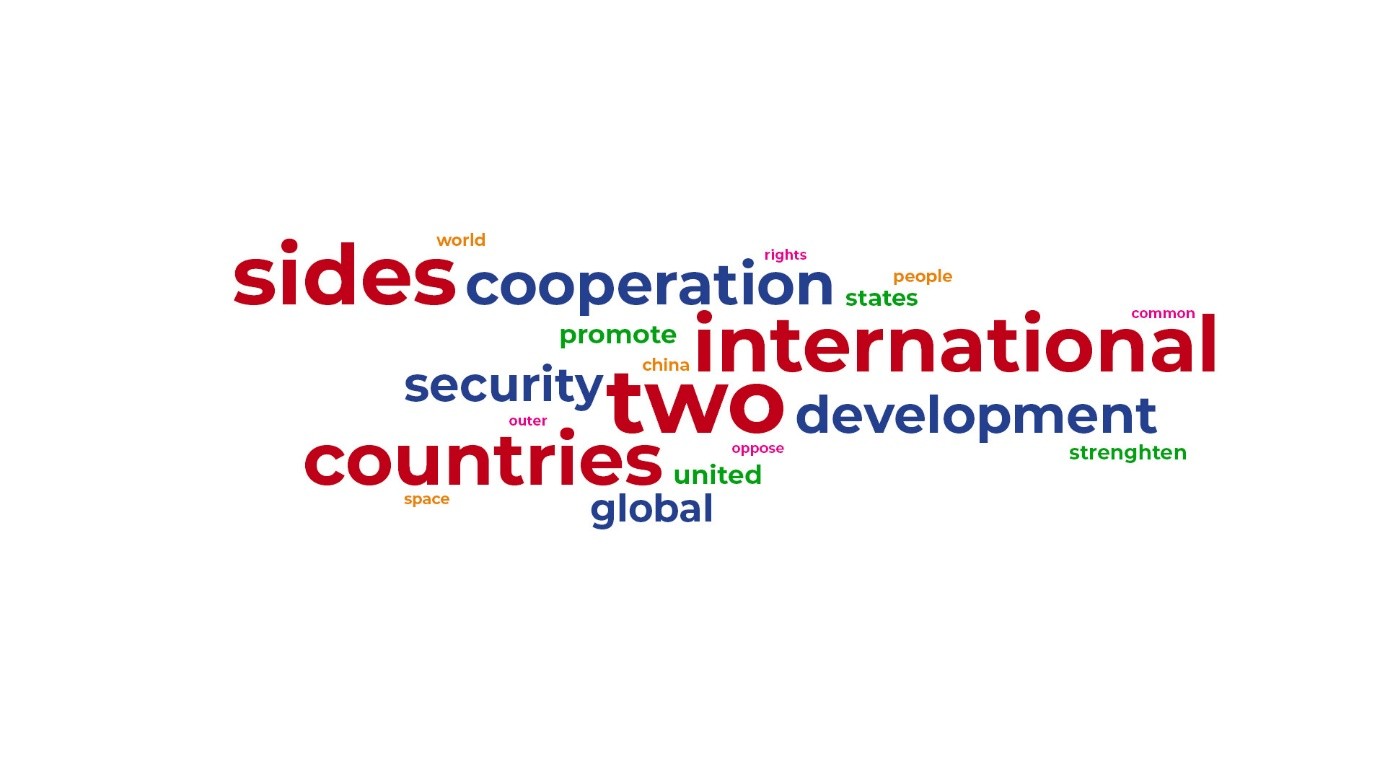
Most-used words (“word cloud”) in the 2023 document
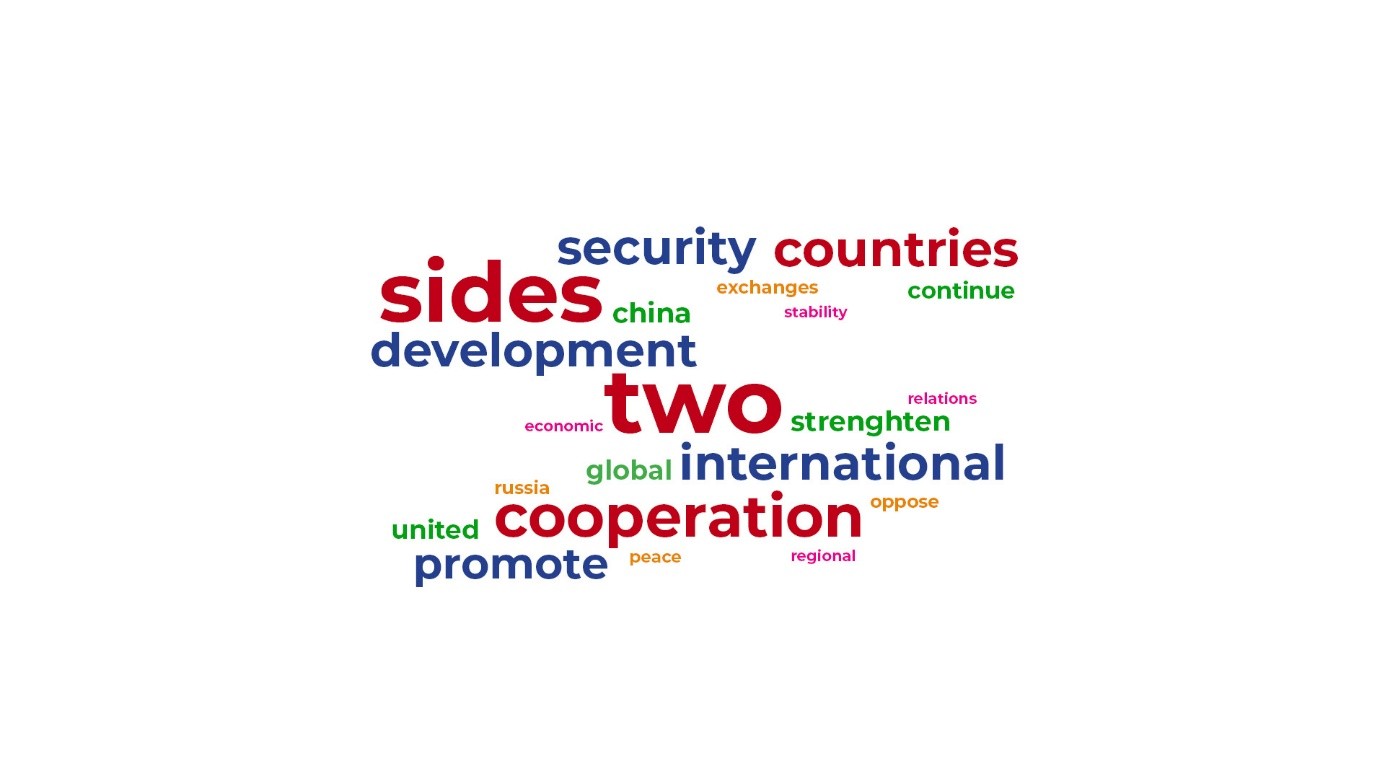
Most-used words (“word cloud”) in the 2024 document
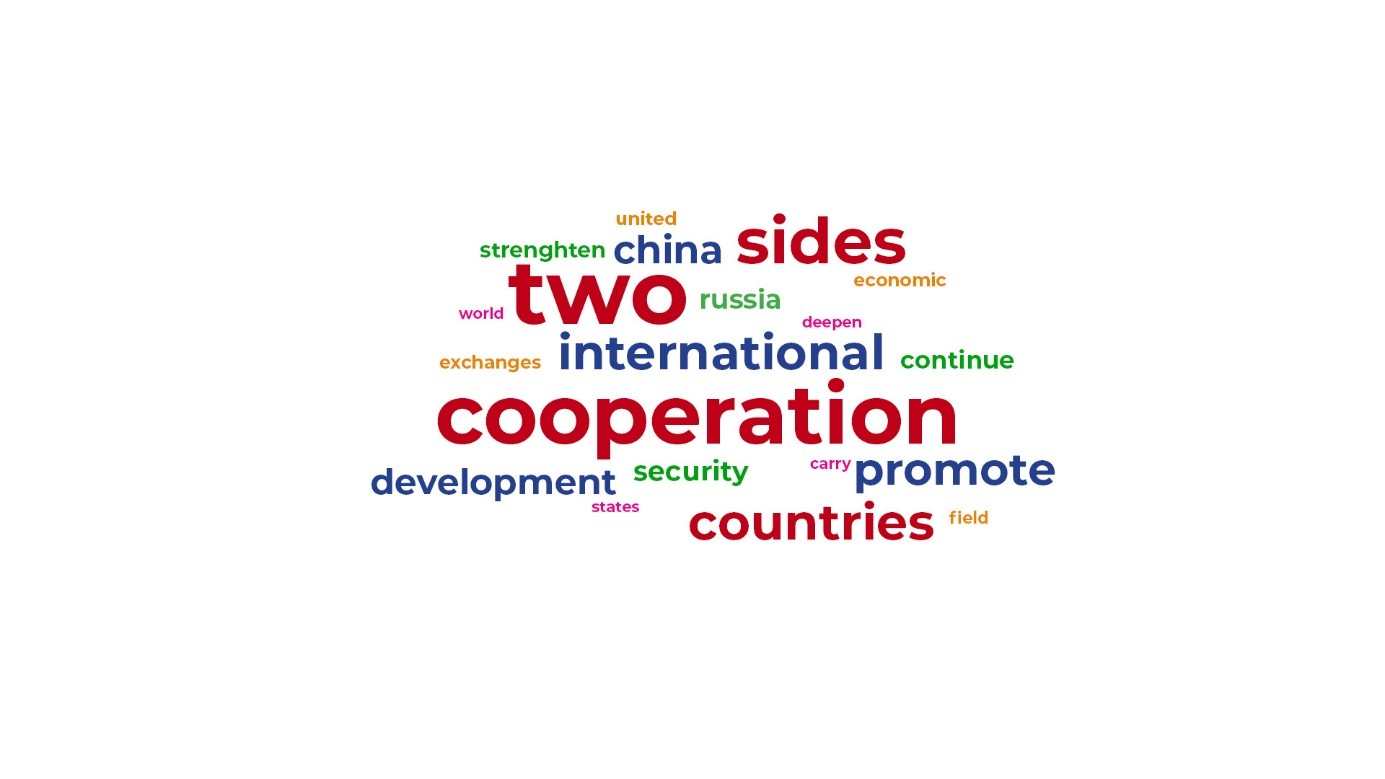
Most-used words (“word cloud”) in the 2025 document
[1] The text is based on the contents of statements in Chinese published by the PRC MFA.
[2] Joint Statement of the People’s Republic of China and the Russian Federation on major international issues, MFA of the PRC, 16 June 2008, www.mfa.gov.cn.
[3] Joint Statement of the People’s Republic of China and the Russian Federation on International Relations and Global Sustainable Development in the new era, MFA of the PRC, 4 February 2022, www.mfa.gov.cn.
[4] Joint Statement of the People’s Republic of China and the Russian federation on deepening the comprehensive strategic partnership of coordination in the new era, MFA of the PRC, 22 March 2023, www.mfa.gov.cn.
[5] Joint Statement of the People’s Republic of China and the Russian federation on deepening the comprehensive strategic partnership of coordination in the new era on the occasion of 75thanniversary of the establishment of diplomatic relations between the People’s Republic of China and the Russian Federation, MFA of the PRC, 16 May 2024, www.mfa.gov.cn.
[6] Joint Statement of the People’s Republic of China and the Russian Federation on further deepening the China-Russia comprehensive strategic partnership of coordination in the new era on the occasion of commemorating the Chinese War of Resistance Against Japanese Aggression, the victory of the Soviet Union in the Great Patriotic War and the 80thanniversary of the founding of the United Nations, MFA of the PRC, 9 May 2025, www.mfa.gov.cn; Joint Statement of the People’s Republic of China and the Russian Federation on Further Strengthening Cooperation and Safeguarding the Authority of International Law, MFA of the PRC, 9 May 2025, www.mfa.gov.cn; Joint Statement of the People’s Republic of China and the Russian Federation on Global Strategic Stability, MFA of the PRC, 9 May 2025, www.mfa.gov.cn. The leaders also additionally signed two differently structured statements on the joint position of China and Russia on the protection of international law and global stability.
[7] M. Przychodniak, “The World According to China. The Chinese Plans for a New International Community,” PISM Strategic File, no. 2 (136), 16 January 2024, www.pism.pl.
[8] A. Dyner, “‘Victory Day’ Celebrations in Russia,” PISM Spotlight, no. 34/2025, 12 May 2025, www.pism.pl.
[9] This is highlighted in the 2022 and 2024 documents, but especially in the one from 2025.
[10] For more on economic relations and China’s support for the Russian economy, see: P. Dzierżanowski, M. Przychodniak, China’s Economic Support for Russia Since the Full-Scale Invasion of Ukraine, PISM Report, January 2025, www.pism.pl.
[11] The issue of the permeability of rail flows between China and the EU is not very important for the value of the export of goods from China to the EU, since most of them arrive by sea. However, railroads are prestigious (due to the rhetoric about the key role of railroad connections under the BRI used by the Chinese authorities, including Xi Jinping) and have strategic importance (as a way to partially diversify exports). Bribes collected by Russian customs in handling these rail links are also becoming a problem for China.
[12] A. Legucka, M. Przychodniak, “China-Russia: Strategic Partners Strengthening Cooperation,” PISM Bulletin, no. 32 (2151), 24 March 2023, www.pism.pl.
[13] M. Przychodniak, “The World According to China…,” op. cit.
[14] Ł. Kulesa, “The Dispute over the Principle of Indivisibility of Security,” PISM Spotlight, no. 6/2022, 3 February 2022, www.pism.pl.
[15] M. Przychodniak, “China adapts Policy in Response to Russia’s Aggression Against Ukraine”, PISM Strategic File, no. 7 (128) 31 March 2023, www.pism.pl.
[16] “‘Friends for Peace’ Group on the Ukraine Crisis Set Up in the United Nations,” PRC Foreign Ministry, 28 September 2024, www.mfa.gov.cn.
[17] S. Zaręba (ed.), Prospects for the Use of Frozen Assets of the Central Bank of Russia, PISM Report, June 2025, www.pism.pl.
[18] M. Przychodniak, “Carrot and Stick: China’s Pressure on Taiwan Increases Short of Force”, PISM Bulletin, no. 131 (2439), 10 September 2024, www.pism.pl.
[19] Similar Chinese demands were described as incompatible with international law by the Permanent Court of Arbitration in The Hague in a 2016 ruling. For more, see: R. Tarnogorski, “Causes and Consequences of the South China Sea Arbitration,” PISM Spotlight, no. 45/2016, 18 July 2016, www.pism.pl.
[20] M. Przychodniak, “Chinese Offer for the EU Seems Illusory,” PISM Bulletin, no. 40 (2541), 1 April 2025, www.pism.pl.
[21] The China-Russia assessment is about the ongoing process in the U.S. of re-examining and re-evaluating history and cultural phenomena in terms of recognising minority rights. Part of Donald Trump’s election campaign was in opposition to these ideas, and the administration's first decisions were calculated to remove requirements identified as “DEI” (the acronym popular among liberal thinkers for this process focused on diversity, equity, and inclusion).
[22] M. Przychodniak, “China and the Challenges of the Fourth Industrial Revolution: Value Chains, 5G, and Emerging Markets,” PISM Policy Papers, no. 1 (171), January 2019, www.pism.pl.
[23] M. Przychodniak, “China Embracing a Global South Strategy,” PISM Bulletin, no. 43 (2351), 12 June 2025, www.pism.pl.
[24] M. Przychodniak, “China Building Up BRICS as Important Foreign Policy Tool,” PISM Bulletin, no. 23 (2524), 28 February 2025, www.pism.pl.
[25] A. Kacprzyk, “Debating Perspectives of European Nuclear Deterrence,” PISM Bulletin, no. 56 (2364), 8 April 2024, www.pism.pl.
[26] M.A. Piotrowski, “What are the Goals and Implications of Israel’s Airstrikes on Iran,” PISM Spotlight, no. 41/2025, 13 June 2025, www.pism.pl.
[27] M.A. Piotrowski, “U.S. Strikes Selected Nuclear Centres in Iran,” PISM Spotlight, no. 44/2025, 23 June 2025, www.pism.pl.
[28] P. Dzierżanowski, M. Przychodniak, China’s Economic Support for Russia since the Full-scale Invasion of Ukraine, PISM Report, January 2025, www.pism.pl.
[29] Word clouds developed by PISM from the documents discussed in this report based on material produced using the Free Word Cloud Generator tool available at www.freewordcloudgenerator.com.


.png)
(1).jpg)
.jpg)