
UK and Germany Agree Treaty of Kensington "on Friendship and Bilateral Cooperation"
The treaty signed on 17 July between Germany and the United Kingdom creates a framework for closer bilateral cooperation after Brexit. It strengthens their strategic partnership in the field of security and extends it to economic and social mobility domains. Together with similar agreements with France, it also consolidates the E3 group (France, Germany, the United Kingdom), which forms the core of a “coalition of the willing” coordinating European diplomatic efforts and the creation of forces capable of guaranteeing the conditions for a potential end to Russian aggression in Ukraine.
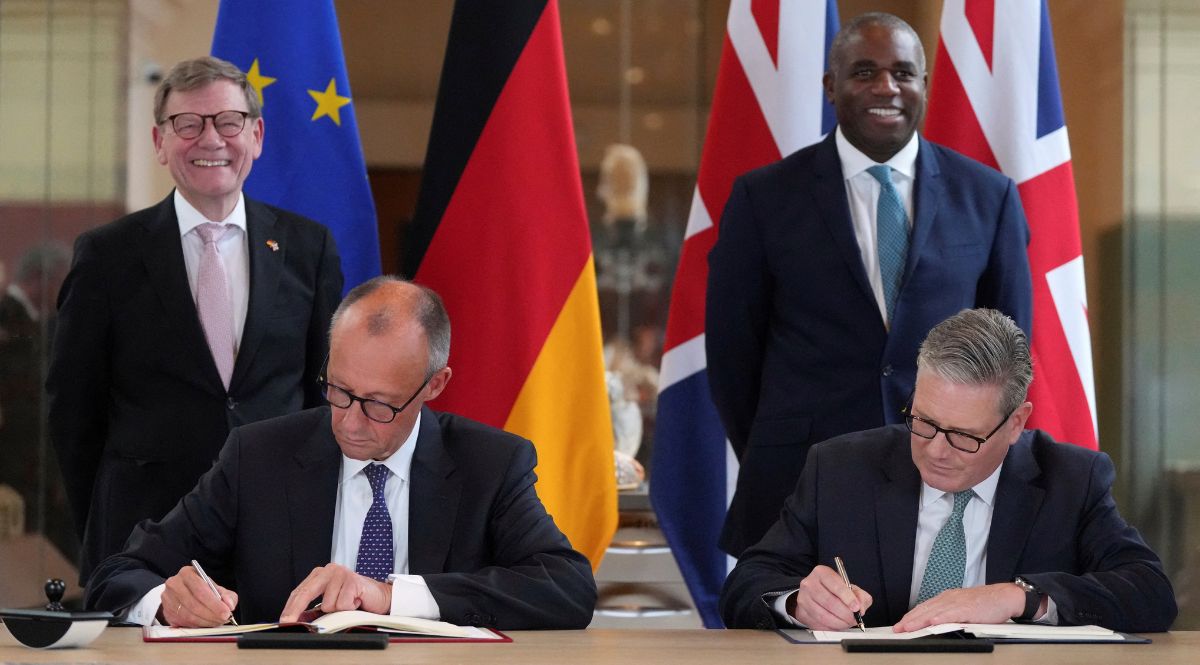 Frank Augstein / Reuters / Forum
Context of the Treaty
The strengthening of British-German cooperation is a response to a fundamental change in Europe’s security environment, which, in the context of Russia’s full-scale invasion of Ukraine, must cope with a reorientation in U.S. security and economic policies. In particular, the Trump administration expects a significantly increased commitment from European countries to deter and defend against Russia, as well as to maintain the sovereignty and security of Ukraine. The redefinition of European-American political relations is evidenced, among others, by the course and conclusions of NATO’s summit in The Hague in June. At the same time, there is a fundamental change in transatlantic economic relations, as indicated by the shape of the EU-U.S. trade agreement of July.
France, the United Kingdom, and Germany recognise that rebuilding cooperation between them after Brexit is essential to strengthening NATO’s European pillar. They have formed an informal group called the E3, which has already been prominent in the negotiations on the agreement concerning the control of Iran’s nuclear weapons programme (JCPOA) and subsequently in the Brexit negotiations. Their leading role in European security and defence is based on the nuclear status of France and Britain, and their experience in conducting expeditionary operations, as well as Germany’s position as Europe’s largest economy and the modernisation of its armed forces from 2022 onwards. The latter process is to be accelerated by a sharp increase in spending on the technical modernisation of the Bundeswehr. The functioning of the E3 is based on bilateral strategic cooperation agreements, including the Franco-British Lancaster House Treaty (2010) and the Franco-German Aachen Treaty (2019). In parallel with the new German-British treaty, which had been in the works since September last year, the French-British declaration on the coordination of nuclear deterrence was signed on 10 July.
Provisions of the Kensington Treaty
The most important provisions of the treaty concern security. The parties declare that any strategic threat to one of them constitutes a threat to the other (the wording is similar to that of the above-mentioned Franco-British declaration). In addition, they announce deeper cooperation in intelligence, arms exports, investment in the defence industry (including planned drone production facilities and the development of missile systems with a range of over 2,000 km), as well as deterring Russia on NATO’s Eastern and Northern flanks. Another important element of cooperation will be combating irregular migration and organised crime, with energy security, particularly in the North Sea, being a specific area of cooperation. In addition, the treaty institutionalises political cooperation by establishing annual consultations between foreign ministers and biennial intergovernmental consultations. At the same time, the document explicitly points to the need for closer coordination of actions with France, with the G7 and the UN serving as platforms for this, which is one of the elements clearly indicating the parties’ willingness to strengthen cooperation within the E3 format.
The treaty is also intended to facilitate economic cooperation and social mobility. It provides, among other things, for the creation of a direct rail link between Berlin and London and for easier travel through automated border control procedures. In addition, both countries place particular emphasis on youth and student exchanges, including vocational training and internships. It also provides for cooperation between national development banks and investment funds.
Negotiations on the treaty proceeded relatively quickly. This was facilitated, among other things, by basing the treaty on the Anglo-German Trinity House Agreement on Defence Cooperation from October last year, as well as the EU-UK agreement from May in respect of the economic and social issues. The negotiation process was not disrupted by the change of government in Germany in May.
Significance for the Parties
For Germany, closer ties with the UK as an Atlanticist country with good relations with the Trump administration (confirmed by an economic agreement on terms more favourable than those negotiated between the EU and the U.S.) are of multifaceted importance. On the one hand, the Merz government assumes that cooperation with the UK will have a positive impact on Germany's security (especially in the event of a reduction in the US military presence in Europe), which is also facilitated by both the Franco-German strategic partnership and the potential for expanding and coordinating Franco-British nuclear deterrence. At the same time, from the German point of view, the United Kingdom balances France’s influence within the developing E3 format by providing bilateral nuclear security guarantees independent of France. On the other hand, closer ties with Britain are intended to strengthen Germany’s position within the EU and vis-à-vis Ukraine and Russia.
As concerns the United Kingdom, the key factor was the desire to further stabilise relations with the EU by strengthening cooperation with its largest Member State, which, in the eyes of the British government, has fundamental influence on the formation of policies across the entire Union (the so-called inside-out strategy of influencing the EU via its decision-making centre). The treaty is thus intended to facilitate the implementation of the EU-UK agreement on cooperation in foreign and security policy signed in May. With regard to sectoral policies, the most important objectives of the Starmer government were to obtain German support for allowing British companies to sell on the EU arms market on terms similar to those enjoyed by EU companies, to facilitate British agri-food exports by negotiating an EU-UK agreement on sanitary and phytosanitary standards, and to conclude a UK-EU agreement on the readmission of irregular immigrants.
An important image-building aspect for the both governments—and a practical one from the point of view of their societies—are the announcements of joint efforts to combat irregular migration and liberalise the rules for crossing the EU-UK border (in the context of the introduction in April of new, more demanding border procedures by the UK and the EU plans to follow suit by the end of 2025).
Conclusions and Prospects
The British-German treaty opens a new chapter in German-British relations. Together with other agreements consolidating the E3 group, it is intended to serve as an additional deterrent to Russia, alongside NATO guarantees. It is also intended to strengthen cooperation and coordination between these countries and, in the medium and long term, facilitate the strengthening of their military capabilities. It may thus contribute to improving the interoperability of the British and German armed forces and, consequently, to strengthening the Eastern Flank of the Alliance, where Britain is the framework nation for the multinational NATO brigade in Estonia and Germany of the one in Lithuania. The treaty is also a signal to the U.S. administration that European countries are gradually taking on greater responsibility for the security of the continent. At the same time, closer cooperation within the E3 may lead to this group dominating decision-making processes in the European part of NATO and its further integration in the defence industry. Furthermore, as France and the United Kingdom play a leading role in the “coalition of the willing”, which has declared its readiness to send a military mission to Ukraine, closer cooperation between Germany and these countries is likely to influence the stance of the German government on this issue, up to now sceptical.
From Poland’s point of view, the key challenge is to ensure that all parts of Europe are represented in the debate on the future of the continent’s security system, including in informal but influential formats such as the E3. This requires pointing out to the E3 countries that it is in their interest to maintain the open nature of the group, including cooperation with Poland as the largest country in Central Europe and on NATO’s Eastern Flank, following the example of the “Weimar Plus” format, for example. To achieve these goals, it is necessary to strengthen bilateral strategic cooperation with France (e.g., by utilising the Nancy Treaty) and the United Kingdom (e.g., based on the 2017 defence treaty and the one currently being negotiated) and good neighbourly relations with Germany.



.png)
.png)
.jpg)