The US and Israeli Attack on Iran from the Chinese Perspective
China views the conflict in the Middle East, ongoing since late February, primarily through the lens of its rivalry with the US. American aggression confirms the radicalisation of the Donald Trump administration’s policies, but does not pose a direct threat to the PRC. Although experiencing economic problems due to the war, China hopes that the conflict will weaken the US and its allies and partners. The modest but visible support for Iran and engagement in diplomatic efforts to promote stability are intended to exert pressure on Trump ahead of his visit to China in May.
 Haruna Furuhashi / Reuters / Forum
China’s priority in the Middle East is economic cooperation with its key partners: Saudi Arabia, Qatar, and the United Arab Emirates. This includes imports of energy resources from the region to China—in 2025, the region accounted for approximately 50% of China’s total crude oil imports (mainly from Saudi Arabia, Iraq, Oman, the UAE, and Kuwait, with Iran providing about 13% of the total) and about 35% of gas imports (mostly from Qatar, as well as Oman and the UAE). The Middle East is also a significant recipient of Chinese goods (just under 7% of exports in 2025), including green technologies, and a key destination for capital investment by Chinese companies and citizens.
Since October 2023—when Hamas’ attack on Israel triggered the war in the Gaza Strip—the political dimension of China’s presence in the Middle East has taken on greater significance, primarily as a competitor to the United States. This includes strategic cooperation with Iran (since March 2021) and support for the Palestinians, as well as regional and global advancement of cooperative frameworks such as China’s Global Security Initiative. As part of this policy, China has criticised Israel for its escalatory actions in the Gaza Strip and its strategic alliance with the US, yet maintains cooperation with the country in advanced economic sectors.
Response to the attack
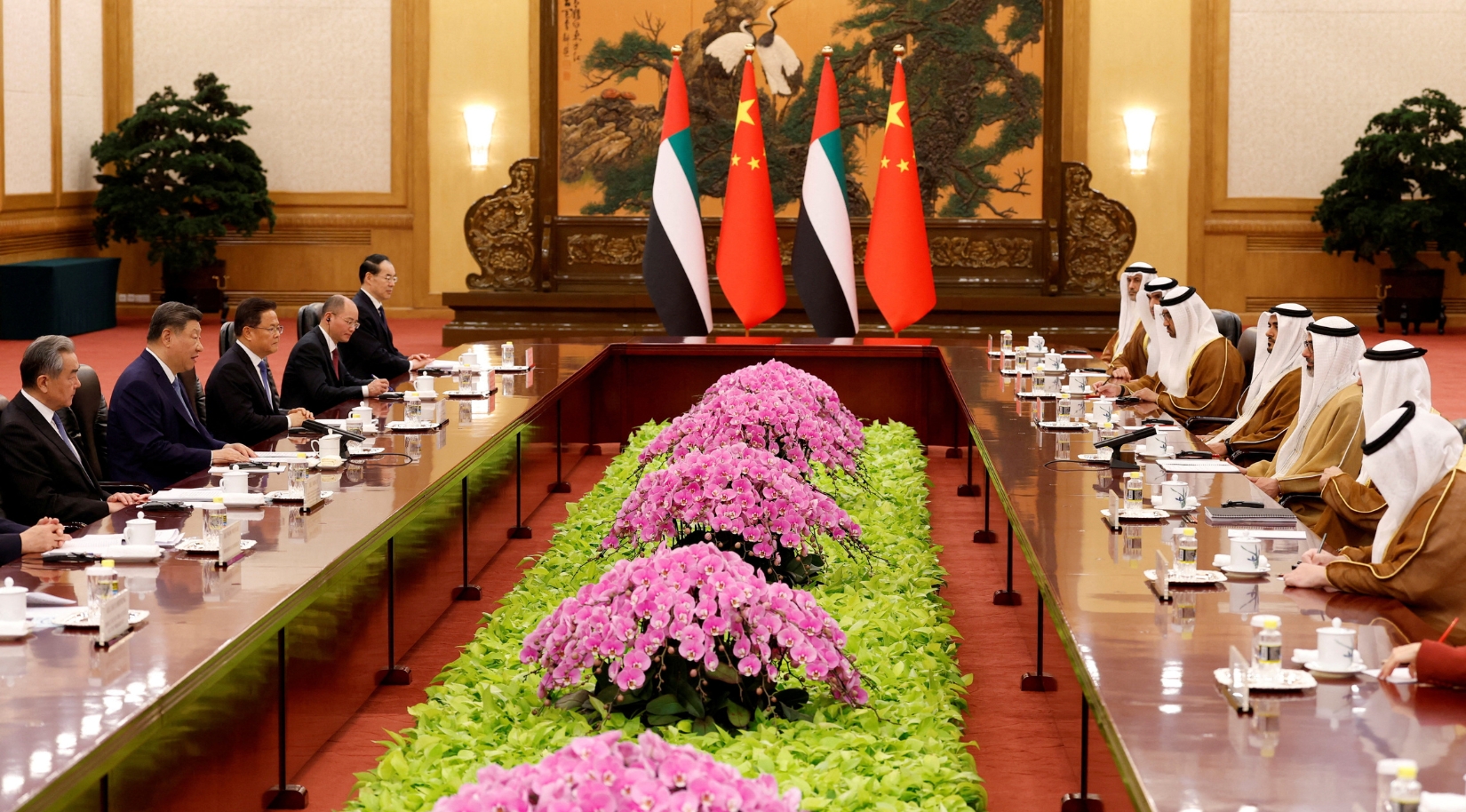
Despite its strategic cooperation with Iran, the Chinese government has been hesitant to provide assistance, including through military aid. Unofficial reports indicate limited supplies of chemical materials for rocket fuel and the sharing of satellite imagery. China’s response (similar to its response to the attacks on Iran in 2025) has focused on diplomatic efforts, seeing them as the only realistic means of influencing the regional situation. The actions taken by China are primarily aimed at promoting its image as a stabilising influence on the region, seeking to ensure the free flow of traffic through the Strait of Hormuz. China—as with Russia—has therefore criticised the American and Israeli bombing campaigns, while emphasising the necessity of maintaining freedom of maritime transport (regardless of which country hinders it), ceasing missile attacks, and peaceful coexistence between Iran and its Arab neighbours. This position was laid out by Chairman Xi Jinping during a conversation with the Crown Prince of the UAE on 14 April, and in the 20 April telephone conversation with the Saudi Crown Prince, he emphasised the importance of freedom of navigation through the Strait of Hormuz. On 16 April, Chinese Foreign Minister Wang Yi conveyed the same message while also declaring China’s support for Iran’s sovereignty. In recent weeks, both he and Zhai Jun, the Chinese Ministry of Foreign Affairs’ Special Envoy to the Middle East, have held dozens of meetings and telephone conversations with regional counterparts, including Israel. These efforts culminated, among other things, in China’s support for Pakistan’s mediation in US-Iran talks and pressure on Iran to commence negotiations.
Political consequences
The situation in the Middle East undermines China’s preferred image as a regional stabiliser, previously symbolised by the 2023 agreement between Iran and Saudi Arabia signed in Beijing. Beyond diplomatic action, China lacks effective means to safeguard its interests, including in Arab countries, where Iranian attacks damaged 18 Chinese-affiliated facilities (such as ports, refineries, and desalination plants).
At the same time, the attack on Iran could strengthen China’s position in its relations with the US. High US munitions expenditure potentially increases dependence on China, as war materiel production is largely reliant on supplies of critical raw materials. China is also intensifying its narrative directed at the Global South, emphasising the US’s hegemonic policies and its unlawful interference in the internal affairs of other states. Some European politicians similarly view the US actions as further justification for increasing cooperation with China. Chinese authorities believe that the lack of a decisive US victory, the inability to stabilise traffic through the Strait of Hormuz, and Beijing’s influence over Iran and Arab states will collectively generate additional pressure on the United States. This will provide valuable leverage in US-China negotiations, including talks regarding Taiwan.
Economic implications
The Chinese efforts to stabilise the regional situation are also driven by economic difficulties at home. Prices for key commodities in China—particularly gasoline and crude oil, as well as natural gas and industrial chemicals (e.g., methanol)—have risen. A protracted conflict could lead to rising inflation (the producer price index rose in March of this year for the first time in 41 months), problems with private consumption, and food production. This could have serious consequences, even assuming that China is diversifying its oil supplies (purchases from Russia rose by 14% year-on-year in March) and its strategic reserves are sufficient for 4–5 months. Equally problematic from China’s perspective are the negative ripple effects on the economies of other Asian countries, the primary recipients of Chinese exports (exceeding 54% in March).
The destabilisation of the Middle East has also reinforced Beijing’s conviction that transforming the Chinese economy is the right course of action— specifically through energy diversification and technology exports. In March of this year, Chinese exports of batteries, electric vehicles, and solar panels rose by 70% year-over-year. The Chinese authorities view the attack on Iran and its impact on access to resources as a signal to accelerate their efforts to build resilience and create state tools to respond to crises. Minister of State Security Chen Yixin highlighted this imperative in a February article for the party journal Qiushi. Consequently, new regulations published in April empower the state to restrict Chinese companies’ cooperation with foreign entities to mitigate supply chain dependency risks.
Conclusions and Prospects
For China, US-Israeli military action against Iran is yet another manifestation of Donald Trump’s unilateral policy, following the operation in Venezuela and demands regarding Greenland. It is not viewed as direct pressure on China, especially since the resulting negative consequences also affect US partners and allies. Chinese authorities recognise the challenges posed by an attack on Iran, but are convinced that the conflict could serve Chinese interests.
Cooperation with Iran remains a key tool for China in its relations with the US, especially in light of Trump’s planned visit to Beijing in May. However, given the importance of economic cooperation with Arab states—highlighted by the upcoming 2026 China-Gulf Cooperation Council summit—close relations with the Iranian regime are not viewed by China as a critical element of its Middle East policy. In this context, Iran’s importance as a strategic partner to China is diminishing. Unlike its relationship with Russia, China’s cooperation with Iran is limited to tactical goals driven by the evolving international situation.
Crucially, the EU must take a sceptical approach to China’s narrative regarding transatlantic policy differences on the war in Iran, including NATO’s future. China aims to use the war in the Middle East to argue for expanding European cooperation with China rather than limiting it due to cooperation with the United States. The one-sided nature of US policy and transatlantic disputes related—such as the refusal of some NATO countries to join operations against Iran—advantages China, particularly regarding Sino-Russian cooperation efforts to alter the European security architecture. However, this will not prompt Beijing to concede to wider EU economic demands, though selective investment offers to EU countries (e.g., Spain) remain possible. From China’s perspective, the conflict in the Middle East also underscores their need to introduce regulations and instruments that facilitate rapid crisis response, particularly concerning relations with foreign entities.