China's 2026-2030 Five-Year Plan: Continuing the Economic Model and Increasing Self-Reliance
The latest five-year plan, adopted in March this year by the Chinese parliament, identifies industrial modernisation and the pursuit of technological independence as key to China’s economic development. It mentions increased consumption and improved social conditions, but these are not priorities. The development of modern industries is intended to increase the competitiveness of Chinese companies relative to entities from developed countries, including Poland. The direction outlined by the plan is another argument for strengthening the protection of the EU single market and supporting an active EU industrial policy.
 Li Jianan / Xinhua News Agency / Forum
Development Model
The 2026–2030 Five-Year Plan, adopted by the CPC Political Bureau in October 2025 and by the Chinese parliament on March 12 of this year, presents the main principles of the model intended to ensure the development of the Chinese economy. The authorities point out the existence of difficult conditions and threats to the country’s development, but the implementation of the plan is intended to enable China to take a leading position in the technological revolution.
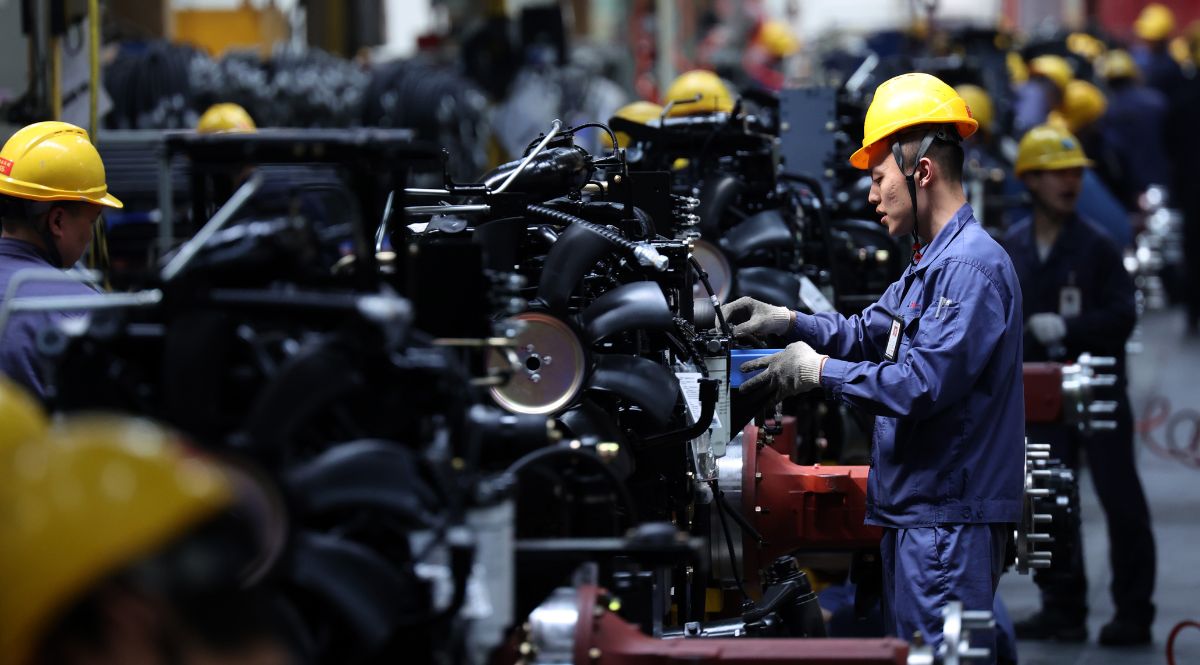
The development model outlined in the plan represents a continuation of the objectives set for 2021–2025. Internal investments aimed at developing industry and increasing its competitiveness will be key, which is expected to translate into higher exports. The plan calls for an increase in industrial productivity and its share of GDP (currently about 25%), though without specifying concrete targets. In the context of the energy sector, it forecasts a further 17% reduction in carbon dioxide emissions by 2030, with renewable energy sources expected to supply over 21% of consumption by that time. Achieving a high level of competitiveness (through subsidies, lower costs, and new technologies) is intended to allow Chinese companies to dominate other markets, primarily in the EU and Southeast Asia. Exports to these regions have been growing significantly for several years, and the tariffs imposed by the US last year provided a new boost. China’s trading partners are becoming increasingly dependent on specific Chinese imports, including those from the high-tech sector. At the same time, China’s reliance on sales to foreign markets is growing.
Innovation and self-reliance
The current five-year plan, like the previous ones, emphasises innovation and technological development, primarily in industry. Spending on research and development is expected to grow by an average of about 7% annually over the next five years (similar to the 2021–2025 period). One of the stated goals is for the digital sector to account for over 12% of GDP by 2030 (in 2024, it was 10.5%).
Innovation and the development of modern industry are intended to reduce Chinese external dependencies, primarily from a national security perspective. Domestic production in China gives the CCP control over the entire process and allows it to avoid using foreign hardware deemed a security risk, such as smart vehicles or robots. The plan also highlights the need for oversight of software to limit the risk of hostile actors seizing control of critical infrastructure. This approach also applies to chip manufacturing and the energy sector, including the development of renewable energy sources, a task which is viewed, among other things, as a means of reducing dependence on raw materials from the Middle East.
The industries identified in the plan as key to China’s development have appeared in official documents for several decades—for example, green energy, semiconductors, software, and new materials were in the 1986–1990 plan, and artificial intelligence in the 2016–2020 plan. A notable addition is the reference in the latest document to developing the thermonuclear fusion energy sector. At the same time, the authorities have highlighted the need to continue progressing green energy, advanced materials, quantum technologies, hydrogen technologies, and 6G telecommunications. They also emphasise the need to accelerate efforts in the silicon chip, modern machinery, biotechnology, and bioproduction sectors. Increasing competitiveness in these areas is to be achieved not only through production subsidies but also through comprehensive research funding and the prioritisation of Chinese products in public procurement.
Under the adopted development model, activity by foreign companies in the Chinese market is to remain limited and controlled. Incentives for investors are primarily linked to the integration of Chinese subcontractors within production chains, such as those of European automotive companies, thereby increasing these entities’ dependence on cooperation with China. In April of this year, the Chinese government also introduced regulations designed to safeguard production cooperation between Chinese companies and foreign entities, granting authorities the ability to intervene (e.g., to exclude a foreign company from the Chinese market) to prevent issues such as excessive dependence on a supplier from a specific country.
Social issues
The new plan also highlights efforts to improve social conditions. Access to healthcare is one of the challenges in this area, including a shortage of doctors, particularly in rural areas. The plan aims to have 3.7 medical professionals per 1,000 residents by 2030 (currently 3.5). By comparison, the ratio is 4.5 in Germany, 4.2 in Poland, and 3 in the US. At the same time, average life expectancy in China is projected to rise from over 78 years today to 80 years by 2030. Another challenge will be expanding the scope and improving the quality of public services in cities. Chinese authorities anticipate that the urbanisation rate will rise from its current level of around 68% to 71% by 2030 through changes to the urban residency registration (hukou) system, though these reforms will not apply to the largest metropolitan areas.
Industrial development is expected to foster job creation, particularly for young people aged 24–29, thereby increasing consumption. Official urban unemployment in 2030 is projected to be below 5.5% (currently 5.2%). However, the plan does not specifically address unemployment within the 24–29 demographic, which officially stood at 7.2% in February 2026. Nor does it indicate how to address the issue of approximately 270 million so-called flexible workers engaged in casual labour, such as couriers or drivers.
The plan includes no specific provisions for a comprehensive government strategy to increase consumption’s share of GDP. The issues it does address, such as the development of the senior services sector and subsidies for replacing household appliances, cannot be viewed as comprehensive due to their limited scale. At present, the Chinese authorities have no intention of significantly modifying the system of national income distribution, as the current system is seen as a mechanism for the party apparatus to exert control over the provinces—for example, by allocating implementation funds for specific tasks. Maintaining the current development model in the face of a significant reduction in revenues—such as from the real estate sector—will therefore entail an increase in debt. In September 2025, the debt-to-GDP ratio stood at over 300%, including household debt, government institutions, provinces, and non-financial firms.
Conclusions and Recommendations
The implementation of the 2026–2030 development plan will serve as a benchmark for the central government’s evaluation of mid- and lower-level officials, thereby increasing the likelihood of its success. It should also be interpreted as the authorities’ preferred narrative regarding China’s positive development path, designed to maintain the overriding role of the party leadership and preserve oversight of the state apparatus through the framework of income distribution. Implementation of the economic and social plans is intended to enhance China’s technological and civil-military capabilities, but their primary purpose is to deliver political objectives, including stabilising the domestic situation and reducing dependence on other countries, primarily the United States.
The content of the five-year plan confirms the continuation of China’s economic policy, and will result in EU companies being displaced from many sectors, correspondingly increasing the EU’s dependence on China in strategic areas. Most notably, this applies to the supply of critical raw materials for the defence sector, posing a threat to EU security. From the EU perspective, the issue of software is also highly relevant; the proliferation of smart vehicles and appliances creates significant risks regarding what data is collected and transferred to China. In response to the Chinese plan, the EU should actively reduce its dependence on China (derisking) and pursue an industrial policy that supports EU companies.
The potential of the EU’s single market and its importance to China as a destination for its surplus production will play a significant role in supporting the effectiveness of any protective measures the EU takes. However, in this context, a unanimous front among member states is unlikely. A potential solution could be through “coalitions of the willing” being used to implement both defensive measures (e.g., safety regulations, screening of incoming investments from China) and offensive ones (screening of outgoing investments, export controls). For Poland, supporting such initiatives would be important for the stability of small and medium-sized enterprises in sectors such as the automotive industry and green technologies. To compete with China, EU and member state investments in research and expanding industrial capacity will also be crucial. From Poland’s perspective, protecting its economically significant sectors (such as automotive, industrial machinery) against Chinese competition is more important than increasing exports to China.