The American path to peace between Armenia and Azerbaijan
Armenia and Azerbaijan, with the United States mediating, have signed a declaration on a future peace agreement. Despite the framing created by President Donald Trump, portraying him as a mediator for peace, the declaration is not groundbreaking. It is unlikely that a peace treaty between Armenia and Azerbaijan will be signed in the coming months. However, the declaration brings the two South Caucasus republics closer to a final end to the Nagorno-Karabakh conflict and expands American influence in the region while limiting Russian one.
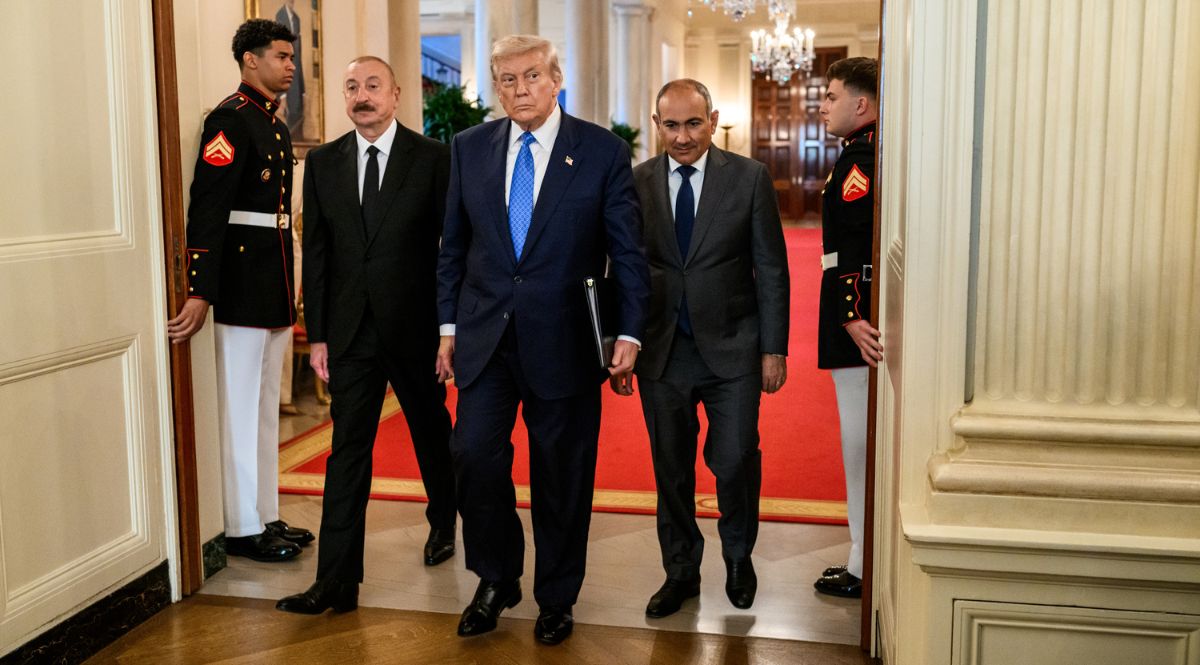 White House / Zuma Press / Forum
After the end of the second Karabakh war in 2020 (the first took place in 1988-1994), the US, Russia and the EU, acting within the framework of the Minsk Group (MG) under the auspices of the OSCE, were involved in mediation between Armenia and Azerbaijan. However, they did not result in a resolution in the form of a settlement of the status of Nagorno-Karabakh (NK) and the signing of a peace treaty. After Azerbaijan took complete control of NK in the autumn of 2023, resulting in an exodus of local Armenians, peace talks with Armenia took place without the participation of intermediaries. In March this year, the parties agreed on the content of a peace treaty and began working to resolve contentious issues (among other things, an intergovernmental commission for the delimitation and demarcation of the common border was established). The involvement of the US proved to be helpful, resulting in a summit in Washington on 8 August this year, organised by President Trump. During the summit, Armenian Prime Minister Nikol Pashinyan and Azerbaijani President Ilham Aliyev committed to concluding a final peace treaty and normalising bilateral relations.
Provisions of the Washington Declaration
In Washington, the foreign ministers of Armenia and Azerbaijan preliminarily initialled the treaty. Three days later, both countries published their text. The document confirms mutual recognition of territorial integrity, the borders between the former republics of the USSR as the borders of independent Armenia and Azerbaijan, and the establishment of diplomatic relations. In addition, the countries renounce any territorial claims against each other. Their authorities also issued a joint appeal to the OSCE to dissolve the MG, a specialised unit created in 1992 to resolve the conflict over the NK region, and this goal was accomplished on 1 September this year. Both sides also committed to unblocking transport routes, with particular emphasis on the so-called Zangezur corridor, which connects Azerbaijan with its exclave of Nakhchivan via Syunik, a southern province of Armenia. In this context, the US administration has proposed to engage, alongside Armenia and possibly third countries, in the creation of the Trump Route for International Peace and Prosperity (TRIPP). However, the provisions concerning the connection are vague, including regarding the scope of the entire project. At the basic level, TRIPP could simply involve restoration of old roads and railways, but a more ambitious version that would boost the project's economic importance would also have to include building a pipeline, a gas pipeline and laying fibre-optic cable. No timeframe for the project has been specified, but it can be assumed that the administration will be interested in at least launching road transport routes before the end of Trump's term. The issue of how to organise border control and customs clearance and guarantee the security of TRIPP also remains unresolved – the US does not want to involve its own military or police forces. These issues may generate a number of problems in the future, and the lack of agreement is likely to prevent the unblocking of transport channels in the region, which has been one of the key points of contention between the countries in the past.
The Role of the US in the Agreement Between Armenia and Azerbaijan
The South Caucasus countries are not a significant focus of US foreign policy – the last Secretary of State to visit Armenia and Azerbaijan was Hillary Clinton in 2012 (Mike Pompeo visited Georgia in 2020). Nevertheless, the Trump administration saw an opportunity to engage as a mediator and bring about a compromise, stabilise the situation, and undermine the influence of American rivals in the region. President Trump's special envoy, Steve Witkoff, joined the talks in February. Republican Senator Steve Daines also held talks with the highest representatives of both countries.
In an effort to create a better negotiating atmosphere, the US authorities decided that emphasising economic issues and the development prospects of both countries would convince them to engage in negotiations and implement the provisions. Therefore, they concluded separate bilateral agreements with Armenia and Azerbaijan on cooperation in the fields of energy, trade and new technologies, including artificial intelligence. In addition, they lifted US sanctions against Azerbaijan, which had previously limited the possibility of defence cooperation.
The Position of Russia, Iran, Türkiye and the EU
Officially, Russia welcomed the signed declaration, expressing hope that it would serve peaceful purposes. In reality, the Russian authorities are aware that the document is a sign of Russia's weakening position in the region and a failure in terms of image. For three decades, Russia was the main mediator between the countries (it co-chaired the MG), and it was thanks to Russia that a ceasefire was reached after the two Karabakh wars. Under the 2020 ceasefire agreement, Russian FSB officers were to control the future unblocked Zangezur corridor.
Iran, like Russia, considered the agreement a step towards peace in the region, but was sceptical about the construction of a transport link through Armenia. It sees US involvement in its creation as a sign of expanding American influence in the region and the threat of possible isolation from the north-south transport route passing through Armenia and Georgia to Russia, as well as a factor negatively affecting the security and stability of the South Caucasus.
The EU and Türkiye have welcomed the agreement. Türkiye, which neighbours the South Caucasus region, is interested in opening up its borders (which will also involve normalising relations with Armenia) and transport links. It sees this as an opportunity to increase trade with Asian and European countries within the so-called Middle Corridor.
Conclusions and Perspectives
Signing the declaration was important for Donald Trump's image, presenting him as someone capable of resolving global conflicts. On the one hand, the agreement was a boost to his ambitions to win the Nobel Peace Prize. On the other hand, it lends him credibility as a mediator in the more difficult conflicts between Israel and Hamas, and Russia and Ukraine. However, the declaration signed in Washington does not automatically mean that peace will be established between Armenia and Azerbaijan. At this stage, it is difficult to say when a peace treaty will be concluded. Nevertheless, the signing of the declaration is a significant event which may lead to the finalisation of the peace process that has been ongoing for years. Its success will largely depend on the real and long-term commitment of the US to regulating Armenian-Azerbaijani relations and the creation of a transport route connecting the two parts of Azerbaijan through Armenian territory. For this reason, it will be crucial to maintain the interest and commitment of the Trump administration in the peace process and the development of TRIPP. This may also allow for the development of a more effective approach by the US authorities towards neighbouring countries, those being Georgia and the countries of Central Asia, with whom Trump plans to meet in Washington in early November this year.
The EU, including Poland, should continue to support the peace process between Armenia and Azerbaijan in the coming months, encouraging the parties to implement the commitments contained in the Washington Declaration. In addition, specific proposals could also be put forward for financial and investment involvement in the development of transport routes in the South Caucasus region, following the opening of the borders between Armenia, Azerbaijan and Türkiye. This could accelerate the construction of the necessary infrastructure and contribute to faster growth and, in the longer term, to trade between the EU and Asian countries within the so-called Middle Corridor, of which the Caucasus route will be an important part.



.png)