
Azerbaijan's Challenges in the Reconstruction of Karabakh
Having regained full control of Nagorno-Karabakh and its surrounding provinces after more than 30 years, Azerbaijan has embarked on what it is calling the Great Return Plan—the reconstruction of areas devastated by the conflict with Armenia. However, it is difficult for the Azerbaijani authorities to convince the international community to provide financial support for reconstruction due to their authoritarian governance and still unfinished peace talks with Armenia. Countries with similar non-democratic governance are, however, ready to financially support the process.
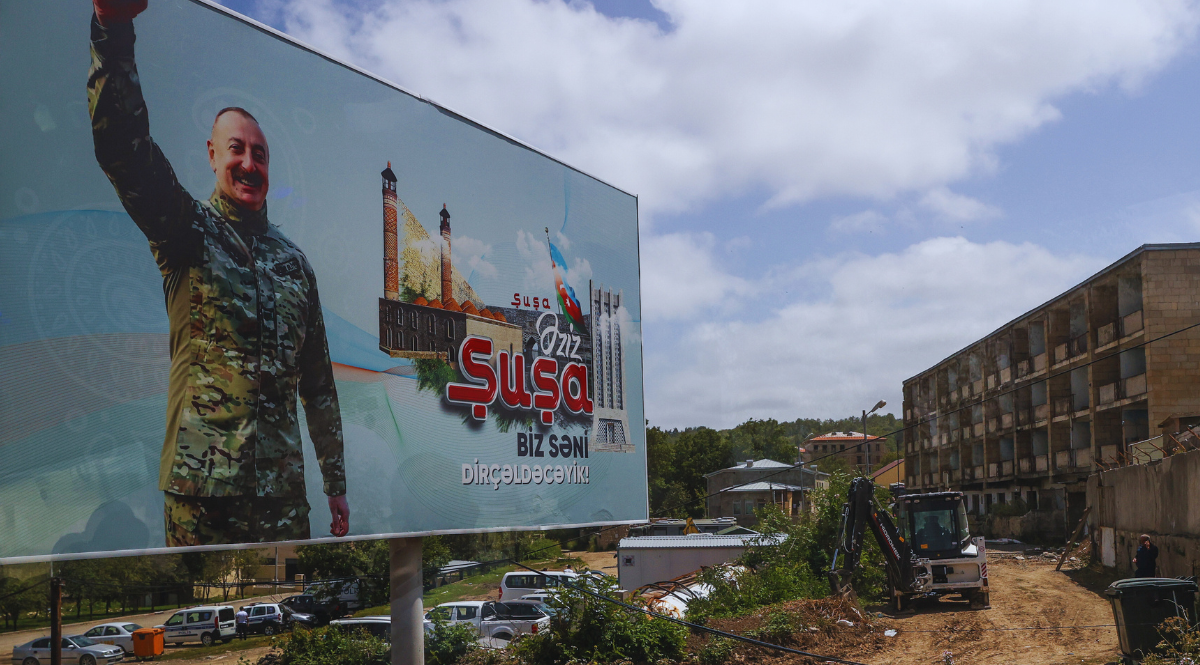 credit: Bulkin Sergey / Russian Look / Forum
Origin and Course of the Conflict
Nagorno-Karabakh (NK) was an autonomous region within the Azerbaijan Soviet Socialist Republic during the USSR period, although Armenians made up the majority of its population. Tensions between them and the Azeris led to the outbreak of the First Karabakh War, which ended with a ceasefire in 1994. As a result, the Armenians took control of NK and seven surrounding regions[1] and declared the formation of the Nagorno-Karabakh Republic (NKR), which was not even recognised by the Armenian state that supported it and functioned as a de facto state. The unresolved dispute over the status of the breakaway region led to tensions between Armenians and Azeris, including armed incidents on the border. In autumn 2020, Azerbaijan resumed large-scale fighting (the Second Karabakh War) and regained control of seven regions and part of NKR.
In December 2022, Azerbaijan imposed a blockade on Karabakh, and then in September 2023 took full control of the rest of the NKR and ended its existence.[2] As a result of the hostilities, almost all Armenians (over 100,000) left the region and the Armenian authorities, human rights defenders, and the European Parliament considered it ethnic cleansing.[3] The EU stressed Azerbaijan’s obligation to respect the rights of Karabakh’s residents, including to remain there safely and to allow humanitarian assistance there. The Parliamentary Assembly of the Council of Europe (PACE) drew attention to the violation of Azerbaijan’s commitment to a peaceful resolution of the conflict dating back to the moment of Azerbaijan joining the Council of Europe and called for Armenians to be allowed to return safely to the region.[4] Since then, Azerbaijan and Armenia have been holding talks that have not yet led to a formal peace.[5]
Situation in the Recovered Territories
The recaptured lands cover about 20% of the territory of the whole of Azerbaijan and are divided into two economic regions: Karabakh (mainly the area of the former NKR, including the city of Khankendi, the regions of Aghjabadi, Aghdam, Barda, Fuzuli, Khojaly, Khojavan, Shushi and Tartar) and eastern Zangezur (the regions surrounding the former NKR, i.e. Lachin, Gubadly, Zangilan, Jabrayil, and Kalbajar).
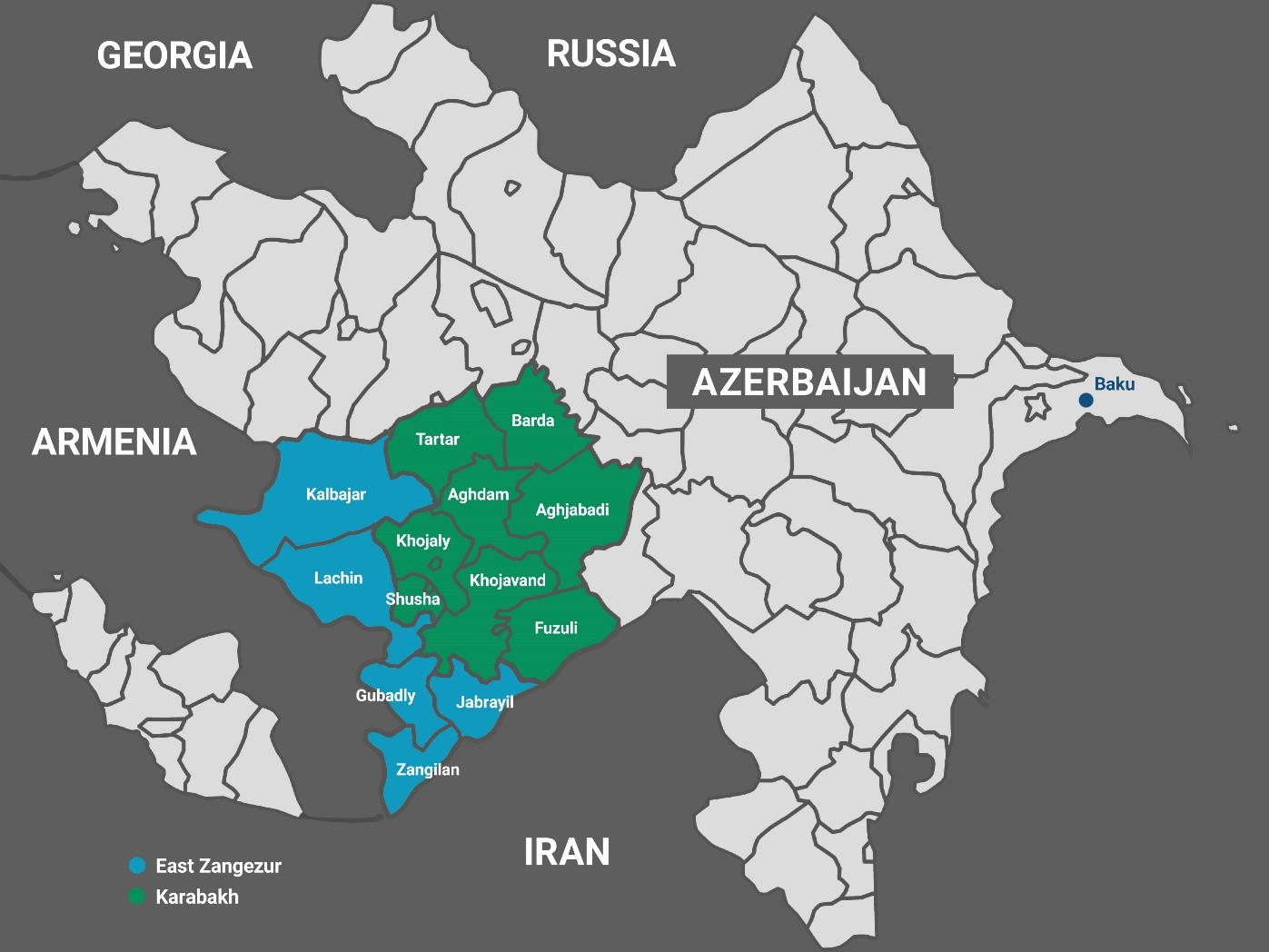
As a result of the conflict, some 800 villages and seven administrative centres were severely damaged (most notably Fuzuli and Agdam, which is referred to as the “Hiroshima of the Caucasus” by the Azerbaijani side[6]). According to the Azerbaijani State Property Service, there were 162,234 buildings, mostly civilian, in the occupied area; around 95% of them are estimated to be completely destroyed or beyond repair. The scale of post-war and post-occupation damage varies—less in the former NKR and more in the surrounding areas, which formed a buffer zone separating the self-proclaimed republic from Azerbaijani-controlled areas. In addition, they remain mined and the infrastructure that remains are outdated and dilapidated, so they need to be developed from scratch. In contrast, in the former NKR, the destruction is not as severe, as it is mainly due to the negligence and actions of the civilian population, such as the neglect of Azerbaijani cemeteries, damage from homemade bombs and landmines left behind by the Armenians leaving the region in autumn 2023.
Although prior to the outbreak of the First Karabakh War the areas surrounding the NKR were much more densely populated than those in which the NKR was established, they became depopulated as a result. Today, the number of internal refugees in Azerbaijan is estimated at around 600,000[7] (just after the war, it was around 1 million[8]). The largest number live in Baku. About half had been given homes in Azerbaijan-controlled areas by 2020, but state assistance is changing. It is now mainly limited to concessions on medical fees, school books, university tuition fees, and better protection of employment and against eviction than for other citizens. However, further assistance announced by the authorities is already linked to the reconstruction of the recovered areas.
Armenian-Azerbaijani fighting has devastated the environment. In the spring of 2022, at Azerbaijan’s request, the UN Environment Programme (UNEP) mission conducted a survey of the state of the environment in the reclaimed area with the support of the Azerbaijani Ministry of Ecology and Natural Resources (MENR). In the past it was a cultivated area (grain, fruit, cotton), but due to the fighting it no longer serves this function. The mission also found deforestation, river, and land pollution.[9] According to Azerbaijan, between 1993 and 2020, Armenians developed mining and quarrying in the occupied areas; out of 151 mineral deposits and quarries, 52 were started and mining was expanded and deepened in previously used areas. It was the detrimental effects of the Karabakh mines that were the official reason for the blockade by Azerbaijani “eco-activists” of the Lachin corridor linking the enclave to Armenia, a supply route calculated to be cut off to regain Azerbaijani control over it in December 2022.
The reclaimed lands are of significant cultural (the town of Shusha is considered the cradle of the state), energy, and economic importance to Azerbaijan. There are deposits of raw materials: gold, copper, cadmium, mercury, molybdenum, lead, silver, tantalum, and zinc, in addition to calcium, gravel, sand, clay, and gypsum. According to estimates by the Azerbaijani authorities, the eastern economic region of Zangezur alone is expected to contribute 4% to the country’s GDP.
Reconstruction Process
The reconstruction of the reclaimed regions has become—once control of the entire territory has been restored—a new national objective for Azerbaijan, and the importance of the project to its authorities is evidenced by the personal involvement of President Ilham Aliyev, who regularly visits Karabakh. He has also appointed his special representatives to oversee the reconstruction timetable (each of them is responsible for one region and chairs the board of directors of state companies specially established for this purpose).
The authorities have begun preparations for full integration of the region even before the entire territory has been recaptured. In January 2021, Aliyev established the Karabakh Revival Fund (KRF) to support the financing of reconstruction and attract investors, and in the longer term, the implementation of the Great Return Plan, adopted in 2022. The plan envisages the implementation of the so-called smart city (village) concept[10] powered by renewable energy sources and the creation of safe living conditions. An important objective remains the reintegration of the reclaimed areas into the economy of the rest of the country by, among other things, building a modern infrastructure with good access to public services, ensuring sustainable socio-economic development, supporting business development, using local natural resources, developing the tourism sector or protecting the environment. The programme narrowly refers to the role of the international community—it mentions it when discussing demining and sources of funding for reconstruction.
The reconstruction process is to be finalised by 2050.[11] The first phase of its implementation should end in the second half of 2026 with the return of some 140,000 people to the recovered areas.[12] In 2024 alone, Azerbaijan spent $2.4 billion on reconstruction, more than a tenth of the state budget, and plans to spend a total of $17.6 billion in the period 2021–2030. Among the sources of funding for the Great Return Plan, the Azerbaijani authorities mention, without indicating their respective shares, the state budget, funds from the State Oil Fund of the Republic of Azerbaijan, extra-budgetary funds (KRF and others), the Azerbaijan Entrepreneur Development Fund, funds from the Agrarian Credit and Development Agency under the Ministry of Agriculture, local and foreign funds, funds mobilised through public-private partnerships, funds from international organisations, donors and funds, and others.
The authorities are focusing on the reconstruction of previously occupied areas, even though these require more resources than the former NKR. Each recovered province has its own reconstruction plan and specialisation. Examples include Jabrail on logistics and trade, Shusha on cultural heritage, Agdam on processing, and Kalbajar on mining, including gold. Industrial parks are also being created, such as Araz Valley. The target is to build five of them, in addition to 50 agro-parks—government-subsidised large agribusiness enterprises that have been operating in Azerbaijan since 2012 on a public-private partnership basis to ensure investment stability. The authorities are encouraging companies to build factories on reclaimed land, while also planning to use it for agriculture and tourism.
Reconstruction began with road infrastructure—some 1,400 km, including the so-called Victory Road from Fuzuli to Shusha, which opened in November 2021, and the longest tunnel in the post-Soviet area—and railway tracks. Water pipelines, telecommunications, and energy networks were also built. In addition to the necessary infrastructural investments, reconstruction is also propagandistic in nature and therefore not always focused on meeting the actual and basic needs of the population. For example, international airports in Fuzuli and Zangilan were built within two years, and construction of another one in Lachin is underway. Fuzuli airport opened in October 2021 at a cost of around $44 million, but a year after its opening there was an average of one aircraft a week landing there, while no take-offs or landings were recorded in 2024[13] (so far, Azerbaijan has had six civilian airports outside the reclaimed land). While such realisations are intended by the Azerbaijani authorities to demonstrate their efficient operation, in practice they call into question the need and desirability of financial assistance from the international community.
In 2021, Aliyev ordered the creation of a Green Energy Zone on the recovered land; ultimately, all energy needs are to be met from RES (mainly solar, wind, and hydropower) and surplus energy is to be exported to the EU, among others.[14] The largest solar farm in Azerbaijan was built in Jabrayil (the investor was British BP) with a capacity of 240 MW. In 2021, a hydroelectric power plant was opened in Gulabird, in the Lachin region, and two in the Tartar region were restored (Sugovushan-1 and 2, used by Armenians as Mataghis-1 and 2). Last May, Azerbaijan commissioned two hydropower plants on the Araz River on the border with Iran (Khudafarin and Giz Galasi, with a capacity of 200 and 80 MW, respectively, which are expected to reach a total capacity of 500 MW in the coming years).[15] In addition to plans to build more wind and solar power plants in Karabakh, the authorities are exploring the possibility of obtaining energy from biomass, thermal, and geothermal sources. In terms of environmental improvement, the reconstruction plan envisages the reforestation of 29,000 hectares between 2021 and 2025, approximately 53% of the forest area destroyed by the conflict. Above all, Karabakh is to become a testing ground for green technologies. Each project is to include solutions in this area and, although their percentage in individual projects may vary, they are a necessary condition for applying for a contract. At the same time, however, the Azerbaijani authorities are accused of fighting environmental activists and using “greenwashing,” as the country’s economy is based on oil and gas extraction and it Azerbaijan unprecedentedly protected these sectors when hosting the COP29 climate summit last autumn.[16]
Controversy over Reconstruction
Azerbaijan is calling on states and international organisations to provide financial and technical support for mine clearance and reconstruction, but the scale of its initiatives to date undermines the need for external sponsors. The reconstruction plan raises objections from the local population, but these voices, as well as issues related to the preservation of Armenian cultural heritage in the reclaimed territories, sporadically break through in the information space.
Demining
According to local experts and Western diplomats, the most pressing reconstruction challenge is the demining of reclaimed areas where more than 350 people, mostly civilians, have been killed in recent years by them. In 2019 the Azerbaijan National Agency for Mine Action (ANAMA) estimated the number of mines in the occupied lands at around 100,000, but it is now at more than 1 million,[17] with the numbers difficult to verify. Most mines are located on the former line of contact, but determining their exact location remains problematic, and maps provided by Armenia are inaccurate. While Azerbaijan claims this is an act of passive aggression, it is just as likely that there is a genuine lack of discernment on the part of the Armenian authorities in the distribution of homemade explosives, which were often haphazardly left behind by fleeing Armenians. Azerbaijani authorities estimate that demining will take some 25–30 years and cost $25 billion (about 10 times the costs cited by the Kyiv School of Economics and the World Bank in the context of demining agricultural land in Ukraine[18]). On this basis, Azerbaijan is seeking foreign funding and equipment for demining. Financial support has been provided by the UK (around £1.5 million[19]), the EU (€4.25 million[20]) and UNESCO,[21] among others, and was pledged by Saudi Arabia last year. The production of demining machinery in Azerbaijan is also financed by private companies, such as DOK-ING from Croatia.
Demining is organised by the government via the Ministry of Defence, the Ministry of Emergency Situations, and ANAMA, supported by volunteers, but the authorities do not want to allow foreigners to manage the process, so foreign assistance remains relatively small and focuses on building the expertise Azerbaijan needs. The Red Cross (Red Crescent) is educating the public on landmines, UNICEF is raising awareness of children on the issue, and UNDP is working with ANAMA on technical standards and good demining practices. In 2020, Poland tried to get involved in training, offering a course for Azerbaijani sappers, but its proposal went unanswered. Last May, Team Europe with the participation of ANAMA and the EU also started support in Karabakh demining. Türkiye sent 140 sappers to Azerbaijan, while the U.S. sent sapper dogs; Hungary and Serbia also announced their readiness to assist in demining. Despite its stated prioritisation of mine clearance, Azerbaijan is allocating significant resources to projects that could be implemented further down the line (e.g., airports).
Population
Contrary to the regime’s declarations, rebuilding the social fabric in the recovered areas remains a real challenge. The authorities envisage quotas of people who will be able to return on specific dates. The first 200 residents (almost 100 families) moved into Aghali in July 2022. According to Azerbaijani media, as of the beginning of May this year, more than 43,000 people had returned to the recovered areas (to the regions of Fuzuli, Lachin, Aghali, Talysh, Zabukh, Hasanriz), including more than 13,700 repatriates, more than 1,100 students, and 28,200 people involved in reconstruction.[22] The target is to have around 140,000 people living there by the end of 2026,[23] and by 2027, 150,000 people.[24] Those registered with the State Committee for Internal Refugees are eligible to move there first. The institution, which has so far been mainly concerned with monitoring their living situation, contacts them as each area is being reconstructed according to the key of the place they left as a result of the First Karabakh War. An additional criterion is the occupation and skills they have, juxtaposed with local demand; after the war in 2020, the ADA university conducted a survey among refugees commissioned by the authorities to plan jobs in the recovered areas and reduce the risk of unemployment. In the longer term, the opportunity to settle in the recovered areas is to be granted to Azeris displaced from Armenia in the late 1980s and early 1990s, and later to other citizens.
Due to the information policy of the authorities, it is difficult to establish the actual attitude of the population towards the Great Return Plan. Officially, among the older generations the vast majority want to return to Karabakh. Accurate data, however, is difficult to verify and there seems to be a less optimistic mood among the younger generations and those who have spent the last 30 years in Baku, where they have established their family and professional lives. Living in the capital influenced career choices and provided access to public services incomparably better than in the rest of the country. The Grand Return Plan only partially addresses these needs. It is based on the assumption that infrastructure investments will encourage the population to move to Karabakh. In this respect, it meets the expectations of the young but not the older generations, who are driven by nostalgia but will not return to the homes they had to leave 30 years ago because they have mostly been razed to the ground and the authorities have no plans to rebuild them. The villages and towns that are being constructed are not a faithful recreation of the grid of villages that existed before the war, because instead of scattered houses, the preference is to create larger clusters, with better access to schools, hospitals, etc. For example, the plan for the reconstruction of Aghdam is to make it the fourth largest city in Azerbaijan with a target population of 100,000 people (36,000 before the war). Accordingly, the city will absorb the villages that previously surrounded it, and instead of single-family houses (1,750 planned, compared to 15,000 before the war), mainly apartment blocks will be built.[25] In addition, the authorities are following foreign trends and entrusting projects to Western companies[26] but are not taking into account the actual needs of IDPs.[27] Reconstruction is therefore largely based on the concept of smart cities (villages), which emphasises the use of digital and green technologies. However, returnees are less interested in such solutions than in reclaiming their former lives, such as the possibility of raising animals.[28] Some refugees suggest that it would be sufficient for the state to compensate them and demine the area, but the authorities do not take these voices into account.[29]
Moreover, smart villages and cities are a costly and complex investment, and this is not conducive to implementation at a fast pace. This is compounded by problems related to inadequate working conditions of the works contractors, sometimes escalating to labour disputes (the commissioning of Aghali was delayed because of them[30]). By the end of 2021, there were media reports of workers employed without proper contracts, unpaid and housed in inadequate conditions, working for Turkish companies contracted for the construction (it was estimated at the time that around 200–300 people were affected).
UNHCR advises the authorities on return policies and cooperates with resettled communities, state authorities, local organisations, and other UN agencies, but nevertheless the process of resettling Karabakh will be multi-layered, slow, and long, requiring the state to prepare incentives. For example, the authorities are considering tax reductions for those moving to Karabakh, free education or subsidies for higher education. They are also considering extending remote-working opportunities or relocating some government agencies to the reclaimed areas. On the other hand, relocation on such a scale could pose a threat to other regions that have based their functioning and development on IDPs, such as the nearby so-called Barda contact line. Those reluctant to relocate, on the other hand, express concern about the possible return of Armenians to Karabakh, although this seems to be very unlikely at the moment.[31]
Protection of the Environment and Cultural Heritage
To strengthen the inclusion of environmental rehabilitation and protection in the reconstruction plan, Azerbaijan has requested technical assistance from UNEP. In its March 2022 report, however, UNEP concluded that the proposed reconstruction of Karabakh will pollute the environment, for example, it will increase greenhouse gas emissions and ultimately reduce forest cover and natural resources, which is in contrast to the authorities’ declared so-called green transformation.[32]
Also unresolved is the issue of protecting cultural heritage in the reclaimed areas. The international community is drawing attention to the problem of safeguarding Armenian heritage in Azerbaijan. The absence of Armenians in the recovered territories makes preservation of these sites difficult and it is particularly threatened by the reconstruction process, although the Azerbaijani authorities declare they will take care of it. In December 2021, the International Court of Justice issued an interim order directing Azerbaijan to punish and prevent the destruction of Armenian monuments, but some of these buildings, such as those formerly serving the separatist authorities of the former NKR, have already been demolished, allegedly for security reasons.
Financing Reconstruction
The Azerbaijani authorities are seeking foreign sponsors for the reconstruction. As the project is mainly funded by the state budget and mining companies, this exposes the authorities to criticism that they are pursuing it at the expense of development and the needs of other regions of the state. According to those in power, these concerns are unfounded because the reconstruction of Karabakh is an additional (independent) expense. However, it is also controversial to cover the costs from, among other sources, newly introduced—and allegedly voluntary—contributions paid on salaries.[33]
Difficulties in Obtaining Foreign Support for Karabakh Reconstruction
Azerbaijan is seeking to attract foreign investors by offering them special conditions for doing business in Karabakh, such as preferential tax rates and public subsidies, especially in the agricultural sector. However, it has had difficulty winning them over due to the precarious situation involving protracted peace talks and an unfavourable business climate, despite the above-mentioned facilities. Although Azerbaijan has been reforming its procurement system, especially in recent years, insufficient transparency in the awarding of reconstruction contracts affects both domestic and foreign companies, encourages corruption, embezzlement of funds, and is inconsistent with the idea of smart villages.[34] Local oligarchs, such as the Pasha Holding owned by the Pashayev family, from which the first lady and vice-president of Azerbaijan Mehriban Aliyeva hails, are enriching themselves from the reconstruction.[35] Thus, what would convince Western partners to support the Azerbaijani Karabakh reconstruction plan is a strong emphasis on the implementation of the green transformation and the use of modern technologies. However, the policy has so far failed to deliver the expected results, while the EU’s involvement in the reconstruction process has been limited so far.
At the same time, Azerbaijan accuses Western countries of applying a double standard—providing humanitarian aid to Armenia, which accepted refugees from Karabakh in autumn 2023, although it was on Azerbaijan territory that the war was taking place. The Azerbaijani authorities expected an international conference would be organised to finance reconstruction (as in Georgia after the Russian aggression in 2008), but it failed to materialise due to the lack of interest from the international community, critical of how Azerbaijan regained control of Karabakh and focused on other issues, such as Israel’s escalating conflict with Hamas and the war in Ukraine. Consequently, in 2021 Azerbaijan held the first Rebuild Karabakh exhibition and brought together 279 companies from 17 countries, including Israel, Germany, Türkiye, and Hungary.[36] According to the organisers, it is an annual event (the next one is planned for 14–16 October this year) would be attended by more and more foreign partners with experience in the energy, IT, construction, agriculture, food industry, mining, transport, and tourism sectors, among others. The actual attendance was, however, difficult to estimate, as the fair was held in parallel with three other events in the same exhibition space, and registration for them was conducted jointly.
The approach of third countries to reconstruction remains patchy and selective, for example, Uzbekistan and Kazakhstan funded the establishment of two schools and a hospital. The support shown by Türkiye—Azerbaijan’s most important partner—is limited due to inflation problems and reconstruction after the 2023 earthquake. Last spring, Slovakia was planning to start work on the construction of the Bash Garvand smart village (about 5,000 homes) in the Agdam region, and there were also proposals from Italy and China to build smart cities. In May last year, the Belarusian regime made declarations of assistance for reconstruction (this would include planning towns and villages, especially agricultural ones).[37] By November last year, Hungary was to draw up a plan indicating the sectors from which its companies could become involved in the reconstruction of Karabakh. The British authorities are committed to reconstruction, but differentiate between the areas of the former NKR (as traditionally inhabited by Armenians) and those surrounding it (as traditionally inhabited by Azerbaijanis) and suggest businesses for possible participation in the reconstruction of the latter.[38] Thus, they supported the reconstruction of Shusha (85% inhabited by Azerbaijanis during the Soviet period), but, for example, the U.S. and French embassies refused to participate in the reconstruction conference organised there in 2022.[39]
Aliyev himself, meanwhile, was to reiterate that reconstruction contracts would be awarded to countries friendly to Azerbaijan, meaning Türkiye, Israel, China, Italy, Belarus, and Russia.[40] This approach is generally implemented in practice, as non-democratic or authoritarian countries (e.g., China, Türkiye) or those primarily interested in energy cooperation with Azerbaijan (e.g., Italy, Slovakia, UK) are largely involved. According to information from May 2024, 503 foreign companies officially applied for involvement in the reconstruction of Karabakh, with the largest number coming from Türkiye (out of more than 4,000 operating in Azerbaijan, 20 are already executing some 50 projects in Karabakh with a total value of more than $4 billion).[41] In July 2024, 10 Chinese companies were planning to participate in the reconstruction of Karabakh.[42] One of Hungary’s largest construction companies was awarded contracts for the complete reconstruction of Soltanly village in the Jabrayil region.[43] British energy and architecture companies have already concluded contracts or are applying for them.[44] However, foreign companies pointed out the lack of disclosure of their involvement; allegedly, in the case of the 2021 reconstruction of Aghali, only China’s Huawei and several countries of origin of other companies were mentioned, including Türkiye, Israel, Italy, and South Korea.[45]
The big absentee from media reports on reconstruction remains Russia. Formally, the Azerbaijani president invited Russian companies to engage in investment in Karabakh at the end of last year, but in reality the Azerbaijani authorities are not interested in expanding Russian influence in the South Caucasus. Six months earlier, Azerbaijan managed to get the Russian “peacekeepers” to leave Karabakh, although they were originally supposed to be stationed there until the end of 2025.[46] One of the few Russian investments in the reconstituted area was the opening of the Kamaz automotive company’s service centre in the Jabrayil region, attended by Aliyev and Rustav Minnichanov, president of Russian Tatarstan, where Kamaz is based.[47] In May this year, the Russian ambassador to Azerbaijan, Mikhail Yevdokimov, reported that at least 24 Russian companies were involved in the reconstruction of Karabakh, including in the construction of a kindergarten and the supply of construction equipment and materials.[48] However, this scale falls far short of Russia’s ambitions. This may be due to the cost of its conduct of the war in Ukraine, as well as its limited ability to benefit from its investment in the form of increased influence in Azerbaijan. While Russia uses project financing in Georgia and Armenia as a tool to deepen its influence there, it is questionable whether applying an analogous approach to the Aliyev clan would yield similar results. First, due to its financial resources and the position of its leader, Azerbaijan has the most assertive policy towards Russia among the South Caucasus republics and presents the withdrawal of Russian forces from its territory as a success. Second, their interests tend to converge, so it is not a state where Russia competes for influence with Western organisations and states.
Apart from its support for demining, the EU as a whole has also not shown much commitment to the Karabakh reconstruction process, giving way to its Member States in this regard. For the EU, this is due to the concentration of its financial efforts on assisting Ukraine, which is defending itself against Russian aggression, caution in its relations with the Aliyev regime, and the uneven attitude of its 27 members towards the parties to the Karabakh conflict (e.g., France is a traditional ally of Armenia, while Italy, Austria, and Hungary have closer relations with Azerbaijan).
Conclusions and Prospects
The reconstruction of Karabakh remains the biggest socio-infrastructural project for the Azerbaijani authorities, who want to use it primarily for propaganda purposes. In domestic politics, the project has become a new national goal to consolidate society. Its implementation is intended to emphasise that the recovered lands are part of Azerbaijan and that this belonging will not change. The plan focuses on large-scale projects with questionable economic and social justification and concepts that do not reflect the Azerbaijani reality outside Baku (smart cities and smart villages). The duration of demining as well as its costs are overestimated, while contracts are awarded in a non-transparent manner, often to companies with links to the state’s elite.
The priority given to reconstruction by the Azerbaijani authorities allows one to assume that reconstruction is likely to succeed on an infrastructural level. The reconstruction of the social fabric in the recovered areas may prove less efficient, but it can be assumed that if it does not occur voluntarily, it will be forced by the Azerbaijani authorities. While the need to rebuild Karabakh is, in principle, legitimate and advisable, the Great Return Plan and the individual projects do not take into account the expectations of the very people concerned—the Azerbaijanis who left the region more than three decades ago. Any criticism of the legitimacy of individual projects or their transparency is marginalised and the whole project is designed to consolidate Aliyev’s power.
Subsequently, the reconstruction of Karabakh is also intended to improve the image of the Azerbaijani leadership in the international community by accentuating its status as a victim of the conflict, which should be supported and directed towards sustainable development, meant to appeal to potential investors from Western countries. The involvement of third countries would send an important political signal that they see Azerbaijan as entitled to occupy these territories, even in the face of reclaiming them by force.
Foreign investors could be attracted to Karabakh by the conclusion of peace with Armenia, but the realisation of this goal has been delayed.[49] Also standing in the way of attracting international support is the political system in Azerbaijan, which allows for corruption and human rights violations, discouraging democratic states from cooperating with the Azerbaijani regime. The authorities are therefore courting them by creating futuristic visions of smart cities (villages), greenwashing,[50] and arguing that the experience of the implementation of the Great Return Plan can be used in the post-war reconstruction of Ukraine. However, it is difficult to assume that Azerbaijan will thus win over states and international organisations that have so far taken a conservative approach to its activities, focusing on their humanitarian dimension, such as mine clearance. Consequently, it is to be expected that possible investments will continue to come primarily from non-democratic countries or those hoping to gain advantages in gas contracts. Although Azerbaijan plans to create a green energy zone, among others, in Karabakh to increase its energy exports to the EU, this may not be a sufficient argument to convince the EU to become financially involved in the reconstruction process. Apart from the above-mentioned reservations regarding cooperation with the Aliyev state, the priority in EU action, including for Poland, will remain assistance to Ukraine, although this does not preclude individual EU countries such as Hungary, Slovakia, or Italy from providing support to Azerbaijan. The EU could be interested in becoming involved in the reconstruction process to show that it is not giving ground to Türkiye, China, or the Arab states in this respect. However, in order to distance itself as much as possible from the regime, it would have to focus on humanitarian support, de-mining, building schools and hospitals, which, due to the scale of the operation and competition, is unlikely to gain it the expected visibility.
A change in the EU’s approach to possible involvement in the reconstruction of Karabakh should be contingent on Azerbaijan increasing the transparency of the process both in terms of the procurement of individual projects and their subsequent implementation, for example, the greater participation of foreign investors in the management of the works. It will also be important to ensure the preservation of the Armenian cultural heritage in the Karabakh area, which could be assisted by international organisations, primarily UNESCO.
[1] Five regions fully—Lachin, Kalbajar, Jabrayil, Zangilan, and Gubadly—and two partially, Aghdam and Fuzuli.
[2] W. Wojtasiewicz, “Nagorno-Karabakh Republic will Vanish,” PISM Spotlight, no. 39/2023, 29 September 2023, www.pism.pl.
[3] “In Nagorno-Karabakh, Azerbaijan’s net zero vision clashes with legacy of war,” The Climate Home News, 15 May 2024, www.climatechangenews.com.
[4] “The humanitarian situation in Nagorno-Karabakh, Recommendation 2260 (2023),” Parliamentary Assembly of the Council of Europe, 12 October 2023, www.pace.coe.it.
[5] W. Wojtasiewicz, “Armenia-Azerbaijan Peace Talks Yield Little Results,” PISM Bulletin, no. 72 (2380), 8 May 2024, www.pism.pl.
[6] “Report of the UNEP Environmental Scoping Mission to the Conflict-Affected Territories of Azerbaijan,” Ministry of Ecology and Natural Resources of Azerbaijan, April 2022, www.eco.gov.az, p. 15.
[7] “Azerbaijan: Analysis of Gaps in the Protection of Internally Displaced Persons (IDPs),” UNHCR, October 2009, www.unhcr.org, p. 6.
[8] J. Sharp, “Azerbaijan’s Great Return Begins,” Caspian Policy Center, 5 October 2024, www.caspianpolicy.org.
[9] “Report of the UNEP Environmental Scoping Mission to the Conflict-Affected Territories of Azerbaijan,” Ministry of Ecology and Natural Resources of Azerbaijan, April 2022, www.eco.gov.az, p. 11–12, 21.
[10] Cities, or in the case of the planned reconstruction, also smaller population centres, based on the principle of sustainable development and whose functioning includes the use of new technologies to improve communication and efficiency.
[11] E. Kristinova et al., “Breaking the ‘frozen’ conflict cycle. The future and reconstruction of Nagorno-Karabakh,” London Politica, April 2024, www.londonpolitica.com, p. 12.
[12] I. Karimli, “Azerbaijan’s ‘Great Return’ Relocates 1,360 Families to Their Liberated Native Lands,” Caspian News, 6 February 2024, www.caspiannews.com.
[13] A. Chapple, “Airports and Emptiness: Inside the Azerbaijani Districts Recaptured from Armenia,” Radio Free Europe Radio Liberty, 01 February 2024, www.rferl.pl.
[14] T. Pastucha, “EU-South Caucasus-Central Asia Electricity Infrastructure Projects Face Challenges,” PISM Bulletin, no. 113 (2421), 1 August 2024, www.pism.pl.
[15] “President of Azerbaijan: Overall capacity of the hydropower plants in the territories liberated from the Armenian occupation are to reach 500 megawatts,” The Azerbaijan State News Agency, 9 November 2023, www.azertag.az.
[16] T. Pastucha, “COP29: Climate Loses, but Azerbaijan Gains,” PISM Bulletin, no. 179 (2467), 28 November 2024, www.pism.pl.
[17] Z. Shiriyev, “Defusing Azerbaijan’s Landmine Challenge,” International Crisis Group, 31 May 2023, www.crisisgroup.org.
[18] I. Piddubny, “Russia’s war in Ukraine: price and opportunity cost of demining land of small-scale agricultural producers,” Kyiv School of Economics, August 2023, www.kse.ua.
[19] “UK commits a further £500,000 to landmine disposal in Armenia and Azerbaijan,” Government of the United Kingdom, 30 June 2022, www.gov.uk.
[20] “EU launches demining project in Azerbaijan,” EU Neighbours East, 8 February 2023, www.euneighbourseast.eu.
[21] G. Hajiyeva, “Azerbaijan Gets New Minesweepers, Drones for Mine Action in Liberated Lands,” Caspian News, 23 June 2022, www.caspiannews.com.
[22] A. Guliyev, “Population in Azerbaijan’s Karabakh, East Zangezur surpasses 43,000,” Caliber, 15 May 2025, www.caliber.az.
[23] Ibidem.
[24] A. Chapple, “Airports And Emptiness: Inside The Azerbaijani Districts Recaptured From Armenia,” Radio Free Europe/Radio Liberty,” 1 February 2024, www.rferl.org.
[25] Ibidem.
[26] In creating the Karabakh reconstruction plan, Azerbaijan had nothing to follow, so it developed its own solution in this regard. It held discussions with, for example, the Boston Consulting Group and McKenzie. In terms of urban design, it collaborated with Chapman Taylor of London, which won the commission to plan the cities of Dzhibrail and Shusha in 2021.
[27] S. Dzamukashvili, “Azerbaijan's Ambitious Reconstruction Plan for Nagorno Karabakh: Smart Yet Vague,” Forbes Georgia, 5 November 2022, www.forbes.ge.
[28] Ibidem.
[29] H. Isayev, “Displaced from Karabakh watch reconstruction process with hope, concern,” Eurasianet, 5 October 2022, www.eurasianet.org.
[30] Ibidem.
[31] Armenia does not have the resources possible to retake Karabakh in the near term. The peaceful return of Armenians to Karabakh also remains uncertain. After the 2020 victory, the Azerbaijani authorities proposed the gradual integration of displaced Armenians into Azerbaijani society (the condition, however, was to accept Azerbaijani citizenship), but the proposal was rejected and not included in the latest reconstruction plan.
[32] “In Nagorno-Karabakh…,” op. cit.
[33] Interview, Baku, April 2024.
[34] Ibidem.
[35] “In Nagorno-Karabakh…,” op. cit.
[36] V. Huseynov, “Opinion: Azerbaijan makes progress on the reconstruction of regained territories,” Karabakh Space, 27 October 2021, www.karabakhspace.eu.
[37] “Belarus offers Azerbaijan help in restoring Karabakh region,” Anadolu Agency, 16 May 2024, www.aa.com.tr.
[38] J. Dowsett, “UK encourages British investment in Azerbaijan’s reconstruction of Karabakh,” Eurasianet, 13 grudnia 2023, www.eurasianet.org.
[39] Ibidem.
[40] U. Natiqqizi, “Top-down Shusha reconstruction facing opposition from Azerbaijanis,” Eurasianet, 27 May 2021, www.eurasianet.org.
[41] F. Shahbazov, “Comment: Azerbaijan invites business to help reconstruct Nagorno-Karabakh,” bne IntelliNews, 21 May 2024, www.intellinews.com.
[42] K. Ochman, “Azerbejdżan zabiega o chińskich inwestorów” [‘Azerbaijan solicits Chinese investors’], Kierunek Kaukaz, 16 July 2024, www.kierunekkaukaz.pl.
[43] “Hungary Announces Comprehensive Restoration Plans for Karabakh,” Caucasus Watch, 28 April 2024, www.caucasuswatch.de.
[44] J. Dowsett, op. cit.
[45] H. Isayev, “Labor problems dog Azerbaijan’s post-war construction,” Eurasianet, 9 February 2022, www.eurasianet.org.
[46] V. Huseynov, “Russia’s Peacekeeping Contingent Leaves Karabakh,” Eurasia Daily Monitor, vol. 21, no. 61, 22 April 2024, www.jamestown.org.
[47] И. Рябов, “Азербайджан ждет денег от России на восстановление Нагорного Карабаха” [‘Azerbaijan expects money from Russia to restore Nagorno-Karabakh’], Gazeta, 18 December 2024, www.gazeta.ru.
[48] “Посол Евдокимов: десятки компаний из РФ помогают восстанавливать Карабах” [‘Ambassador Evdokimov: Dozens of companies from the Russian Federation are helping to restore Karabakh’], News.ru, 5 May 2025, www.news.ru.
[49] W. Wojtasiewicz, “Armenia-Azerbaijan Peace Talks…,” op. cit.
[50] “In Nagorno-Karabakh…,” op. cit.

.jpg)
.jpg)
