Ever closer to China - the Slovak government's policy
Since Robert Fico returned to power, Slovakia has been strengthening its cooperation with China. It is doing so despite China’s pro-Russian stance and the associated security dilemmas. High-level visits, the elevation of relations to the level of a strategic partnership, and the agreements concluded are accompanied by efforts to attract Chinese investment to Slovakia. The rapprochement with China, driven by Prime Minister Fico, is undermining the coherence of the EU’s policy towards the People’s Republic of China (PRC).
 JADE GAO / Reuters / Forum
Political rapprochement
The foreign policy of Fico’s fourth government, formed in October 2023 under the slogan “to the four corners of the world” and reinforced following Peter Pellegrini’s assumption of the presidency in June 2024, aims to strengthen relations with non-EU partners, particularly China. Its goal is to secure political and economic benefits by forging alternative ties to those with the West. This approach stems in particular from the stance of Prime Minister Fico’s Smer-SSD party, which emphasises in its manifesto “respect for non-democratic states”, such as China. This political rapprochement is also facilitated by the Slovak authorities’ decision to refrain from raising issues sensitive to the People’s Republic of China, including human rights. According to the government’s programme, the Indo-Pacific region requires more intensive diplomatic and economic engagement—due to “the shift in the geopolitical and economic centre of gravity”.
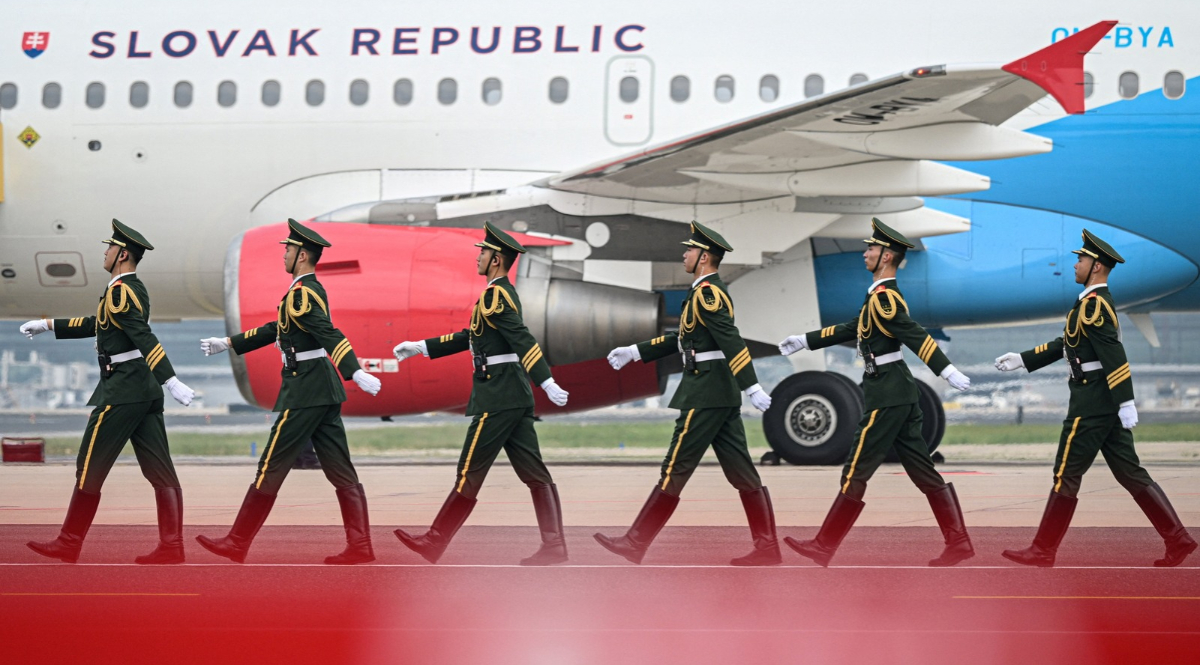
This approach has led to closer ties between Slovakia and China, as evidenced by a series of high-level visits. Pellegrini visited Beijing in July this year, the first Slovak president to do so in 16 years. Fico, meanwhile, has visited China twice in the last two years—in November 2024 and September 2025. He had also previously visited the country as Slovak Prime Minister in 2007—following a 13-year hiatus—and met with President Hu Jintao during the latter’s visit to Bratislava in 2009.
This strengthening of ties has led to greater institutionalisation of Slovak-Chinese cooperation. The highlight of the 2024 visit—involving the largest government and business delegation in Slovakia’s history—was the establishment of a strategic partnership and the signing of 13 agreements and memoranda concerning, amongst other things, the introduction of visa-free travel for Slovak citizens on short stays in China, investment cooperation in the digital economy, as well as a Bratislava–Beijing air link (yet to be launched). The partnership also established an intergovernmental Cooperation Committee, whose first meeting, attended by Prime Minister Fico and China’s Deputy Minister of Foreign Affairs Hui Chunying, took place in Bratislava in January this year.
China’s close cooperation with Russia does not prevent the Slovak authorities from strengthening relations with the PRC. This is because they have an ambivalent stance on the Russian invasion of Ukraine. Moreover, Slovakia is using these ties to deepen its political dialogue with Russia. In September 2025, during the celebrations in Beijing marking the 80th anniversary of the end of the Second World War and China’s victory over Japan—in which Fico was the only EU leader to participate—he held a bilateral meeting with President Vladimir Putin. In May 2024, meanwhile, the Slovak authorities endorsed the “agreement on a political solution to the Ukrainian conflict” announced by China and Brazil, which provided for a freeze on the Russian-Ukrainian conflict, without mentioning the withdrawal of Russian troops from Ukrainian territory or security guarantees. This move was in line with Fico’s rhetoric of striving for peace, which his government used to suspend military aid to Ukraine.
Economic dilemmas
The Slovak authorities hope to attract Chinese investment, particularly in the automotive and electromobility sectors. This is expected to be facilitated by good political relations and incentives, such as an increase in the quota for work visas for citizens of the PRC (to 1,000 per year) from July 2025. In the same year, Gotion, a Chinese manufacturer of lithium-ion batteries used in cars, began construction of a factory in Šurany. Meanwhile, Volvo Cars, owned by the Chinese automotive group Geely, has announced the opening of an electric car factory in Valaliky, near Košice, in 2027. The cumulative value of Chinese foreign direct investment (FDI) in Slovakia to date has been relatively small—in 2024, it accounted for 0.14 per cent of Slovakia’s total FDI stock.
The Slovak authorities are critical of the limited access to the Chinese market and the widening trade deficit with the PRC, which stood at around €6.7 billion last year. Trade relations, dominated by the automotive sector, are also developing in the field of critical raw materials, the supply of which the Slovak government sought—unsuccessfully—to guarantee by securing licences for them in September 2025. The bilateral negotiations were preceded by the PRC’s introduction of export restrictions on some of these raw materials, as well as—in response to this move—the adoption by the European Parliament of a resolution calling on EU Member States to develop a “unified position” on trade in such substances with China.
Despite security risks, Slovakia is seeking closer economic cooperation with China. In its most recent report (for 2023), the Slovak Information Service highlighted PRC intelligence activities linked to Chinese companies. Meanwhile, Slovakia’s 2021 security and defence strategies, which remain formally in force, define China as an economic and technological competitor, as well as a systemic rival to the EU. Meanwhile, the Slovak authorities have declared their intention to develop cooperation in the fields of new technologies, artificial intelligence and robotics. One example of this is the testing of autonomous taxis in Bratislava by the Slovak company DiusAI and the Chinese firm WeRide.
Cooperation in international forums
Slovakia is seeking to improve relations between the PRC and the EU. The Fico government considered the stance of EU institutions towards China to be too confrontational, particularly over trade relations. Fearing retaliatory measures that could harm the Slovak automotive sector, Slovakia opposed the EU’s imposition of countervailing duties on Chinese electric vehicles in October 2024 (despite opposition from Germany and others, the duties came into force). Since then, Slovakia’s importance to the PRC has increased due to the increasingly hardline stance adopted by some European countries towards China—particularly Germany—and by the EU itself, as confirmed at the European Council summit on 15–16 October this year.
Slovakia is strengthening its ties with China despite the deterioration in relations between the PRC and most Central European countries following Russia’s invasion of Ukraine. According to Slovakia, its support for the Belt and Road Initiative—despite the initiative’s current stagnation—is intended to set it apart from other Central European countries in a positive light. Having held the annual presidency of the Visegrád Group since July, it is using the V4+ format to engage in broader dialogue with Far Eastern partners, and the presidency’s programme highlights the intention to use this format in relations with China. During a meeting of the V4 and Japanese foreign ministers in Tomášov, near Bratislava, on 1 September this year, the Slovak Foreign Minister, Juraj Blanár, emphasised the need to engage with China for the sake of “mutual benefits arising from international relations”.
Conclusions and outlook
Strengthening relations with China has become one of the priority objectives of Slovak foreign policy over the last three years. A visit by President Xi Jinping, anticipated by the Slovak authorities in 2027, as well as the announced trip to China by the Slovak Minister of Education and representatives of scientific and research organisations, are expected to help maintain the positive momentum in bilateral relations. Slovakia also hopes that China will support its candidacy for a non-permanent seat on the UN Security Council for the period 2028–2029.
The Slovak authorities are striving to become China’s main partner amongst the Central European states. These intentions have been reinforced by Prime Minister Viktor Orbán’s loss of power in Hungary. While Orbán had been strengthening ties with China, the new authorities have reversed course, deciding to subject Chinese investments to reviews to ensure compliance with EU and national environmental protection requirements. Slovakia also sees an opportunity for further rapprochement with China in its Visegrád Group presidency—Fico would likely capitalise on a potential V4+ China summit in the run-up to the parliamentary elections scheduled for autumn 2027.
Although Slovakia has voiced concern over its trade deficit with China, it remains likely to oppose restrictive tariff measures in the EU’s economic negotiations with the PRC, particularly if backed by a coalition of other Member States adopting a similar stance. This approach is motivated both by a desire to maintain good relations with China and by fears of retaliatory measures. The Slovak authorities argue, however, that the key to redressing the trade imbalance lies in improving access to the Chinese market for domestic businesses.