
V4 a Stronger Europe - Slovakia's presidency of the Visegrad Group
Slovakia’s assumption of its seventh annual presidency of the V4 on 1 July this year coincides with the resumption of intergovernmental cooperation within the Visegrad Group. This has resulted in a more ambitious presidency programme than before, and Robert Fico’s government will seek to capitalise on this in the context of next year’s parliamentary elections, announcing the group’s return to activities within the EU, broad consultations under the V4+ format and multifaceted sectoral cooperation.
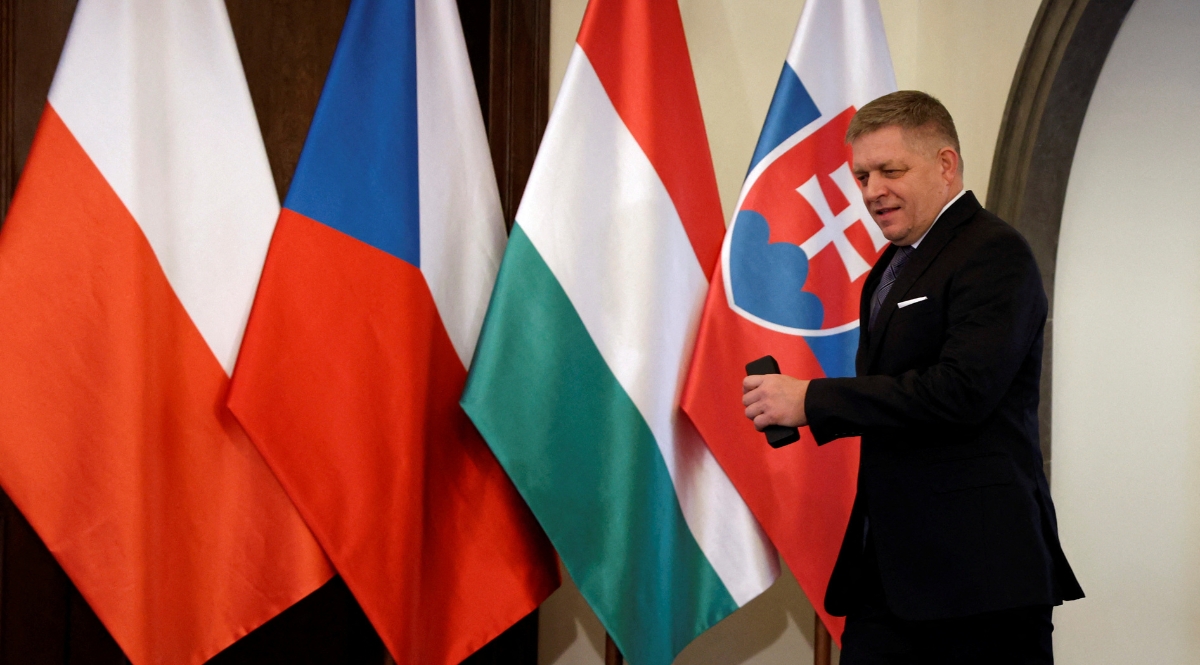 David W Cerny / Reuters / Forum
What is the state of Visegrad cooperation following the end of Hungary’s presidency?
Following more than four years of stagnant political cooperation, the revival of the V4 coincided with the end of the Hungarian presidency. The change of government in Hungary following the April parliamentary elections led to changes in Hungary’s eastern and security policies, including a shift away from pro-Russian actions and an immediate improvement in Polish-Hungarian relations. The resumption of intergovernmental cooperation was facilitated by signals from the prime ministers of Poland, Czechia and Slovakia at the European Political Community summit in Yerevan in early May this year, brief consultations on the sidelines of the European Council summit on 18 June, and a meeting of the prime ministers in Gödöllő, near Budapest, on 23 June. The resumption of sectoral Visegrad cooperation was demonstrated by the meetings of the V4 defence ministers in Budapest on 25 June, followed by the agriculture ministers’ meeting on 30 June in Balatonfüred, which was attended by representatives from Romania, Croatia, Bulgaria and Slovenia. Prior to these developments, the Hungarian Presidency had succeeded in maintaining the meetings of the Speakers of Parliament, which took place on 26 February this year in Budapest, and of the heads of state on 3 December last year in Esztergom (held annually without interruption). The next summit of the V4 heads of state is due to take place in Trenčín in November this year.
What priorities has the Slovak Presidency set out?
“V4 a Stronger Europe” – the Presidency’s motto – highlights Slovakia’s focus on EU issues. Its four priorities are: European competitiveness, EU enlargement, sectoral cooperation and people-to-people contacts. Following the four previous presidencies, including the Polish and the previous Slovak presidencies (with the latter taking place immediately after the start of Russia’s invasion of Ukraine), the restoration of Visegrad political cooperation now allows for a more ambitious thematic programme scope. Furthermore, Fico’s government, viewing the presidency as an opportunity to strengthen its international standing, appears keen to utilise the V4+ format. Within this framework, it has not only announced consultations with EU partners, including Germany and Ireland (which currently holds the EU Council presidency), but also with Japan, the US, Turkey, India and China. From Poland’s perspective, it is beneficial that the programme recognises the potential of Polish LNG terminals in diversifying gas supplies within the V4. With regard to the development of sectoral cooperation, Slovakia has highlighted needs in the areas of infrastructure (including a long-term high-speed rail project) and security (particularly police cooperation), whilst, in terms of strengthening people-to-people contacts, it emphasises the usefulness of the International Visegrad Fund, headquartered in Bratislava.
What EU-level steps is the Fico government announcing on behalf of the Visegrad Group?
The restoration of V4 consultations at the governmental level increases the chances of developing a unified approach within the EU. The Visegrad countries would like to retain their status as net beneficiaries of the EU budget, and thus the presidency attaches great importance to the multiannual financial framework for 2028–2034 currently being negotiated within the EU. It also emphasises the importance of EU funding for cohesion policy, the common agricultural policy, the development of transport infrastructure, and nuclear energy. However, it is sceptical of the EU Emissions Trading Scheme (ETS2), covering households and transport, and has announced plans to revise it. Furthermore, it makes reference to the traditional support that V4 members provide to countries aspiring to join the EU. Fico’s government considers Montenegro, Albania, and Serbia to be the best prepared for this (although only the first two have fully open EU accession negotiations, as in Serbia’s case they are effectively suspended). Meanwhile, in the context of the EU’s enlargement to include Ukraine, the presidency’s programme emphasises the need for Ukraine to bring its agricultural product standards into line with those of the EU and calls for support for Ukraine’s post-war reconstruction, highlighting the V4 countries’ vital transit role.
What challenges does the V4 face?
Bilateral disputes may continue to have a negative impact on the functioning of the V4. Although Polish-Hungarian relations have improved, the change of government in Hungary has led to a deterioration in that country’s relations with Slovakia, as the “Beneš Decrees” have once again become a source of bilateral tension. Based on these decrees, the Czechoslovak government during the Second World War stripped the Hungarian population of their citizenship and confiscated their property, which subsequently formed the basis for their expulsion. Legislation adopted by Slovakia at the end of last year, which penalises “undermining the post-war order,” and the criticism of these changes by the new Hungarian government have both caused friction. Although the Slovak authorities have declared their support for Ukraine, informed its government of the V4 presidency’s objectives and are jointly preparing the fourth round of bilateral intergovernmental consultations, at the same time they are presenting a conciliatory stance towards Russia (as exemplified by Prime Minister Fico’s visits to Moscow, including in May this year). Making peace efforts the ‘fifth priority of the presidency’ (as Prime Minister Fico noted) is an unrealistic proposal given the divergences in the V4’s eastern policy (among other things, Slovakia opposes Ukraine’s membership of NATO, whilst Hungary has announced a referendum on its EU membership). There is also the risk that the V4 brand will be used to advance Fico’s government agenda ahead of the elections to the Slovak National Council planned for autumn next year. For Poland, the restoration of cooperation within the V4 primarily offers the prospect of more effective coordination with regional partners on EU matters.


.png)