Conclusion of Negotiations on the EU-India Trade Agreement
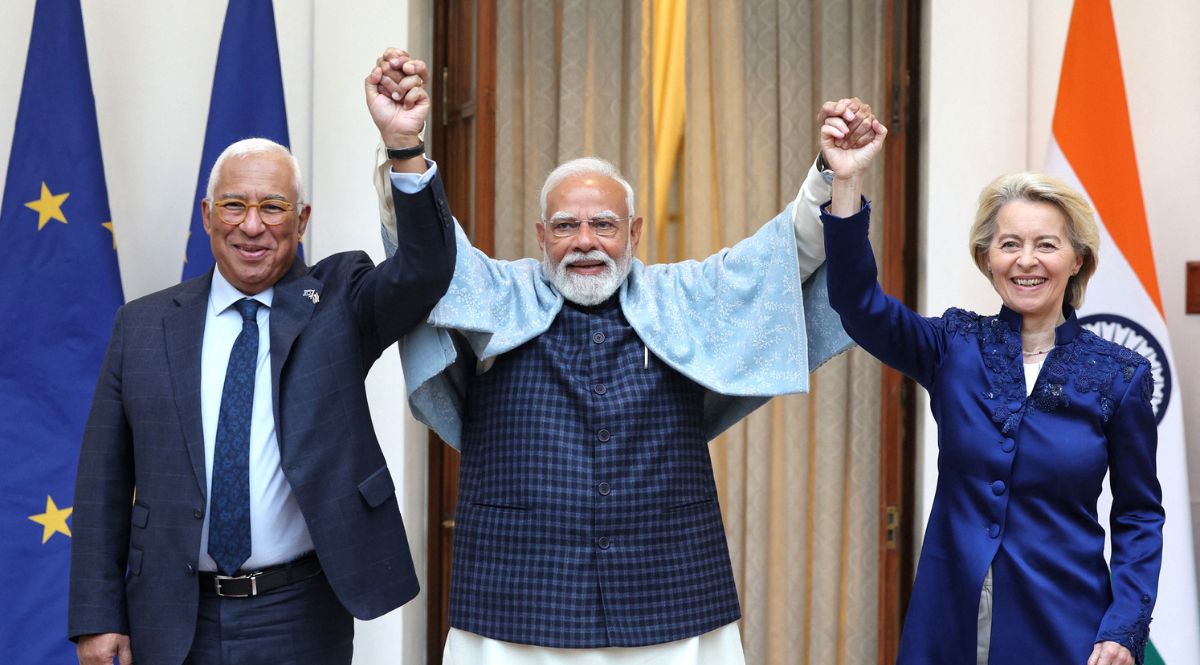
The most important outcome of the 16th EU–India summit, which took place on January 27 in New Delhi, was the announcement of an agreement on a trade deal. When it comes into force, it will create one of the largest free trade areas in the world and open up a huge Indian market for goods and services from the EU. At a time of growing protectionism in international trade and power-based politics, strengthening economic ties between the EU and India takes on a strategic dimension.
 AA/ABACA / Abaca Press / Forum
Negotiations on a free trade agreement (FTA) between the EU and India have been ongoing since 2007, though with a break between 2013 and 2022. In recent years, the talks have accelerated, partly due to growing competition from China and the unpredictable policies of Donald Trump's administration in the US. In 2019, the EU recognised China as, among other things, a systemic rival. Together with a growing economic dependence on China and the Union’s desire to diversify trade, this made India one of the EU's main partners for restructuring supply chains. This was also influenced by disruptions in international trade, including those related to the COVID-19 pandemic. Recent unilateral actions by the US, including the imposition of tariffs and threats to introduce further ones, have prompted India and the EU to seek other markets. The main area of disagreement between the EU and India, which has hampered negotiations, is their differing attitudes towards Russia and its aggression against Ukraine. Despite these differences, however, the EU has decided that it is in its interest to strengthen relations with India, which it hopes may translate into a weakening of its ties with Russia, among other benefits. The agreement will enter into force in full after its adoption by the European Parliament and the Council of the EU and by the Indian side, which at the earliest will happen at the end of 2026.
Opportunities
The agreement will bring together the world's second and fourth largest economies, creating a free trade area covering approximately 1.9 billion people and approximately 25% of global GDP. For both sides, this is the largest agreement they have ever concluded. It introduces trade liberalisation for goods accounting for 96.6% of the value of EU exports to India (including the elimination of tariffs on 93% of these over a period of up to 10 years) and 99.3% of the value of Indian exports (including the complete elimination of tariffs on 91% of these). For example, tariffs on cars manufactured in the EU, one of the main export products of EU countries, will be reduced over time from 110% to 10%, and India is to abolish tariffs on car parts within 5-10 years. Most Indian tariffs on machinery (currently 44%), chemical products (22%), and pharmaceuticals (11%) are also to be gradually eliminated. Duties on selected agricultural and food products will also be reduced or eliminated, e.g., spirits will be subject to a 40% duty (currently 150%), and the target rate for processed products (e.g., bread, pasta) will be 0%. The agreement also aims to provide EU companies with greater access to the Indian services sector, including financial services and maritime transport. In order for small and medium-sized enterprises to benefit as much as possible from the FTA, they will receive support, including the establishment of contact points in the EU and India for interested companies.
According to the EC, the tariff reductions will save EU businesses around €4 billion a year and are expected to double the value of bilateral trade in goods by 2032 (in 2024, its value was €120 billion). EU products will become more competitive in relation to Chinese and American goods, among others (in early February, the US also agreed the terms of a trade agreement with India). This will strengthen the position of EU products in the rapidly growing Indian market—according to IMF estimates, India's GDP growth in 2025 was up to 7.3%, and in 2026 it is expected to be 6.4%. The agreement will also facilitate bilateral trade in services (in 2024, this value was almost €60 billion), as well as investment cooperation (in 2023, the value of bilateral direct investment amounted to €150 billion, of which €140 billion was invested in India by EU entities) and technological cooperation. It will also strengthen the protection of labour and phytosanitary standards and promote competition in the EU in high-emission sectors by maintaining the “carbon tax” Carbon Border Adjustment Mechanism (CBAM). The agreement also covers issues of sustainable development and environmental protection, and creates a dispute resolution mechanism.
The agreement may particularly benefit those EU countries that have the largest share of exports to India, including Germany (31% share in fiscal year 2024–2025), France (12%), and Belgium (10%). The sectors that are likely to benefit most from the positive change in the EU are the agri-food, chemical, pharmaceutical, machinery, medical devices, aviation, and automotive industries. In India, labour-intensive sectors such as fisheries, textiles, footwear, chemicals, and pharmaceuticals will benefit.
Challenges
The entry into force of the FTA will mean increased competition on the EU market from Indian companies. However, unlike China, India does not currently have the potential to dominate the EU single market with its products – increased imports from India may only be visible in selected sectors, such as steel, ceramics, and machinery. Moreover, the abolition of customs duties on the main goods imported into the EU market (e.g., clothing and textiles) will primarily compete with other developing countries that have so far benefited from EU trade preferences, such as Bangladesh and Pakistan, as well as with Chinese products.
Although the impact of the agreement on individual industries can be better assessed after the publication of its full text, which is expected soon, the greatest public concern in the EU is its possible impact on the agri-food sector and the potential increase in migration from India. However, there are a number of exemptions (e.g., the liberalisation does not apply to, among others, poultry, beef, milk powder, rice, and sugar), quotas, and transition periods have been applied in the agricultural sector, and products entering the EU market will still have to meet high quality standards. Indian agriculture is also largely complementary to that of the EU and less competitive than that of the Mercosur countries, which should have a positive impact on the attitude of EU farmers towards the agreement. On migration, the agreement promises to facilitate mobility, including the provision of services (e.g., relocation of employees of Indian companies), but does not include any commitments to open up the EU market in this area. The Mobility Partnership, adopted separately at the summit in New Delhi, regulates controlled migration and gives member states the option to take advantage of this option on a voluntary basis.
The FTA excludes, among other things, the issue of public procurement, leaving it for later discussions. Two other agreements are still being negotiated—on geographical indications and investment protection—which will allow the FTA's potential to be fully exploited. The main challenge, however, will be the implementation of the agreement's provisions and possible disputes over their interpretation, e.g., in the areas of product certification, rules of origin, or the use of quotas.
Conclusions for Poland
Due to Poland’s weak economic ties with India, the direct effects of the agreement will only be felt to a limited extent. The value of bilateral trade in goods in 2024 amounted to only €5.3 billion (with a €2.7 billion deficit for Poland), and India accounted for only 0.4% of Polish exports and 1.1% of imports. Although Poland is the fifth largest economy in the EU, in the 2024-2025 fiscal year, it accounted for only 2% of the EU's exports to India (and 2.8% of total EU-India trade) and was India's 44th largest trading partner.
In the initial period of the agreement, the benefits for Poland will be mainly indirect, through increased exports to India from other EU countries with which Polish industry is linked, such as Germany. In the long term, the agreement offers opportunities to better realise the potential of Polish-Indian cooperation. However, this will require intensifying political dialogue at the highest level and supporting Polish businesses entering and increasing their presence on the Indian market. More frequent political visits should be accompanied by business missions, including representatives of the largest Polish companies.
From the Polish perspective, it is worth developing a detailed analysis of the agreement's impact on the domestic economy, as well as conducting an information campaign encouraging Polish companies to take an interest in partners in Asia. It is worthwhile for public institutions to develop financial instruments that protect exporters and investors and increase their competitiveness in the Indian market. Consideration could be given to resuming the GoIndia export support program, which operated briefly in 2015, as well as increasing the capacity of the PAIH foreign trade office in Mumbai, including personnel support. It will also be useful to support Polish companies in existing and new formats of EU-India dialogue announced at the summit in New Delhi, such as the Business Forum, the Start-up Partnership, and the Defence Industry Forum. Taking advantage of the opportunities offered by the EU-India trade agreement should be a key element of diversifying Polish exports and increasing the presence of Polish companies in dynamically developing non-European markets.
Reductions in Indian customs duties on selected categories of products exported from the EU,
as provided for in the trade agreement
|
Category of goods |
Exports in 2024 (euro) |
Current customs duties |
Future customs duties |
||
|
Machinery and electrical equipment |
16,3 bln |
up to 44% |
0% (most products) |
||
|
Aircraft and spacecraft |
6,4 bln |
up to 11% |
0% (most products) |
||
|
Optical and medical equipment |
3,4 bln |
up to 27,5% |
0% (90% of products) |
||
|
Plastics |
2,2 bln |
up to 16,5% |
0% (most products) |
||
|
Pearls, precious stones, and metals |
2,1 bln |
up to 22,5% |
0% (20% of products); reduced tariffs (36% of products) |
||
|
Chemical products |
3,2 bln |
up to 22% |
0% (most products) |
||
|
Motor vehicles |
1,6 bln |
110% |
10% (250k units per year) |
||
|
Iron and steel |
1,5 bln |
up to 22% |
0% (most products) |
||
|
Pharmaceuticals |
1,1 bln |
11% |
0% (most products) |
||
|
Agricultural and food products |
Current customs duties |
Future customs duties |
|||
|
Wine |
150% |
20% (premium class), 30% (medium class) |
|||
|
Spirits |
Up to 150% |
40% |
|||
|
Beer |
110% |
50% |
|||
|
Olive oil, margarine, and vegetable oils |
Up to 45% |
0% |
|||
|
Apple juice and non-alcoholic beer |
Up to 55% |
0% |
|||
|
Processed food (bread, pasta, sweets, cookies, chocolate) |
Up to 50% |
0% |
|||
|
Sausages and meat products |
Up to 110% |
50% |
|||



.png)