Reluctant but compelled: the inevitable divorce of India and Russia
Russian President Vladimir Putin's visit to India on December 4-5 of this year strengthened the Russian-Indian partnership, but it will not reverse India's long-term trend of drifting away from Russia. This will be unaffected by attractive arms and energy offers from Russia or Donald Trump’s aggressive policy towards India. The visit boosted Russia's prestige but did not bring tangible benefits. How rapidly Indo-Russian relations weaken will depend on the development of the Russian-Chinese alliance and India's closer cooperation with the EU.
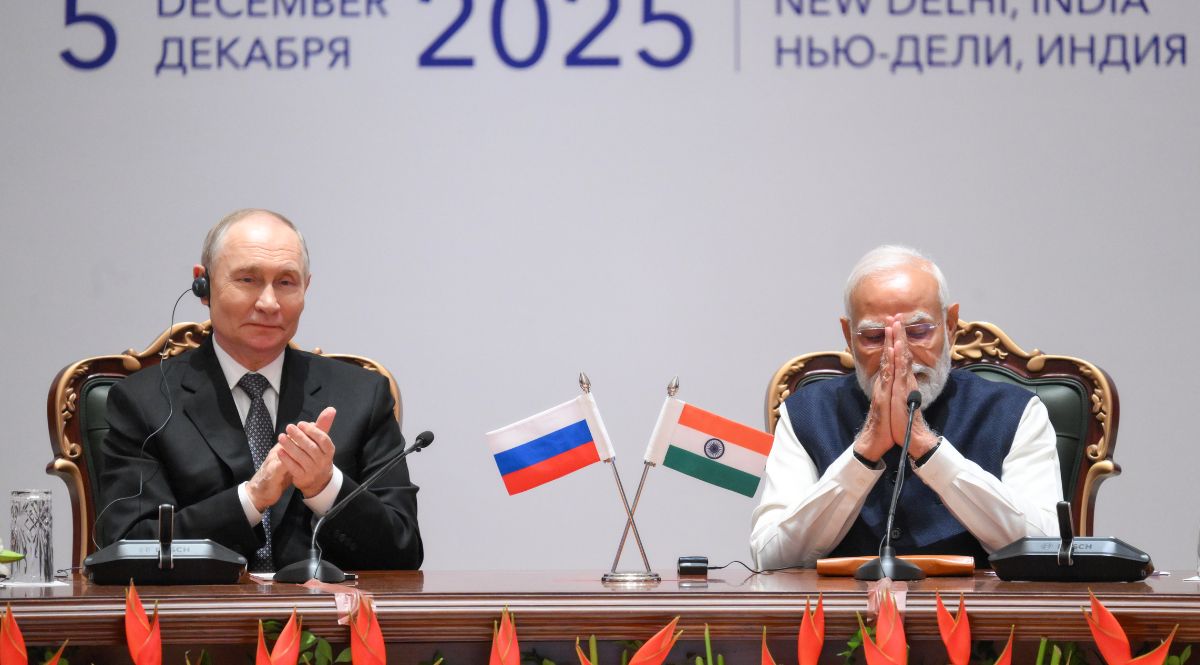 Grigory Sysoyev / Zuma Press / Forum
Vladimir Putin's warm reception in New Delhi went far beyond diplomatic protocol. India and Russia signed 15 documents strengthening cooperation in the areas of labour mobility, education, media (e.g., the launch of the Russian television station RT in India), infrastructure, and trade. The Russian delegation, including representatives of major companies, the central bank, and several ministries, also discussed financial settlements and arms contracts, but no agreements were announced. Although both sides consider the summit a success, its economic outcomes fell far short of the Russian side’s expectations, which viewed the visit with greater significance due to EU and US sanctions.
International context
Annual Russia-India summits have been held since 2000, but were discontinued following the aggression against Ukraine in February 2022. India adopted a neutral stance on the war and maintained close ties with Russia, significantly increasing its imports of Russian oil (the Russian share of India's crude oil imports increased from less than 1% in 2021 to 36% in 2024), while simultaneously avoiding antagonising its Western partners – hence the decision to suspend the annual summits. Putin and Indian Prime Minister Narendra Modi, however, still met at multilateral forums. The suspension of regular bilateral meetings and Russia’s strong rapprochement with China have weakened Indo-Russian cooperation.
The war in Ukraine has also negatively impacted a key dimension of relations – defence cooperation. Due to its own needs, Russia is struggling to fulfil its arms contracts and has not delivered two of the five S-400 missile defence systems ordered by India in 2018. Losses on the frontline are undermining confidence in Russian equipment in India, traditionally its largest recipient. As a result, India has not signed any new arms contracts with Russia since 2022, and the Russian share of India’s arms imports has fallen from 72% in 2010-14 to 36% in 2020-24.
The visit came at a time when India is under pressure from the US to reduce its imports of Russian oil and arms and to limit contact with Russia under BRICS. The 50% tariff imposed on India by the Donald Trump administration, followed by sanctions on Rosneft and Lukoil, has not yet halted oil imports from Russia, but has hampered them. The future of crude oil imports was therefore one of the key topics of the visit.
India’s interests
For India, its cooperation with Russia is aimed at halting the country's growing dependence on China, its rival. At the same time, growing tensions with the US have reinforced its need to uphold its “strategic autonomy.”
Furthermore, Russia plays a significant role in security. Over 70% of the weapons used by the Indian armed forces are still of Russian origin, and maintaining them requires cooperation with Russia. India wants to accelerate the delivery of the overdue S-400s, purchase missiles for its current batteries, and order five additional systems which proved effective during the conflict with Pakistan in May of this year. They are also interested in cooperation in the modernisation of SU-30MKI fighters and BrahMos supersonic missiles, as well as in leasing a nuclear-powered submarine.
Economically, India’s primary aim is to reduce the massive trade deficit with Russia ($58 billion in 2024) caused by the surge in oil imports (the deficit was $3 billion in 2021). The payment system used for oil purchases, impacted by Russia's exclusion from the SWIFT system, also requires resolution. India wants to deepen cooperation in the development of India's space and nuclear energy sectors.
Russian interests
Putin’s visit was intended to demonstrate the ineffectiveness of Russia’s international isolation, while strengthening relations with India would serve to bolster Russia’s position vis-à-vis the United States. By pointing to India's willingness to increase trade and investment in the Arctic and Siberia, Russia will seek to persuade the United States to do the same during negotiations over the war in Ukraine. Relations with India will also be an element of Russia’s more assertive policy towards China, through partial replacement of Chinese goods with Indian imports (e.g., smartphones, medicines, automotive and railway components, and industrial machinery) and an attempt to attract Indian investment to the Russian Far East and North.
Economically, India is a major market for oil exports (second only to China) and arms (the world's largest). Although after the invasion of Ukraine, approximately 70% of Russia's trade was redirected to Asian countries, India accounts for only about 10%, despite a surge in oil exports. Since Putin doesn’t want to lose the Indian market, which accounts for 38% of Russian oil exports, he gave assurances during his visit of “readiness for uninterrupted supplies.” According to media reports, Russia is offering discounts of up to $7 per barrel. Increasing the small share of Russian supplies in the Indian gas market (approximately 6%) is also crucial. To this end, it is trying to convince India to invest in the Arctic Northern Sea Route, rare earth metal mining, and the sanctioned Yamal LNG, Arctic LNG 1 and 2, and Sakhalin-2 projects. In addition to maintaining the Kudankulam nuclear power plant, India’s only nuclear power plant, built by Russia, the Russian side is offering to develop a joint program for the construction of additional large- and small-capacity power plants.
It is important for Russia to maintain its status as the largest arms supplier to India. To this end, it is offering not only continued sales of S-400 missile systems but also contracts for the more modern S-500 and fifth-generation SU-57 fighter jets. The Russian offer is cheaper than Western proposals and includes technology transfer and production relocation, consistent with India’s plans to develop its own defence industry.
Conclusions and prospects
The Russia-India summit in New Delhi was a temporary political and image success for both sides. Putin gained the PR benefits of demonstrating the ineffectiveness of isolating Russia, while Modi strengthened India’s position vis-à-vis the United States. The visit could also strengthen the cohesion of the Shanghai Cooperation Organisation and the BRICS group (India will hold the chairmanship in 2026), including its resilience to US sanctions. Despite this, the summit failed to deliver breakthrough decisions in key areas – security, energy, and the economy. These issues were merely the subject of discussions and non-binding declarations. The leaders focused solely on deepening academic cooperation, increasing labour mobility, and improving person-to-person relations. If these plans are not translated into practical decisions on strengthening economic, energy, and security cooperation are not made soon, Indo-Russian relations will weaken in the long term.
In the short term, however, Russia will maintain its intense political, bureaucratic, and business relations with India. Yet it will not achieve its most important goal, which is to bring India into the “anti-Western club” of states like China, Iran, and Venezuela. It will have increasingly fewer advantages – its affordable and sometimes unreliable weapons will no longer be the core of the Indian military’s armament, and cheap oil will not attract investment from Indian businesses. Therefore, Russia will attempt to antagonise India against the West, for example, by drawing on India’s colonial resentment toward Western countries and maintaining its offer to sell crude oil at discounted prices.
Modi's caution in the areas of defence and oil trade demonstrates that he does not want to risk damaging relations with the West while negotiations on trade agreements with the US and EU are in their final stages. India’s trade with Russia, excluding oil, hovers around $8-10 billion annually, incomparably smaller than with the EU (over $136 billion in the 2024-25 fiscal year) or the US ($132 billion), making them much more important economic partners. Europe and the US are home to the resources India needs to accelerate its own development – capital, technology, and receptive markets. Therefore, in today’s world, Russia needs India more than India needs Russia.
From India's perspective, the best solution is a swift end to the war in Ukraine (regardless of the conditions) and the normalisation of relations between Russia and the West. This would improve relations with the US and reduce Russia’s dependence on China. The low probability of such a scenario means India will continue to strike a balance between Russia and the West. To facilitate rapprochement with the West, the EU should engage India in key areas (defence, energy, technology, information), replacing Russian influence. The costs of India circumventing Western sanctions should be clearly communicated, and the risk of critical technologies leaking to Russia should be prevented.