Alexandru Munteanu - technocratic prime minister of Moldova's pro-European government
The government of Alexandru Munteanu, appointed on 31 October by the Party of Action and Solidarity (PAS), which, after the September elections, rules independently with a majority of 55 MPs in the 101-seat Parliament, guarantees the continuation of efforts towards Moldova's European integration. The challenges remain the need to revive the economy and carry out internal structural reforms.
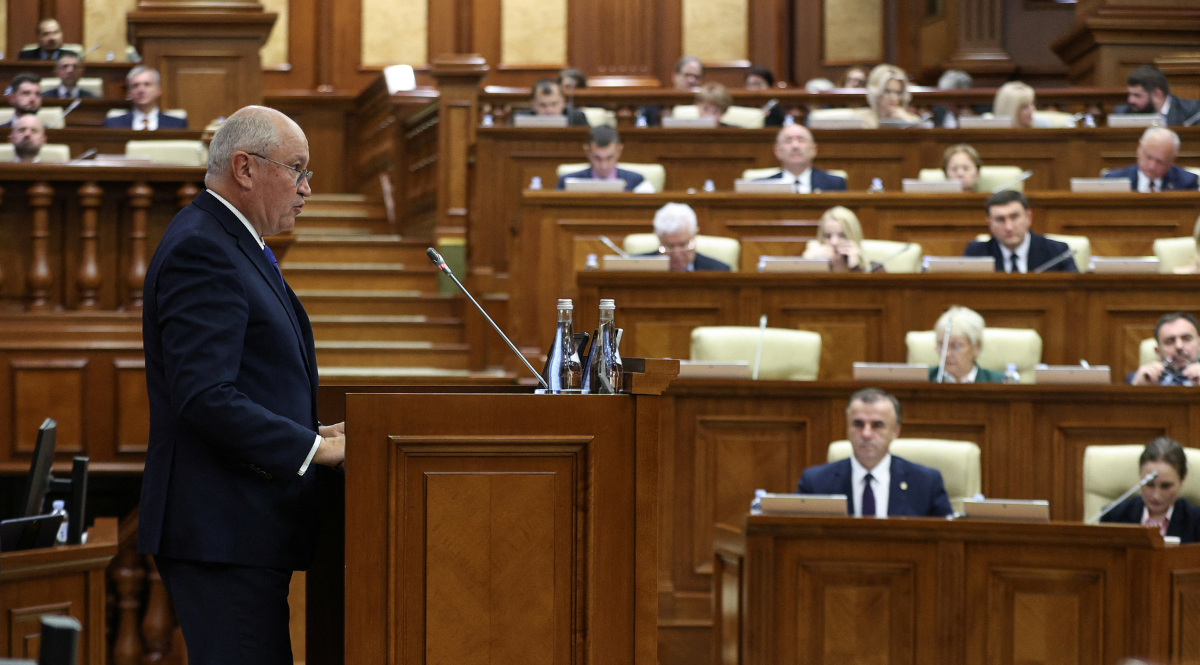 Vladislav Culiomza / Reuters / Forum
Why did President Maia Sandu appoint Munteanu?
The change of prime minister in the new parliamentary term is to be seen by the public as a new political opening by PAS and President Sandu, who is effectively leading it. Through this, they aim to distance themselves from some of the failures of the previous term and mark a transition from the stage of defending the state against Russian interference–the focus of the outgoing Dorin Recean cabinet–to the stage of its development. Munteanu's international business and management experience spoke in his favour. He gained it while working at the World Bank in Washington, D.C., and then managing American companies investing in Ukraine and Moldova, where he also co-founded the American Chamber of Commerce and a branch of the Alliance Française. Munteanu considers himself a technocrat. He has no political experience or background, nor does he have any independent political ambitions – he lived in Ukraine for over 20 years, moving to Romania in 2022 in the face of war and returned to his homeland in 2025. This allows Sandu and PAS to shift responsibility for key reforms onto him and minimise the risk of damaging the party's image with their costs, as well as making it difficult for the opposition to accuse PAS of politicising state institutions.
What are the government's European policy goals?
The strategic goal of the Munteanu cabinet remains Moldova's accession to the EU. The new prime minister reiterated PAS's announcement that the country will be ready by 2028–otherwise, he will declare his resignation–with accession ultimately taking place by 2030. Key politicians for the accession process have retained their positions in his government: Mihai Popşoi, Deputy Prime Minister and Minister of Foreign Affairs, and Cristina Gherasimov, Deputy Prime Minister for European Integration and Chief Negotiator with the EU. To strengthen the effectiveness of their efforts, Sandu has established the position of Presidential Special Envoy for European and Strategic Partnerships, to which she has appointed Nicu Popescu, a former expert and Minister of Foreign Affairs, who has good contacts with EU institutions and Member States. The Moldovan authorities declared their immediate readiness to open all negotiation clusters. However, early achievement of this goal is doubtful, due to the EU's informal linking of Moldova's and Ukraine's progress. Meanwhile, Hungary has vetoed Ukraine's European integration, and there is no consensus within the EU on separating the two countries.
What are the most important challenges in the Munteanu government's domestic policy?
The key task for the Munteanu government is to boost Moldova's economic and infrastructural development. Its economy is in crisis – in 2022, GDP fell by 5%, in 2023 it grew by only 0.8%, and in 2024 by 0.1%, and in 2025, projected growth is expected to reach 1.5%. Although the main causes of the crisis were Russia's energy blackmail in 2021 and its full-scale invasion of Ukraine, part of the population associates the issue with the rule of PAS, which took power in August 2021. Munteanu has promised to overcome the crisis through the effective use of the €1.9 billion from the Reform and Growth Facility for Moldova announced by the EU in February (for comparison, the entire state budget in 2025 is €4.4 billion). The plans would generate investments worth €4 billion, including in transport, energy and social infrastructure, such as schools and hospitals, and support 25,000 businesses.
What key reforms is Munteanu's cabinet announcing?
Munteanu has announced that he will complete the reform of the justice system. This is intended to enable the effective prosecution of corruption, break up the oligarchic networks of Vlad Plahotniuc's rule, which lasted until 2019, and strengthen resistance to Russian attempts to destabilise Moldova. A key element is to finalise the protracted verification of the honesty of judges and prosecutors – the prime minister wants to complete this by 2026. Munteanu's cabinet is also to carry out the long-delayed administrative reform of the country, which is currently divided, according to the post-Soviet model, into 32 raions and about 850 small communes (excluding Transnistria), most of which are wholly lacking in terms of staffing and finances. The current programme of voluntary mergers has been ineffective, with only 34 localities deciding to join it. The planned reform is intended to enable more effective governance of the country and implementation of investments, as well as to improve access to public services for the population. For Poland, one of the main advocates of Moldova's EU membership, this would be an opportunity to offer its experience in the development and functioning of local governments.