The Tenth Year of the Three Seas Initiative
Established in 2016, the Three Seas Initiative (TSI) remains a permanent platform for discussions in the eastern part of the EU, focused mainly on the need to develop infrastructure in this area, particularly on the north-south axis. However, member states have so far treated the priority projects submitted to the TSI as in fact separate country sections, and if they implement them, they do so without the involvement of the Initiative. In order to establish effective cooperation and coordination of activities within the TSI for the joint implementation of infrastructure objectives, binding decisions by the governments of the countries participating in the Initiative would be necessary.
 Kacper Pempel / Reuters / Forum
Activities and evolution of the TSI
The TSI is a regional platform established on the initiative of the presidents of Croatia and Poland by 12 EU Member States: Austria, Bulgaria, Croatia, the Czech Republic, Estonia, Lithuania, Latvia, Poland, Romania, Slovakia, Slovenia and Hungary (Greece joined in 2023). According to the declaration adopted at the founding meeting in Dubrovnik, the Initiative is intended to deepen European integration and harmonise it across the EU, mainly through the development of transport infrastructure and the digital economy, as well as through strengthening energy security in Central Europe.
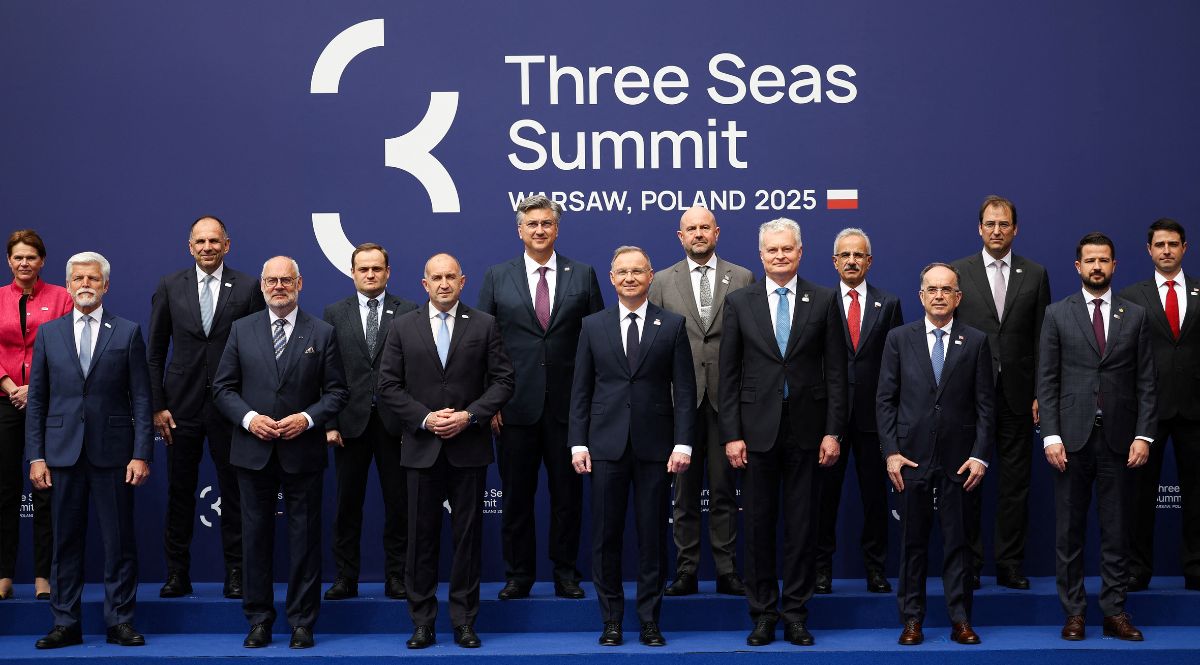
The direction of TSI discussions is set by annual presidential summits (in practice, participation is often at a lower level) and accompanying forums (business, city, local governments and parliamentary), as well as by granting some countries a partnership with the Initiative, and by one enlargement. After the founding meeting, in 2017 the second took place in Warsaw, with President Donald Trump in attendance, and the U.S. became an observer of the TSI. In 2018, in Bucharest, the European Commission and Germany were granted such status. At that time, the TSI also decided to establish the Three Seas Fund, which was inaugurated in 2019 in Ljubljana. The summit in Riga, in 2022, in turn, brought about a discussion on security and commitment to Ukraine—which was defending itself against Russian aggression and to which the TSI granted participating partner status, enabling this country to participate in TSI projects. In 2023, in Bucharest, the same status was granted to Moldova, and Greece was admitted as a member. In 2024, in Vilnius, Japan joined the strategic partners (formerly observers), and in 2025, in Warsaw, Spain and Turkey joined with the same status, while Albania and Montenegro became participating partners. At the summit in 2017, the leaders announced 129 priority projects, while in 2025, there were 143.
Interest in and involvement in the Initiative
Most of the TSI countries are passive towards the initiative. Individual countries have promoted it mostly in connection with the increased interest when organising a summit. Even though they remained supportive after the summit ended, this usually did not translate into actions beyond participation in annual meetings.
Some countries have a more pronounced attitude towards the TSI. On the one hand, Romania (and, earlier, Estonia) has been consistently involved in promoting it. Among the partner countries, the U.S. has promoted the Initiative, especially during Donald Trump’s presidency. In his first term, the country pledged $1 billion to the Three Seas Fund, but it was only after losing the 2020 election that his outgoing administration approved the still-unimplemented decision to transfer $300 million. On the other hand, Austria, the Czech Republic, Slovakia and Hungary have shown minimal interest in the TSI. They have not organised a summit (some participants have already organised two) and, with the exception of Hungary, have not joined the Three Seas Fund, which has a minimum contribution of €20 million. In Croatia, a co-initiator of the TSI, the incumbent president (in post since 2020) has been critical of it, though the government continues to support it.
Key challenges and limitations
The main factor limiting the effectiveness and operability of the TSI is the fact that it does not apply to cooperation and coordination of the implementation of projects. This is because these are—occasionally with the exception of short transborder parts—essentially composed of independent national sections which are fully dependent on state and EU funds. The establishment of such cooperation, in turn, is limited by the fact that the development of infrastructure, particularly road infrastructure, rarely requires international political involvement at the highest level, especially from countries other than those that share a border. As a result, when the TSI countries do implement infrastructure on their sections of projects submitted to the Initiative as priorities (e.g. the Via Carpatia road, or the railways: the Rail Baltica, Rail2Sea from Gdańsk to Constanța), they do so without factual connection to the Initiative, rather than thanks to cooperation within this forum. At the same time, almost a decade of the TSI’s existence shows that these projects are often not a real priority in the national plans of member states.
The Three Seas Fund, established by the state-owned banks BGK from Poland and EximBank from Romania (and registered in Luxembourg) to support and finance infrastructure projects, has not been used for this purpose. This is due, among other things, to the limited interest shown in it by the participants, or even a lack of support from some—it has raised only slightly more than €900 million of the planned up to €5 billion, of which €750 million was contributed by Poland. However, the Fund has allegedly invested most of the funds raised (at least €780 million) in shares in companies in sectors such as locomotive rental and photovoltaics (Poland), data centre expansion (Estonia), harbour operation (Bulgaria) and solar power plant management (several countries).
The expansion of the topics of discussion in the Initiative also encountered limitations. The attempt to widen the scope of debates on security issues highlighted the divergence between TSI countries in their eastern policy to such an extent that Hungary issued a separate statement on part of the conclusions after the 2025 summit. In doing so, they distanced themselves from condemning Russia's war in Ukraine, supporting its sovereignty and territorial integrity, endorsing acceleration of its and Moldova's accession to the EU, and increasing pressure on Russia. Hungary justified its action based on the U.S.-negotiated ceasefire in the Russian-Ukrainian war.
Conclusions and prospects
The evolution of the TSI, including the admission of a new member state and various partnerships with several others, as well as the attempt to broaden the topics of discussion after Russia's invasion of Ukraine, does not fundamentally change how it operates. This is because it does not affect the way in which the Initiative's key objective is pursued or the dynamics of the discussions on this forum. Hungary's pro-Russian and anti-Ukrainian policy, although it obstructs the Initiative at the level of declarations, has not disrupted its functioning and will not lead to the abandonment of its summits. Unlike, for example, the Visegrad Group, the TSI has limited capacity for action, which means that Hungary's stance does not constitute a political burden for the other partners.
The risk for the TSI is that its significance will undergo gradual marginalisation, following the example of the Central European Initiative. For almost a decade, the challenge has been both the inability of the TSI to go beyond the formula of annual forums for discussions and the lack of binding decisions, including financial ones, that would lead to the actual joint and coordinated implementation of the proposed projects.
In its tenth year of operation, the TSI retains a presidential formula and relies on the personal commitment of leaders. Meanwhile, the 2025 summit was the last one attended by the co-author of the Three Seas Initiative, Polish President Andrzej Duda. Romanian President Klaus Iohannis, who strongly supported the Initiative, also ended his term in 2025, and his successor, Nicuşor Dan, does not refer to it. Thus, the task of maintaining the interest of the TSI partners will rest mainly on the new Polish president Karol Nawrocki, who supports it, and in the near future, the visibility of the Initiative may largely depend on his commitment.
The establishment of a governmental pillar could be an opportunity to transform the TSI into a functional platform for the joint implementation of the flagship priority of developing connections between its member states. Such a pillar exists, for example, in the Bucharest Nine, where the relevant ministers meet and coordinate cooperation independently of the presidential format. In the case of the TSI, this could involve, among others, ministers responsible for infrastructure connections. However, even in such a case, it would be necessary for these governments to engage by giving actual priority—including in terms of financing—to projects submitted to TSI.


.jpg)