The development of Lithuanian-German security cooperation
Germany and Lithuania have been strengthening their ties following the war in Ukraine. Security and defence have become a key area of cooperation, and the deployment of a Bundeswehr brigade in Rudniki by the end of 2027 is a key strategic project for both countries. For Lithuanian authorities, this is the most important element of NATO’s engagement on its territory, while for Germany, it is evidence of its growing role in European security. The growing importance of bilateral relations is also reflected in the project to interconnect their energy systems via the Baltic Sea.
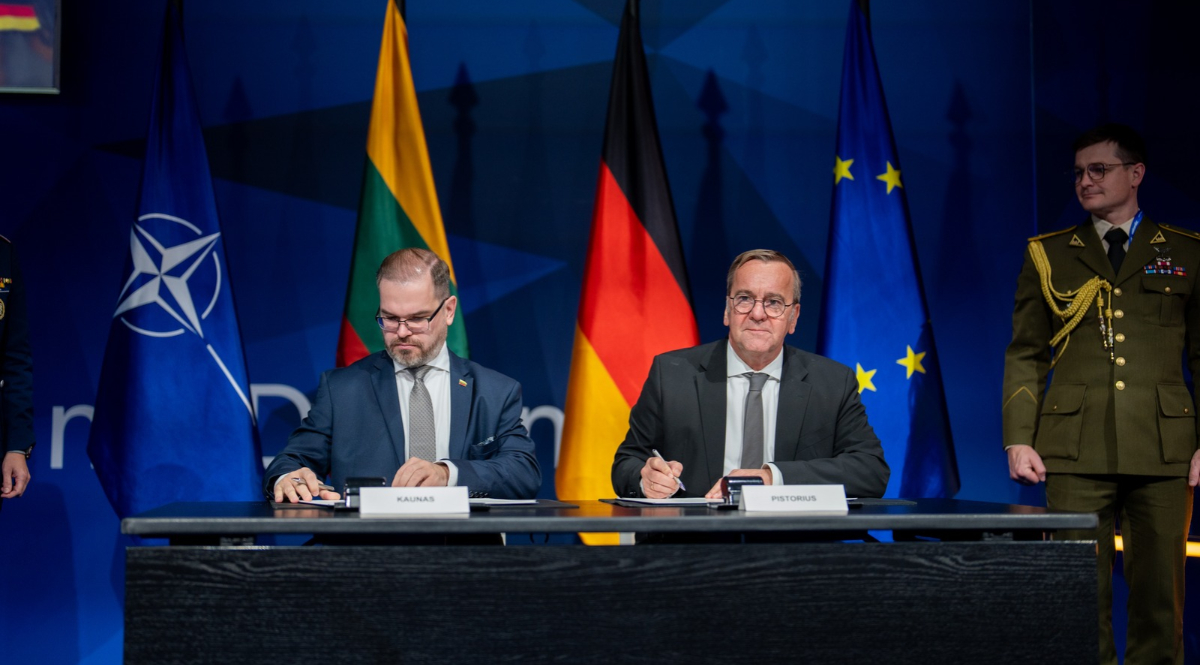 Lietuvos Respublikos Krašto apsaugos ministerija (Ministerstwo Obrony Litwy) / št. srž. A. Čemerkos / KAM nuotr. / Flickr
The primacy of security
The most important aspect of relations between the two countries is the strengthening of Germany’s military presence in Lithuania, as detailed in the 2023 roadmap for the deployment of a German brigade in Lithuania. As a result, the number of Bundeswehr troops has increased significantly, from approximately 1,000 soldiers on a rotational deployment to nearly 5,000 as part of the permanently stationed 45th Armoured Brigade. Since February of this year, the NATO Multinational Battalion Group stationed in Lithuania—previously under the command of the Lithuanian “Iron Wolf” Brigade—has also come under its command. The 45th Armoured Brigade will be equipped with the most advanced equipment, including Leopard 2A8 tanks and the “Uranos” artificial intelligence-assisted command-and-control system. It is also tasked with electronic monitoring of military activity in Kaliningrad Oblast and Belarus.
Germany is also strengthening Lithuania’s security by participating in NATO missions. As part of “Eastern Sentry” and “Baltic Sentry,” it counters Russian violations of the Alliance’s borders and protects critical maritime infrastructure. In addition, for years the Luftwaffe has deployed aircraft to secure the airspace of the Baltic states as part of NATO’s Baltic Air Policing (renamed Baltic Air Defence as of July of this year), operating from bases in Šiauliai, Lithuania; Lielvārde, Latvia; and Ämari, Estonia.
Lithuania aims to enhance military interoperability with Germany. This will be achieved through the development of joint operational plans and regular exercises with the Bundeswehr. These exercises are to take place both as part of NATO exercises and on a bilateral basis, including scenarios involving the deployment of troops to Lithuania, such as overland via Poland.
The political dimension of cooperation
For Germany, the deployment of a Bundeswehr brigade also demonstrates its credibility as an ally and its readiness to assume greater responsibility for Europe’s security. This is part of the Bundeswehr’s modernisation and development programme, the goals of which include strengthening Germany’s role in NATO.
The efficient deployment of the 45th Brigade is intended to confirm the effectiveness and sustainability of the changes in German security and defence policy. To achieve this goal, in September the Federal Ministry of Defence abandoned its original plan to make service in Lithuania entirely voluntary. Due to a failure to obtain sufficient volunteers—including IT specialists—the vacancies will be filled by assigning several hundred soldiers to serve in the 45th Brigade.
The permanent presence of the Bundeswehr in Lithuania is a subject of political controversy in Germany. It is supported by the ruling coalition parties—the Christian Democratic Union (CDU), the Christian Social Union (CSU), and the Social Democratic Party of Germany (SPD)—as well as the opposition Greens. However, the far-right Alternative for Germany (AfD) advocates for a rotational presence of small forces in Lithuania, with the option of deploying reinforcements from German territory. This is in line with the party’s platform, which calls for a strategic rapprochement with Russia and limits the role of the armed forces to the defence of Germany, making their involvement in NATO missions contingent on alignment with German national interests. The most critical stance is taken by the far-left Die Linke, which entirely rejects the Bundeswehr’s participation in any foreign missions.
Increasing Germany’s involvement in Lithuania—above all in the military sphere—has been one of the main goals of Lithuanian foreign policy for years. Lithuanian political parties unanimously regard Germany as their most important European partner. For several years, Lithuania has applied for the permanent deployment of German troops on its territory, offering numerous incentives, such as the construction of new schools and hospitals for soldiers and their families.
Additional areas of security-related cooperation
Expanded military relations are accompanied by an increase in German economic engagement in Lithuania. This is most evident in investments made by defence companies. These began with a facility in Janów, launched in 2023, which repairs heavy equipment for the Lithuanian and Ukrainian armed forces. In addition, since November 2025, Rheinmetall has been building an artillery ammunition factory in Bejsagola and an armoured vehicle assembly and repair facility in Kaunas, which are scheduled to be operational by November 2027. The Kaunas and Janów facilities are operated by Lithuanian Defence Service, a company established by Rheinmetall and the European holding company KNDS.
In addition to economic benefits, the creation of this defence infrastructure has a strategic dimension. The new plants will facilitate the maintenance of tanks for the 45th Brigade and for the Lithuanian Army, which has ordered 44 Leopard 2A8 tanks for the “Iron Wolf” Brigade’s armoured battalion. German companies expect that by manufacturing equipment in Lithuania, they will be able to more easily secure contracts from other countries in the region. The tanks ordered by Lithuania are to be assembled at the Kaunas plant.
Given the presence of the Bundeswehr, Lithuania is also investing in additional infrastructure. Construction is underway on a new military base in Rudniki—intended to become the main stationing site for the 45th Brigade—financed entirely with Lithuanian funds, including, among other sources, support from the SAFE program. Germany and Lithuania are jointly financing the expansion of the base in Rukla, where a new barracks complex has been built, and a second one is scheduled for completion by 2030. In addition, two schools for a total of 1,200 German children are being built in Vilnius and Kaunas.
The expansion of energy infrastructure is set to play an important role in bilateral relations. As part of the Baltic-German PowerLink project, Germany, Lithuania, and Latvia plan to build wind farms in the Lithuanian and Latvian exclusive economic zones in the Baltic Sea. The project will also include the construction of an undersea interconnection between the three countries’ power grids. For Germany, this project is intended to be part of the country’s energy transition, which aims to rely on renewable energy sources, while for Lithuania and Latvia, it is expected to enhance their energy security by enabling electricity supplies from Germany. Currently, the national transmission system operators—Germany’s 50 Hertz, Lithuania’s Litgrid, and Latvia’s AST—are conducting feasibility studies aimed at having the project designated as a Project of Common Interest (PCI) by the EU. These countries anticipate its implementation between 2037 and 2040.
Conclusions and perspectives
The strengthening of defence cooperation between Germany and Lithuania, although initially a response to Russia’s full-scale invasion of Ukraine, has now become a permanent element of both countries’ foreign and security policies. The scale of the military presence in Lithuania indicates that Germany is prepared to assume greater responsibility for security in the region on a long-term basis. Germany’s long-term commitment is also supported by the Lithuanian infrastructure provided for the soldiers of the 45th Brigade and their families, which recalls the model of the US military presence in some European countries, including Germany. Cooperation with Lithuania also aims to strengthen the broader regional economic presence of German companies, particularly defence contractors.
For Lithuania, the permanent stationing of the 45th Brigade is—in addition to enhancing security—also a demonstration of the effectiveness of its foreign policy. The completion of this tactical unit’s deployment, along with reaching the 5% of GDP threshold for defence spending, is being used to present Lithuania as one of NATO’s most reliable members. In the long term, military cooperation is expected to contribute to deepening economic ties with Germany.
One factor that could jeopardise security cooperation between Lithuania and Germany would be pro-Russian parties taking power at the federal or national levels in either country. However, although these forces have been successful in Germany at the local level—for example, the AfD in Saxony-Anhalt—they remain isolated in the parliaments of both countries, making this scenario currently unlikely.
The development of military cooperation between Lithuania and Germany has a positive impact on the security of NATO’s eastern flank. From Poland’s perspective, it would be beneficial to join the joint initiatives of these two countries, especially on issues such as logistics and military mobility. This could ultimately lead to expanding this framework into trilateral defence cooperation. Regardless, Poland could offer these partners easier access to infrastructure in the northeastern part of the country, supporting the redeployment of an entire brigade and its stationing in Lithuania.