Human Rights, but with CPC Characteristics, Rising in China's Foreign Policy
For China, human rights in relation to a sovereignty is gaining importance in its cooperation with countries of the Global South. The Chinese authorities emphasise the right of governments to make their own decisions in this area, which is welcomed by many of these, mainly authoritarian, states. For the EU, it is important both to counter the Chinese narrative on such disparities in human rights standards and to apply sanctions against China in cases of violations.
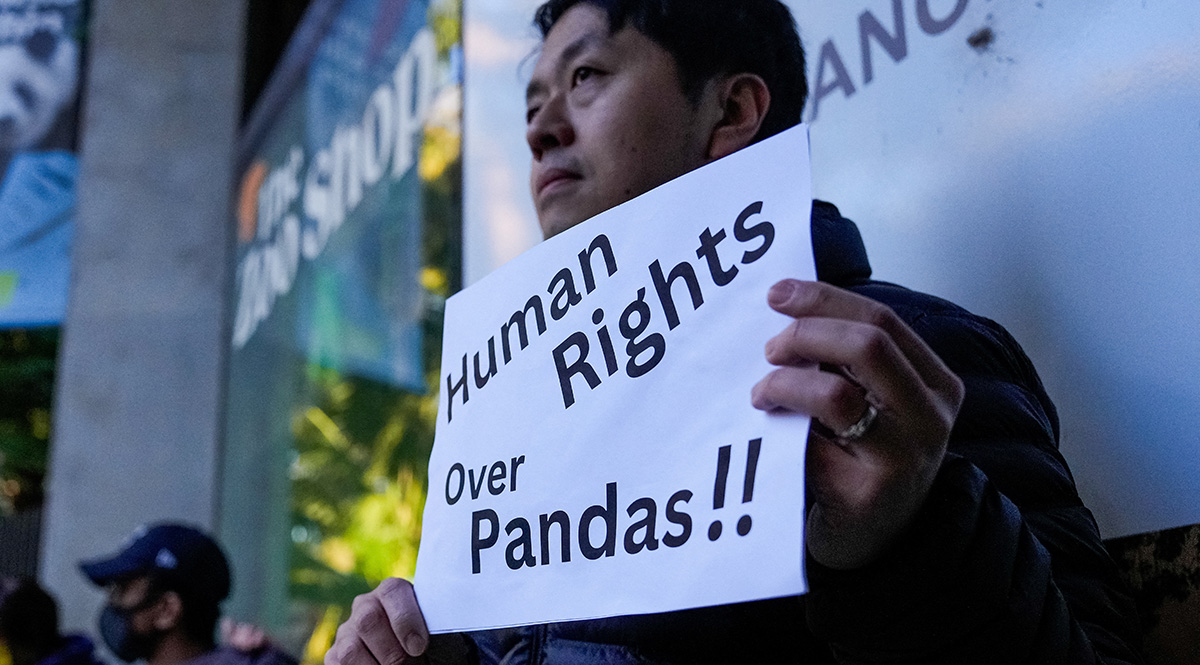 Asanka Ratnayake / Reuters / Forum
China’s rejection of a universal understanding of human rights, particularly “first generation” (civil and political) rights, is an important element of internal policy of the Communist Party of China (CPC). Although the 1982 constitution provides Chinese citizens with political rights (e.g., freedom of speech, assembly, religion), these are not respected. The authoritarian nature of the political system renders civil liberties a threat to the CPC’s power. Despite adopting most international human rights instruments, China interprets them differently than the West. In its view, the so-called international human rights canon, particularly concerning civil and political freedoms, which is considered part of the current international order, should be amended. According to Chinese doctrine, human rights are not universal because their observance (especially with regard to political rights) depends on a country’s level of economic development and on the sovereign decision of its authorities. Therefore, Western accusations of human rights violations are interpreted as unacceptable interference in domestic issues. The CPC assesses the actions of societies against their governments, as in Ukraine in 2014 or during the Arab spring in 2011, not as an expression of the struggle for respect of human rights, but as the result of external, mainly American, interference.
In addition to the different interpretation of civil and political rights, the Chinese judicial system is dependent on the party, constituting an additional obstacle to attempts to protect such rights effectively in China (e.g., in accordance with the state’s constitution). Since the beginning of President Xi Jinping’s rule in 2012, the persecution of groups and individuals attempting to be independent of the authorities has continued (winnowing them to just a few today). This repression has particularly affected academics, lawyers, activists, journalists, as well as members of political parties and NGOs in Hong Kong. Several hundred people have been imprisoned during this time and several notable ones have died behind bars, including in 2017 the dissident Liu Xiaobo, winner of the 2010 Nobel Peace Prize. The tightening of the authorities’ control over society has also affected entire ethnic groups (Uighurs, Mongolians, Tibetans), religious groups (Muslims), and Hong Kong residents.
Foreign Policy Tool
China adopted the Universal Declaration of Human Rights when taking a seat on the UN Security Council in 1971, replacing the Republic of China, a signatory to the act. It is a party to most of the UN human rights conventions in force, which it has accepted as evidence of the state’s priority of socio-economic rights over political rights. China has ratified the Convention on the Elimination of All Forms of Discrimination against Women (in 1980), the Convention on the Rights of the Child (in 1992), the Covenant on Economic, Social and Cultural Rights (in 2001), and the Convention on Organised Crime (in 2003). In 1998, it signed the International Covenant on Civil and Political Rights, but has not ratified it (nor acceded to any of its additional protocols). In December 2023, in a speech to mark the 75th anniversary of the adoption of the Universal Declaration of Human Rights, China’s Foreign Minister Wang Yi emphasised that China is a developing country and therefore “has not yet completed the process of human rights development”.
China’s human rights rhetoric, part of which portrays Western accusations against the Chinese authorities as hypocritical, has become an important element of the state’s policy towards the Global South. Its narrative has been promoted, for example, within BRICS+, during Xi’s visit to Serbia in May, and in Sino-Russian cooperation. Each of the statements following the Xi-Putin meetings in 2022, 2023, and 2024 contains a common position between the two countries that coincides with this rhetoric.
The effectiveness of China’s approach is evident in the UN Human Rights Council (China was re-elected for the 2023-2026 term), particularly through the Universal Periodic Review (UPR), the Council’s regular assessment of each UN country’s human rights record. It provides an opportunity for members of the organisation to ask questions. China has been subject to the UPR four times so far (in 2009, 2013, 2018, and 2024), and its track record (e.g., China-friendly questions on socio-economic rights from states participating in the review) shows that the number of partners sharing China’s human rights narrative is growing over time. In 2013, these numbered four countries out of 16 (Cuba, Myanmar, Slovenia, Sri Lanka), in 2018 it was 12 out of 25 (Algeria, Belarus, Bolivia, Egypt, Myanmar, Pakistan, Portugal, Russia, Saudi Arabia, South Africa, UAE, and Uruguay), and in 2024, 23 out of 36 (e.g., Algeria, Bangladesh, Belarus, Cameroon, Cuba, North Korea, Eritrea, Iran, Singapore, Slovenia, Sri Lanka, Russia, Venezuela, and Vietnam).
EU and U.S. Reaction
China’s anti-Western rhetoric and actions with regard to human rights issues are met with a moderate response from the West, mainly due to fears of Chinese retaliation in the economic sphere. China in turn has responded strongly, for example, against Norway after the Nobel Peace Prize in 2010 was award to Liu Xiaobo for his long-standing human rights work in China—it took until 2015 to restore stable relations. Other Western responses have included, in March 2021, the EU under the European “Magnitsky Act”, the U.S. under the Uyghur Rights Act adopted in 2020, and Canada and the UK, which imposed differential sanctions on Chinese politicians (the U.S. also put them on Chinese companies) responsible for the repression of Uyghurs in Xinjiang. The Netherlands, the U.S., and Canada have described the Chinese policies pertaining to the Uyghurs as “genocide”. The U.S., under the Hong Kong Autonomy Act 2020, also sanctioned officials from that administrative region as well as in China responsible for the passage of the National Security Law in 2020, which exerted control over the formerly autonomous region. Both the U.S. and the EU are also seeking to restrict imports of products suspected of being made with forced labour in Xinjiang. In May this year. (under the Uyghur Forced Labour Prevention Act of 2022), the U.S. Department of Homeland Security banned 26 Chinese textile companies from exporting to the United States. In March this year, an agreement was reached in the EU on an instrument to eliminate forced labour from the supply chains of companies operating on the single market. The timeframe for its implementation is three years. However, imports of goods from Xinjiang to EU countries, mainly to Belgium, Poland, and Germany, are increasing, as evidenced by Q1 2024 data.
A separate format for EU and U.S. contacts with China are the human rights dialogues. These were put on hold in the European Union in 2019 but resumed in 2022, with the 39th session held in China in June this year. At the same time, the Chinese authorities are limiting the ability of diplomats to monitor the internal situation, for example in Tibet and Xinjiang. Trips organised and arranged by the Chinese Ministry of Foreign Affairs, such as those during the last session of the dialogue, did not allow verification of official declarations by the Chinese authorities, for example, concerning forced labour or respect for religious freedom. In the U.S., the Human Rights Dialogue with China was suspended in 2016. Neither the Biden nor Trump administrations were interested in resuming it due to the lack of results. However, the topic of human rights was raised by President Joe Biden during his 2023 meeting with Xi in California. The issue was not mentioned in the communications following the German Chancellor’s visit to China in April, the French president’s talks with Xi in May this year, or the Polish president’s visit to China in June this year.
Conclusions and Perspectives
China’s approach to human rights stems from both its domestic and foreign policy objectives that seek to change the international order, which it believes has been imposed by the West, and hence its rejection of the concept of universal rights, also in the context of international agreements binding China, and the adoption of its own interpretation. The Chinese approach to human rights has also become another element in the offer of cooperation aimed mainly at the countries of the Global South. This approach also creates a platform for China’s cooperation with Russia, Iran, and North Korea.
From the perspective of the West, it is important to continue and improve the effectiveness of the measures already in place to enforce human rights standards, such as highlighting China’s violations of accepted international commitments and pressing for the ratification of the International Covenant on Political and Civil Rights to verify that country’s commitments. Financial and organisational support by the EU and the U.S. for Chinese democratic circles operating on their territory and, with in relation to Hong Kong, for those choosing to emigrate for political reasons (through, e.g., visa facilitation and settlement assistance) is also valuable. It is worth considering suspending agreements with China on legal assistance in civil and criminal matters (in force in 14 EU countries, including Poland) or extradition (concluded by seven EU countries, but not by Poland), as they make it easier for the Chinese authorities to prosecute dissidents living abroad. It is necessary to reformulate the EU-China Human Rights Dialogue to increase the involvement of the Chinese side and, if this is not possible, even to suspend it, as happened with Russia or Syria. This has been advocated by NGOs such as Human Rights Watch. Sanctions based on the European Magnitsky Act, adopted in December 2020, should also be a tool used more often by the EU.