Victory for the protest movement in the parliamentary elections in Serbia
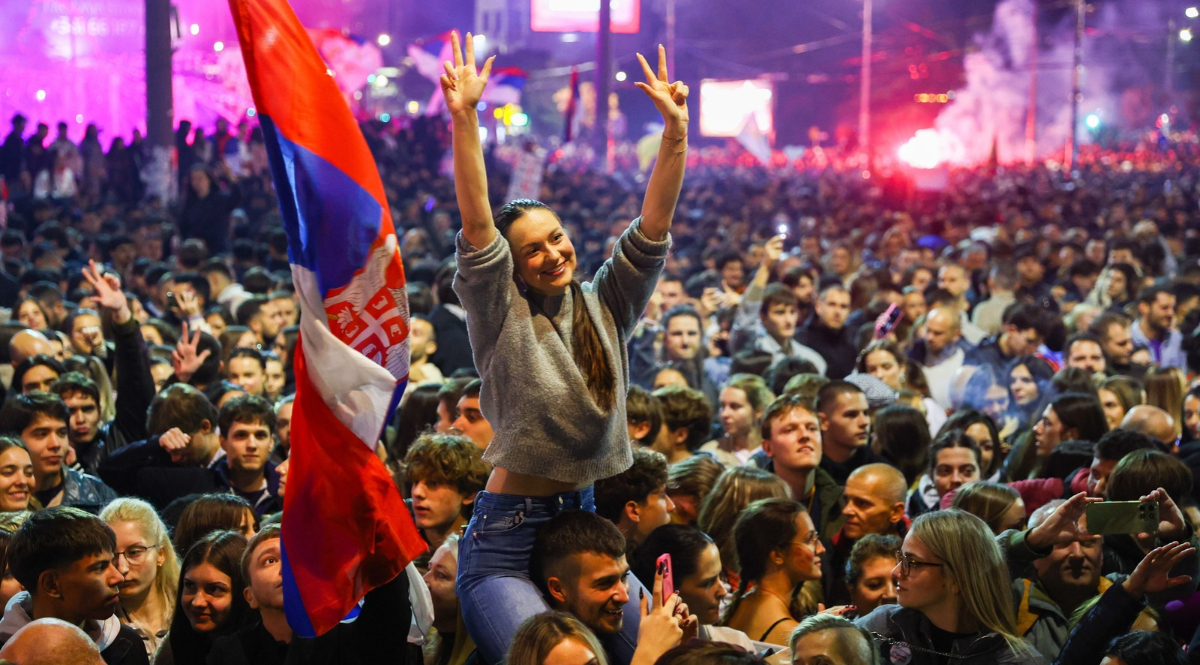
The parliamentary elections held on 25 October this year were a referendum on support for the nationwide student protests that had been ongoing for two years. The resounding victory of the political movement that emerged from these protests, coupled with a record-high turnout (69%), provides a strong public mandate for reforms in a country whose democratic standards have, in recent years, fallen to the lowest level in the Balkans.
 Рюмин Александр / Zuma Press / Forum
What are the election results?
The snap parliamentary elections were won by the Student List–Students Win (LS). It was formed in the wake of the nationwide protests against the authorities but was registered only at the start of the election campaign in September this year. With no formal leaders (the list was headed by cardiologist Ilija Srdanović, whilst economist and former central bank governor Dejan Šoškić stood out in the debates), it fielded candidates including lecturers, doctors, experts, sportspeople, and actors—none of whom had previously served as MPs—but no students. According to the almost complete results (as of 28 October), the LS won 53.7% of the vote and 141 seats in the 250-member unicameral parliament. The election was lost by the list Aleksandar Vučić–United Serbia, centred on the Serbian Progressive Party (SNS), which has been part of coalition governments for almost a decade and a half. It secured 39.5% of the vote and 103 seats (compared with 129 in the outgoing term). The other lists, including the Serbian Socialist Party, which has been part of the coalition governments for almost two decades, failed to clear the 3% electoral threshold. The National Assembly will be supplemented by six MPs from national minority parties, which is a record low number.
What was the focus of the election campaign?
The LS election campaign focused on accusing the government of systemic corruption and state capture, including of public media. This reflected the demands of the nationwide protests that erupted in November 2024 following the collapse of a canopy over a newly renovated railway station in Novi Sad that resulted in the deaths of 16 people. According to the protesters, the structure’s failure was the result of corruption and incompetence on the part of the authorities. LS called not only for the rule of law to be established but also—as protest slogans proclaimed—for those in power to be held to account. At the same time, the List did not put forward any candidates for the post of prime minister or for ministerial positions. For its part, the ruling party, whose candidate for prime minister was Vučić, following his resignation as president a month before the election, accused the student movement of being destructive, whilst presenting itself as a guarantor of stability; amongst other things, it also granted senior citizens additional one-off benefits and promised further increases in pensions.
How did the debate on foreign policy unfold?
Given the protests against corruption and the capture of the state that had been ongoing for two years, foreign policy played a less significant role in the election campaign. However, it was brought into the debate by the SNS, which accused the LS, amongst other things, of seeking to recognise Kosovo’s independence, of classifying the crimes in Srebrenica as genocide, and of imposing sanctions on Russia. In fact, both blocs adopted convergent positions on these issues. The failure of the LS to declare any changes may have stemmed both from a strategy of focusing attention on the substance of the dispute over democratic standards and from public sentiment regarding these policies. Both blocs were also united by a desire for EU integration, although the LS position is that the way to accelerate this process is through the democratisation of Serbia with the support of Western partners, whilst the SNS accused the West (including forces in the U.S. not associated with President Donald Trump) of acting against the government.
What do the election results mean for Serbia’s European integration?
A change of government means Serbia may resume realistic talks on EU membership. Although it has formally been conducting accession negotiations since 2014, European integration has in fact been at a standstill for almost five years. Serbia’s most recent success in this regard was the opening of Cluster 4 (green agenda and connectivity) in December 2021. The stagnation in the negotiations stemmed from Serbia implementing solely superficial reforms and the deterioration in democratic standards in the country (in the European Commission’s annual reports on the negotiations, it specifically noted this regress, which it does only in exceptional circumstances). Serbia was recognised as being the most corrupt country and its media the most subjugated in Europe after Russia and Belarus. Meanwhile, success for Serbia in EU integration will depend on the pace and effectiveness of the strengthening of the rule of law in the country, an aim announced by the LS. The pace may also be conditioned by foreign policy, including alignment with the EU’s approach to Russia, which is a particularly important requirement, for example, for the Baltic states. Serbia has opened 22 out of 35 negotiation chapters, two of which it has provisionally closed.
What will be the biggest challenges facing the new government?
The key challenge for the future government will be to ensure the apolitical nature of state institutions wherever this is guaranteed by the constitution so that they are capable of strengthening democratic standards. In order to fulfil the main objective of combating corruption and holding those guilty of this crime to account, the challenge will be to depoliticise law enforcement agencies and the judiciary. Another test for the new government will be to free public media from political control whilst upholding due process, and to eliminate systemic shortcomings in elections. In efforts to improve the rule of law, maintaining parliamentary unity within a camp characterised by diverse views and a lack of political experience may prove challenging. The presidential election scheduled for December this year will serve as a political test, although it is of lesser significance than the parliamentary election because the head of state has limited powers.