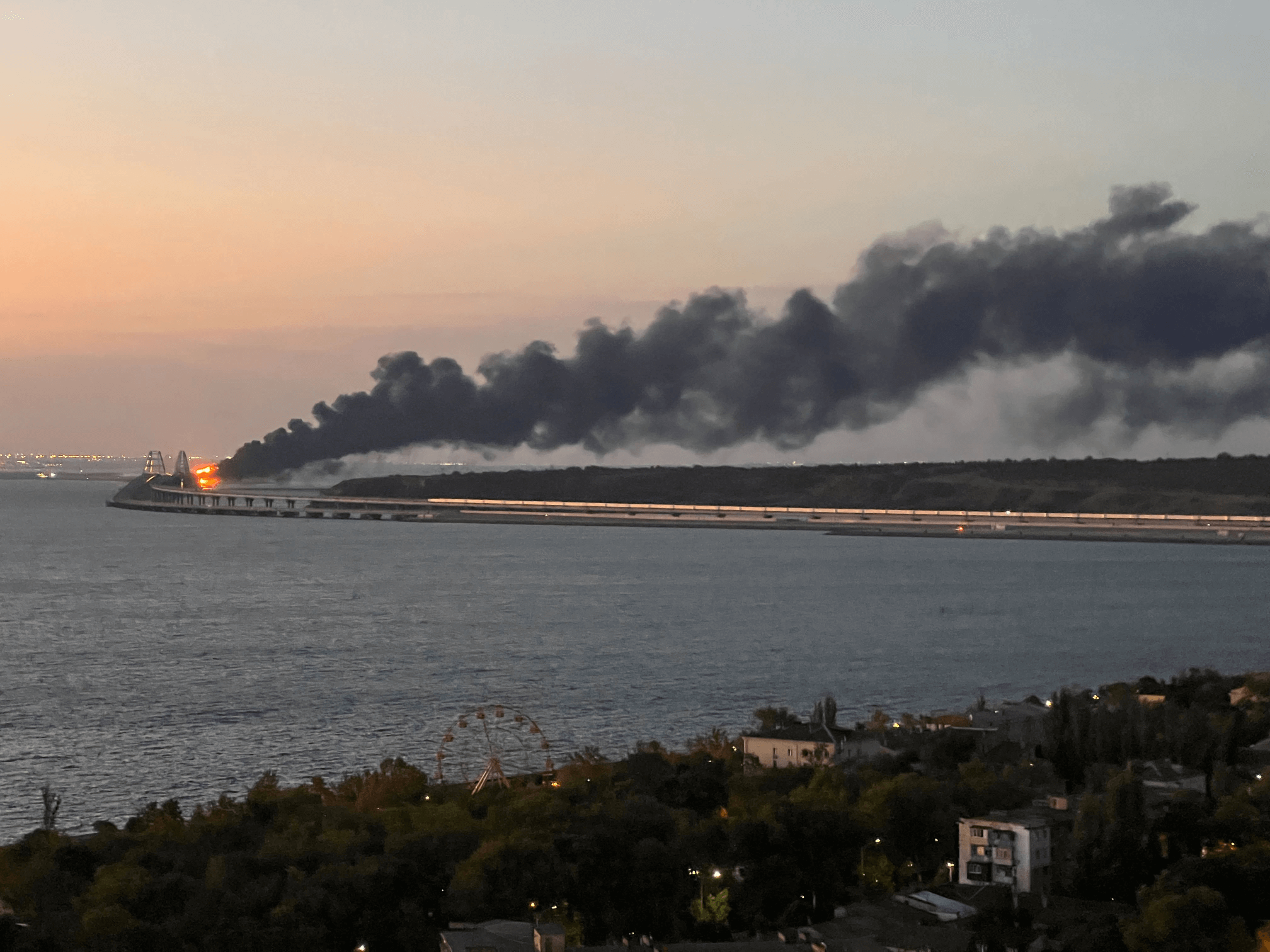
Ukraine's Defence of Black Sea Basin and Trade Routes Remains Vital
The Black Sea is crucial for Ukraine’s security and economy. The reduction of Russia’s operational capabilities in this sea is one of the most important Ukrainian military achievements to date. Nevertheless, Russia continues to make military and diplomatic attempts to gain control of the Black Sea. Therefore, it is necessary to continue to support Ukraine in developing its capacity to maintain the navigability of maritime trade routes by, among others, de-mining and supporting the Ukrainian economy, for example, by facilitating the transport of products by land.
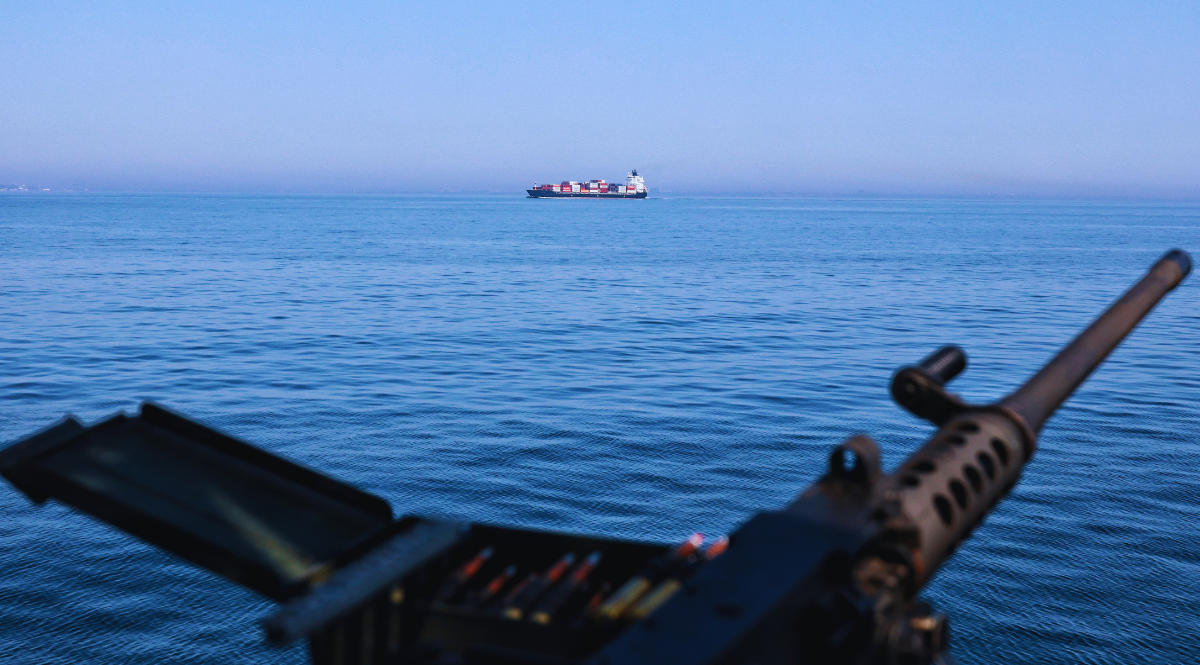 credit: Nina Liashonok / - / Forum
 The Importance of the Black Sea for the Ukrainian Economy
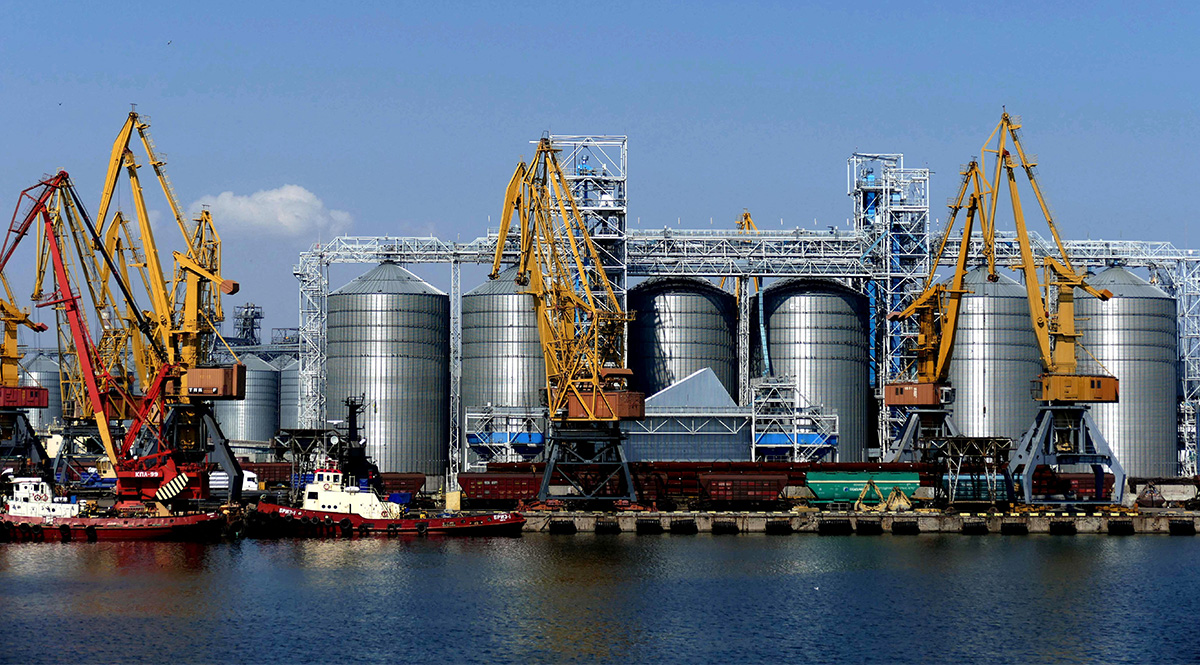
The Black Sea provides Ukraine with fast and cheap access to markets in Europe, the Middle East, and Africa and, via the Suez Canal, to Asian markets. However, as a result of Russian aggression, only three Ukrainian ports on the country’s northwestern coast are operating: Odesa, Chornomorsk, and Pivdennyi. Others, such as the port of Mykolaiv, which before the invasion accounted for 25-30% of Ukrainian exports, are either not functioning due to hostilities or are under Russian control, like Mariupol, located on the Sea of Azov. In addition, attacks on port infrastructure, and higher insurance rates for transport by sea due to the ongoing war, are further limiting export opportunities.
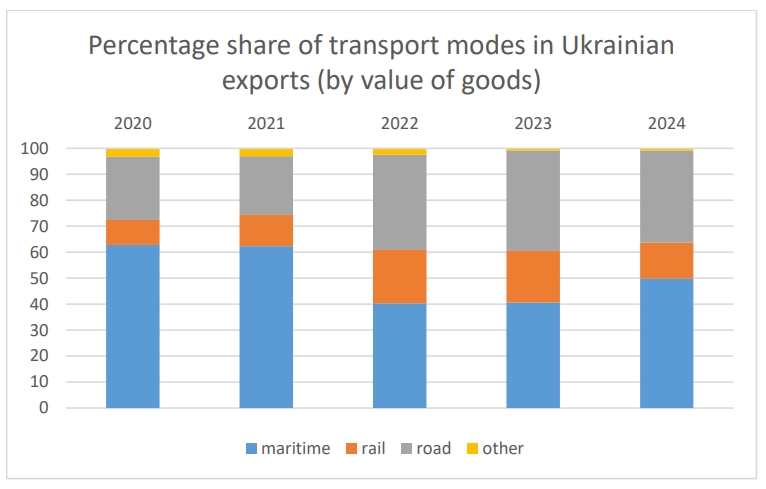
Russia’s blockade of Ukrainian ports after the full-scale invasion was not only of military significance but was also part of attempting to weaken the Ukrainian economy. It led to some Ukrainian exports being diverted overland (to a lesser extent via Danube ports) to European Union countries. However, road and rail transport has not been able to fully replace maritime transport due to the limited capacity of trucks and railway depots. The efficiency of land transport is also limited by the insufficient capacity of the border infrastructure. Therefore, after Russia withdrew from the so-called Black Sea Grain Initiative in July 2023, Ukraine broke the Russian blockade and renewed the transport corridor on its own, partly through the territorial waters of Romania and Bulgaria, virtually restoring the sea route to full operation. As a result, in 2024 the share of goods delivered by ship accounted for almost 50% of the value of exports ($20.8 billion). However, it has not been possible to return to pre-Russian aggression levels, when goods equivalent to around 62% of total exports ($42 billion in 2021) were shipped by sea.
The Importance of the Black Sea for Ukraine’s Security
At the start of the full-scale invasion against Ukraine, Russia had a clear advantage in naval capabilities, including the number of vessels that operated in the Black Sea and the Sea of Azov. Unlike Russia’s, the Ukrainian fleet had not received any modern ships in the 21st century. In addition, in 2014 during the illegal annexation of Crimea, Russia seized a significant portion of Ukrainian naval and border guard assets at naval bases. Moreover, 6,000 sailors and officers who had previously served in the Ukrainian army joined the Russian Black Sea Fleet. As a result, in 2022 Ukraine had mostly Soviet-era vessels, and four formerly U.S.-owned border guard patrol ships, a total of 20 poorly armed vessels.
In the first phase of the invasion, the advantage in naval capabilities provided Russia with, among other things, the ability to blockade Ukrainian ports and conduct shelling of Ukrainian territory using sea-based missiles. It also raised concerns about the possibility of conducting a naval landing in support of land forces’ operations, which could have significantly changed the course of the war in the first months.
Ukraine neutralised this advantage by using at first, missiles, and then drones (both air and naval, such as the Magura) . Successful attacks on individual ships, including the sinking of the Russian Black Sea Fleet’s flagship cruiser Moskva, a huge propaganda moment, and ports in Russian-occupied Sevastopol and Berdiansk resulted in Russia losing 28 ships (21 of them irretrievably) and being forced to relocate its vessels to the port of Novorossiysk, beyond the reach of Ukrainian drones. Ukrainian defensive actions have rendered the maritime theatre of operations secondary. However, the weakening of Russia’s ability to operate in the Black Sea has only reduced its ability to strike targets within Ukraine, including civilian infrastructure. Ukraine has also been helped by Türkiye’s decision in February 2022 to close the Black Sea straits to Russian ships, preventing support for the Black Sea Fleet.
Regional and Global Consequences
Ukrainian military action not only allowed the restoration of Black Sea trade but also reduced the risk of a Russian landing in southern Ukraine (Odesa region) and a breakthrough to Transnistria, reducing the potential threat to Moldova.
The unblocking of transport routes in the Black Sea was also important for global food security. In 2021, Ukraine accounted for 9% of global exports of wheat, 12% of maize, 17% of barley, and 46% of sunflower oil (World Economic Forum data). While Russia attempted to block these exports, it used the resulting food crises in messaging to the Global South to falsely blame Ukraine and its partners for it and to raise the prices of food it exported.
Challenges for Ukraine
In the near term, further military and diplomatic attempts by Russia to block exports from Ukraine can be expected, which will strengthen Russia’s position as a key exporter of food products, and which the country’s authorities will want to use to soften the sanctions regime. Russia will still want to incorporate maritime trade arrangements unfavourable to Ukraine into the negotiation process, such as the ship inspections proposed at the Riyadh talks. Accepting such proposals would open up opportunities for it to control Ukrainian exports, and would thus be an instrument to weaken Ukraine. It also cannot be excluded that Russia would try to regain the military initiative in the Black Sea, allowing it to once again block the trade routes used by Ukraine.
Port defence also continues to be a challenge for Ukraine, as Russia has increased the number of drones used to conduct air attacks on Ukrainian infrastructure in recent weeks—in June, it sent a record 5,337 drones. The attacks not only mean an immediate threat but also paralyse port operations; in 2024 in Odesa, for example, enforced work stoppages totalled 32 days that year.
Conclusions and Recommendations
Efforts by Ukraine and partner states should focus on maintaining military superiority in the northwestern Black Sea and guaranteeing free navigation, during and after hostilities. It is therefore essential to continue to provide Ukraine with the armament necessary for effective port defences, such as air-defence systems, or with the means of maintaining the functionality of sea routes, such as missiles, reserves of which may become exhausted due to the increasing number of Russian attacks. It will also be important to ensure that Ukraine is able to cooperate with the Black Sea states of NATO in the future, including through the organisation of military exercises and support in rebuilding its navy. At the same time, Alliance countries should draw on the Ukrainian experience to improve the security of their own ports, ships, and undersea critical infrastructure.
Guaranteeing the security of the Black Sea should also be one of the key elements of a future peace plan. It should include a point on the establishment of an international monitoring mission in the sea basin with the aim of preventing Russia from conducting hostile military actions and regaining control of the trade route. Also key will be the actions of the Black Sea states of the Alliance, which are already taking common initiatives, such as demining the basin. It would be worthwhile for Poland to consider joining these efforts.