Terrorists Kill at least 137 at Moscow Concert Hall
On 22 March, a terrorist attack took place in Moscow, killing at least 137 people. The Islamic State of Khorasan Province (ISIS-K) claimed responsibility for the attack, although the Russian government is seeking to place co-responsibility on Ukraine and some NATO countries. Russia will try to use the attack to justify, among other things, intensifying attacks on civilian targets in Ukraine, activity against Alliance members, broadening the spectrum of service activities, and increasing surveillance of Russian society.
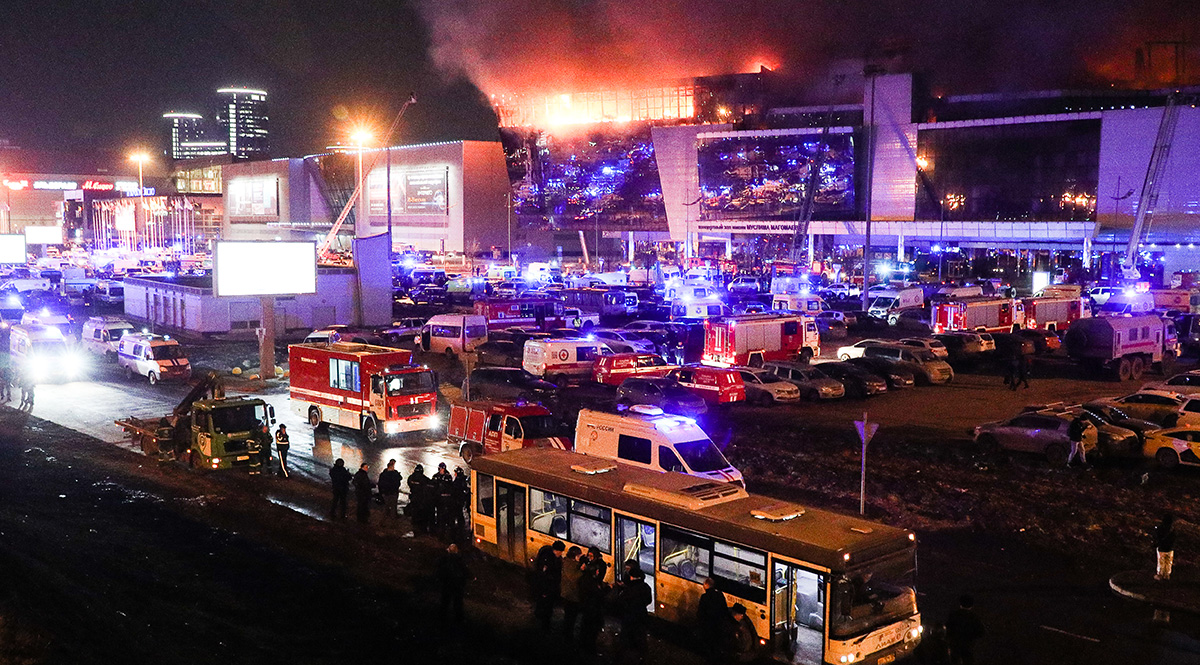 Sergey Petrov / Russian Look / Forum
How did the attack happen and who was behind it?
The attack took place before a performance by the popular rock band Picnic, for which more than 6,000 people had bought tickets. Four armed men forced their way into the Crocus City Hall, opened fire on the people gathered inside, and later detonated explosives, causing a large fire that collapsed part of the building’s roof. The Islamic State of Khorasan Province (ISIS-K) claimed responsibility for the attack. The group is one of the most active wings of the original ISIS, formed in 2015 in Afghanistan and whose name refers to a historical region that includes parts of Central Asia, Iran, and Pakistan.
On the morning of Saturday, 23 March, the director of the Federal Security Service (FSB), Aleksandr Bortnikov, stated that all the attackers had been captured, along with a further seven people who had been charged as accomplices. Bortnikov stressed that the terrorists were going towards Ukraine (they were captured in the border region of Belgorod), implying they were supported by that country. The FSB at the time did not clarify the nationalities of the detainees, stating only that they are not Russian citizens.
What was the context of the attack?
The terrorist attack occurred five days after the presidential election and on a day when Kremlin spokesman Dmitry Peskov announced that Russia was in a state of war, not just a special military operation, as it had transformed due to the involvement of Western countries on the Ukrainian side. This, along with statements by some Russian politicians accusing Ukraine of the attack and the anti-Ukrainian messaging taken up by Russian media initially raised concerns that the attack may have been a deliberate provocation aimed at mobilising and intensifying military action against Ukraine. The likelihood of this was shattered, however, by the swift admission by ISIS that its affiliate, ISIS-K, had carried out the attack and the emergence of information that ISIS-K had been planning an attack on a synagogue in Moscow at the beginning of March, which was prevented by the FSB thanks, among other things, to information provided to it by U.S. services. Moreover, on 7 March, the U.S. embassy in Moscow issued a communiqué to its citizens residing in Russia to avoid public gatherings ahead of the elections and raised the alert level to the highest, advising Americans not to travel to this country.
What were the first reactions of the Russian authorities?
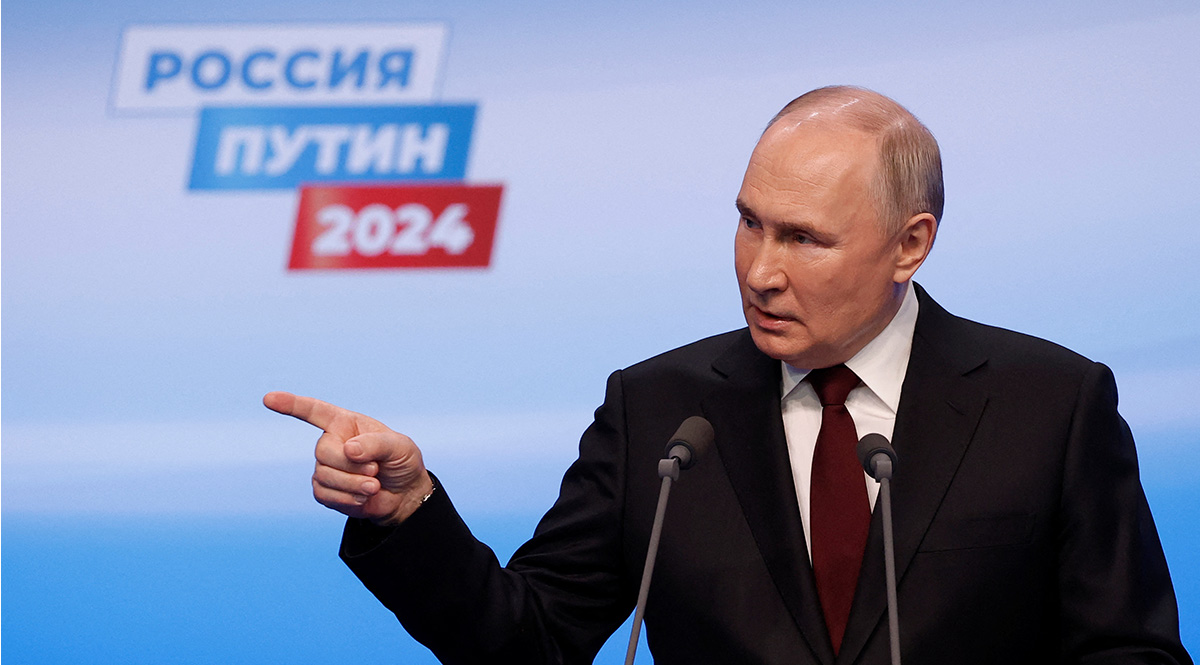
Although ISIS-K quickly claimed responsibility for the attack, the Russian authorities and media implied from the beginning that the terrorists were assisted by Ukraine and some NATO countries. The theme of Ukrainian support for the attackers was one of the most important points in a short speech delivered by Vladimir Putin on Saturday afternoon. Putin compared the actions of the terrorists to the policies of the Nazis during the Great Patriotic War, which aligns with Russian accusations that the Ukrainian authorities are pursuing Nazi-like policies. He also announced that the perpetrators and their helpers would be held accountable, regardless of who supported them, and called on Russians to unite.
However, many doubts have been raised by, among others, Russian opposition media abroad and international experts about the course of the rescue operation, including that the police and counter-terrorist OMON units arrived at the event many minutes after the attack had started, despite their posts being located nearby, and that the FSB failed to prevent the attack altogether knowing that some ISIS-K fighters remained in Moscow.
What are some of the consequences of the terrorist attack?
In the public perception, the terrorist attack may undermine the image of the Russian special services and, indirectly, of Putin. Therefore, the Russian authorities will seek to prove even indirect Ukrainian involvement in the attack so that they can once again justify the need for the SMO. It is also highly likely that Russia will want to show that the attackers were supported by some NATO countries. With its accusations of sponsoring terrorism, Russia will seek to tarnish Ukraine and the Alliance in the international arena in an attempt to undermine their credibility.
ISIS activity have posed a security challenge to the Russian authorities for years as ideas such as creating a caliphate that includes its territory have gained popularity in the Islam-dominated regions of the North Caucasus. In 2015, ISIS declared jihad against Russia due to its involvement in the war in Syria on the side of Bashar al Assad. The Russian authorities will therefore use the attack as a pretext to increase the competences of the services for surveillance of Russian citizens and residents. Nor can it be ruled out that the authorities will allow more violence, both by the security apparatus and Russian society, against Muslim economic migrants from Central Asian countries, who were initially accused of carrying out the attack.