
Israel's Intervention Rattles Syrian Transformation
On 16 July, Israel attacked government targets in Damascus in response to actions by Syrian security forces in the As-Suwayda region. These forces were attempting to regain control of territories held by separatist Druze groups allied with Israel. The Israeli attacks undermine the transformation in Syria. Stronger opposition from the international community to Israel’s military actions is necessary to support peaceful change in Syria.
 credit: AA/ABACA / Abaca Press / Forum
What led to the escalation?
On 12 July, armed clashes began in Syria, the result of several overlapping situations. One of them is the long-standing dispute between the Bedouins and the separatist Druze. Both of these groups are involved in criminal activity and compete with each other, for example, for control of smuggling routes. The immediate cause of the outbreak of violence was the kidnapping of a Druze vegetable seller, which triggered a series of mutual abductions that escalated into armed clashes. The Druze involved were mainly linked to the Suwayda Military Council and the religious leader Hikmat al-Hijri. The Council and Al-Hijri cooperate with Israel and members of the former Assad regime and oppose the complete integration of Druze territories into the Syrian state. When, despite attempts at negotiation by local leaders, the violence between the Druze and Bedouins continued, the Syrian army intervened to calm the situation. However, this failed, leading to further escalation. As a result, Hijri’s supporters attacked the Syrian soldiers, his opponents among the Druze, and civilians.
How did the Syrian forces react?
The Syrian army became directly involved in the conflict on 14 July. This was accompanied by talks with the pro-government Druze factions (led mainly by Laith al-Balous) to coordinate actions and support negotiations with the separatists. Shortly after the soldiers entered the area, Druze fighters kidnapped nearly 20 of them, killed 10, and subjected the rest to public humiliation. In addition to attacks against the separatists, the army also raided a complex taken over by former Assad officers. There were also crimes and attacks on civilians by the Syrian army. When, after two days of military action, the army took over part of the territories controlled by Hijri, a ceasefire was announced, but Hijri unexpectedly withdrew from it, which coincided with the beginning of the Israeli intervention. During the escalation, nearly 600 people were killed, including about 75% of the combatants, and President Ahmad al-Sharaa announced an investigation into abuses by the Syrian troops.
Why did Israel become involved in the conflict?
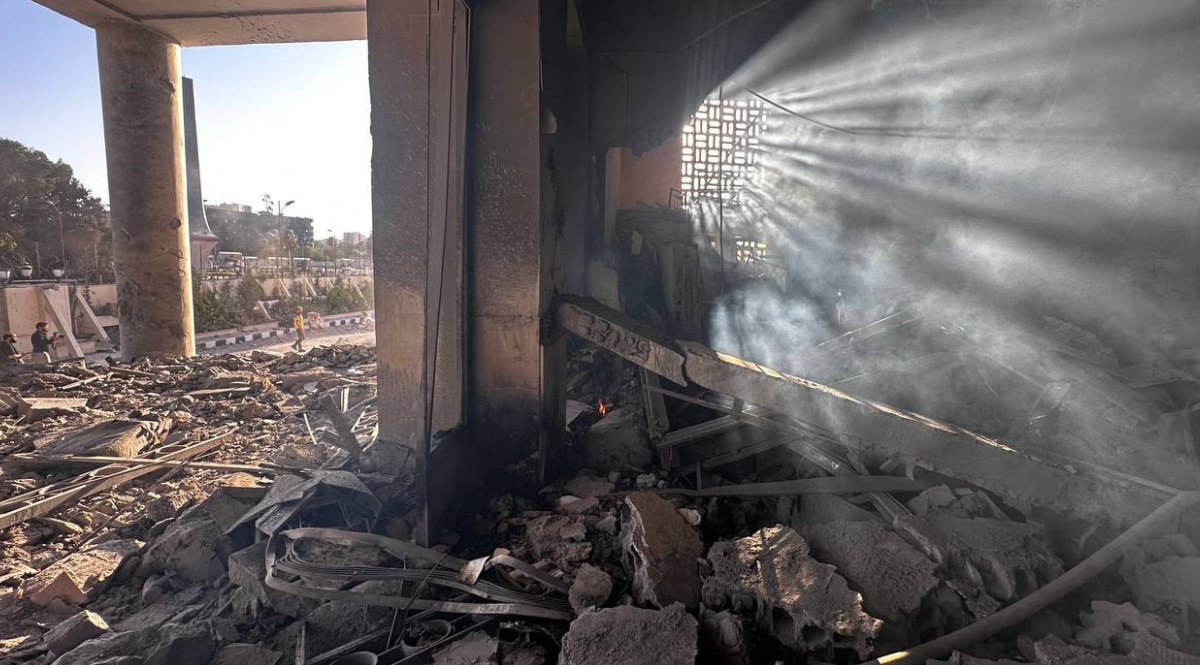
After the fall of the Bashar al-Assad regime, the Israeli authorities announced that they would take the Druze in southern Syria under their protection (despite opposition to it from most of them), thus justifying the occupation of areas along the Golan Heights. They see support for separatist groups in this area as a tool to weaken the new Syrian authorities and force them to make concessions, including the demilitarisation of areas south of Damascus. The intervention of the Syrian government forces on 14 July was used by Israel to escalate the conflict, striking not only military units but also state facilities in Damascus, including the Ministry of Defence and General Staff buildings, as well as the area around the presidential palace. This was intended to signal Israel’s categorical opposition to the Syrian army taking control of centres previously dominated by subversive groups cooperating with it. These actions were accompanied by violations of the Syrian border by the Druze community in Israel and a repeated call by the Israeli authorities for the Syrian government to demilitarise southern Syria. The U.S. also became involved in the mediation, pressing both countries to withdraw their forces from Suwayda. It was only after U.S. intervention that a ceasefire agreement was negotiated.
How will the escalation affect Syria’s transformation?
The final agreement sanctioned the withdrawal of government forces from southern Syria, deepened divisions in Suwayda and forced the Bedouins to leave the region. The Syrian army withdrew from the province, and groups allied with Hijri returned to the south of the country, leading to a reduction in the presence of pro-government Druze organisations in these areas. As a result, some Bedouins and pro-government Druze groups resumed armed operations, leading to Israeli airstrikes on their targets and preliminary declarations allowing the Syrian army to station troops in Suwayda for 48 hours. Residents of other provinces have also begun to mobilise, accusing the Druze of armed resistance against the state and its new authorities. This is evidence that the exploitation of internal divisions in Syria by foreign actors is one of the greatest challenges to the transition process. Israel’s actions are conducive to the activities of groups linked to Russia, Iran, and the former Assad regime, which are fuelling anti-government sentiment and undermining the al-Sharaa government’s ability to protect religious minorities. The continuation of Israel’s military actions threatens to radicalise both separatists and their opponents, which could lead to a resumption of the civil war in Syria. From the perspective of the European Union, the priorities should be pressure on Israel and support of the new government, whose actions are conducive to improving the security situation and limiting the influence of the EU’s opponents in Europe’s southern neighbourhood.



.png)