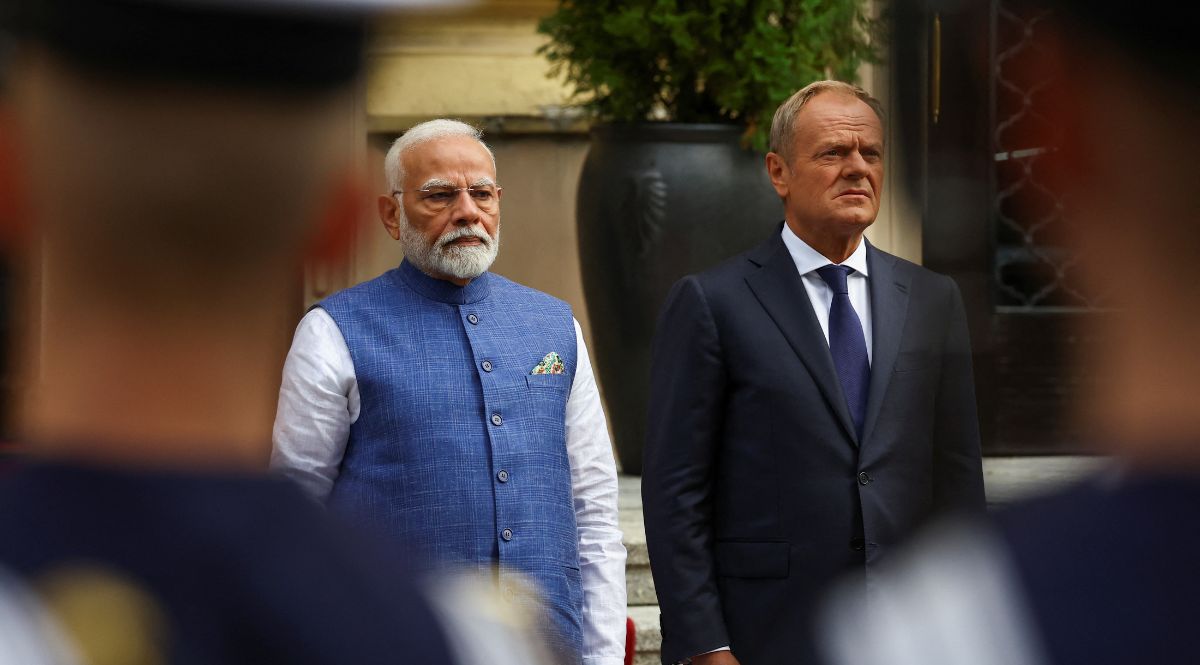
India as a prospective space sector partner for Poland
The signing of a Memorandum of Understanding between the space agencies of both countries, planned to take place during Polish Prime Minister Donald Tusk’s visit to India in October, will open up new opportunities for technological partnership. The landing of an Indian lunar rover on the Moon in 2023, together with the country’s ongoing commercialisation of the space sector, makes India one of the key players in space exploration. The success of cooperation in this area will depend on identifying the needs and complementarities of both sides, followed by the creation of effective institutional and financial frameworks to support joint projects and research.
 FRANCIS MASCARENHAS / Reuters / Forum
India’s achievements in space
India’s space programme, developed since 1962, has in recent years transformed the country into one of the four major powers in this sector (alongside the US, China and Russia). In 2014, the Mangalyaan mission placed a satellite into orbit around Mars, whilst in 2023 the Aditya-L1 mission began observing the Sun. In the same year, India became the fourth country to successfully land a spacecraft on the Moon (the Chandrayaan-3 mission) and the first to reach the lunar south pole. Thanks to the SpaDeX experiment in January 2025, India became the fourth country to demonstrate autonomous docking in space. With NavIC, India also joined the select group of nations (alongside the US, Russia, China, the EU and Japan) that have developed their own satellite navigation system. It also ranks seventh in the world in terms of the number of satellites in Earth orbit (over 90).
The main organisation responsible for space exploration is the Indian Space Research Organisation (ISRO), established in 1969 and overseen by the government’s Department of Space. Since its first rocket launch in 1979, ISRO has carried out 106 launches (the most recent in September 2026). It has one of the smallest budgets amongst the major space powers (approximately $1.6–2.5 billion per year), which forces it to be among the most cost-effective in the world. To boost the sector’s potential, the Indian government recently implemented major reforms, beginning with deregulation in 2020 and culminating in the 2023 adoption of the new Indian Space Policy. These changes opened up the sector to private partners, with the aim of increasing commercialisation, investment and innovation. Two new companies were also established—NewSpace India Limited (NSIL) and the Indian National Space Promotion and Authorisation Centre (IN-SPACe). Their role is to transfer technologies developed by ISRO to the private sector, provide financial support to start-ups and deliver space-related services.
As a result of these changes, 440 space start-ups had been established by August 2026, the best-known of which include Skyroot Aerospace, Agnikul Cosmos, and Pixxel. In May this year, GalaxEye launched the Drishti satellite into orbit, utilising the company’s proprietary OptoSAR technology for Earth observation (a world-first combination of optical imaging with synthetic aperture radar). In July this year, Skyroot Aerospace made history as the first private entity in India to successfully launch a carrier rocket, the Vikram-1, into low Earth orbit (this private launch capability had previously been limited to the US and China). In total, since 2021, the value of private-sector investment has increased sixfold—from $100 million to $618 million by the end of March this year.
The country’s reforms have also opened up the sector to foreign investment. Under the new investment policy introduced in 2024, foreign ownership caps were raised to 74% for satellite manufacturing and operations, 49% for launch vehicles and spaceports, and up to 100% for satellite components and ground-segment infrastructure.
Plans and challenges for the space sector
India's plans for the development of its space sector are even more ambitious. Among its future objectives are another unmanned mission to the Moon in 2027 (the Chandrayaan-4), the Gaganyaan crewed mission in 2027 (with three astronauts spending three days in orbit 400 km from Earth), the launch of a satellite into orbit around Venus in 2028, and the establishment of a crewed space station by 2035. This is intended to pave the way for a crewed mission to the Moon in 2040. Beyond boosting the country’s prestige, India’s space programme is intended to drive economic growth and technological progress. Valued at $9 billion in 2026, the Indian space sector accounts for a modest share—roughly 2%—of the global space market. However, the Indian government forecasts that the sector’s value will rise to $40–45 billion by 2033 and $100 billion by 2040.
However, carrying out crewed missions, developing a satellite system or reusable rockets requires overcoming a number of challenges. Insufficient funding, restrictions on access to certain dual-use technologies and ineffective legal regulations have so far contributed to frequent mission delays and slowed progress in the sector. To deliver on its ambitions, India needs a reliable and stable supply of specialised components—including chips, radiation-hardened electronics and high-resolution sensors. There is also a growing need to develop situational awareness in space (e.g. avoiding space debris collisions) and to recruit more qualified engineers and scientists. Simultaneously, the lack of clear laws and regulations—such as rules governing liability insurance for accidents in space or the use of public infrastructure—continues to deter foreign investments.
International cooperation
India has already signed over 300 space cooperation agreements with 61 countries and 5 international organisations. These agreements cover research, technological development, joint missions and capacity-building in the sector. To date, the main focus of this cooperation has been India’s provision of commercial satellite launch services to other countries, and 399 satellites had been launched in this way by August this year.
The partner that assisted India with its first rocket launches was the USSR, and Russia still plays an active role in training Indian astronauts, exchanging expertise and transferring technology. However, this role is diminishing as cooperation with Western partners develops, including the US (India joined the Artemis programme in 2023), Japan, France and the European Space Agency (ESA). Opportunities for cooperation with Western partners are increasing due to the commercialisation of the sector and the growing role of private companies.
Poland, which is rapidly developing its space sector and is set to host the new ESA centre for security and resilience, has so far had little experience of cooperation with the Indian space sector. In 2024, a satellite built by the Polish company SatRev (the SOWA-1 mission) was launched into space by an Indian rocket. The participation of astronauts from both countries (Sławosz Uznański-Wiśniewski and Shubhanshu Shukla) in the European Space Agency’s Axiom-4 mission in 2025 also had a symbolic and profile-raising dimension. In July this year, the Polish Space Agency (POLSA) and ISRO began discussions on cooperation regarding the observation station in Ladakh. The Polish-Finnish company ICEYE has also begun cooperation with India.
Conclusions and recommendations
The recognition of the development of cooperation in the space sector as one of the objectives of Prime Minister Donald Tusk’s visit to India (21–23 October this year) sets out an ambitious, forward-looking and strategic dimension to the partnership between Poland and India. India’s achievements in space make it an attractive partner for Poland, particularly in the areas of launching satellites into orbit and developing future technologies. India can benefit from the potential of Polish companies and scientists, for example in the fields of optoelectronics, satellite construction and space situational awareness.
To capitalise on these opportunities, it is necessary for both sides to clearly set out their expectations and needs, as well as to establish an institutional and financial framework to support space cooperation. In this context, Prime Minister Tusk’s planned visit to ISRO’s headquarters in Bengaluru, accompanied by representatives of Polish space companies and potentially both astronauts from the Axiom-4 mission, will be a good opportunity to demonstrate the potential for cooperation. The planned signing of the POLSA-ISRO MoU will mark the first step towards institutionalising this cooperation and may encourage the involvement of private and public entities from both countries.
It would also be worthwhile to expand the network of agreements between Polish research institutions (e.g. the Łukasiewicz Research Network- I-TECH, technical universities, scientific institutes) and Indian partners (e.g. the Indian Institutes of Technology). It would be useful to set up a special programme to fund start-up projects in the space sector. Both governments could even consider establishing a dedicated Polish-Indian Space Fund to support joint research and the exchange of expertise and specialists between the two sides. Private companies will play a key role in this cooperation, and it is therefore important to ensure the creation of a favourable regulatory environment and financial incentives. It should be borne in mind that India has no shortage of attractive partners. For Poland, however, cost-effectiveness, technological complementarity and good political relations offer the foundations for a strategic partnership with long-term potential—one well worth the diplomatic and financial investment.
|
Indicator / Country
|
India (ISRO) |
Europe (ESA) |
USA (NASA) |
China (CNSA) |
Russia (Roscosmos)
|
|
Annual government budget |
~$ 1.9 bln |
~$7.8 bln |
~$25 bln |
~$14 bln |
~$3.6 bln |
|
Number of orbital launches (2025) |
5 |
8
|
181 |
92 |
17 |
|
Number of active satellites in orbit (2026) |
~90+ |
~100+ (ESA/EU)
|
~10,768+ (including Starlink’s private fleet of 10,068) |
~1000+ |
~220
|
|
Main launch sites (spaceports) |
Satish Dhawan Space Centre (SDSC) (Sriharikota Island, Andhra Pradesh) Kulasekarapattinam, Tamil Nadu (under development for smaller rockets— Small Satellite Launch Vehicle, SSLV and private launches)
|
Guiana Space Centre (Kourou, French Guiana) |
Cape Canaveral / Kennedy Space Centre (Florida), Vandenberg Space Force Base (California), Starbase Boca Chica (Texas—Starship tests) |
Jiuquan (Gobi Desert), Xichang, Taiyuan, Wenchang (Hainan Island—heavy-lift rockets), offshore platforms |
Baikonur (Kazakhstan—leased), Plesetsk (northern Russia—military missions), Vostochny (Russian Far East) |
|
Sources: Orbital Radar (https://orbitalradar.com/), StatRanker (https://statranker.org/) |
|||||