
EU-U.S. Agree Framework of New Trade Deal
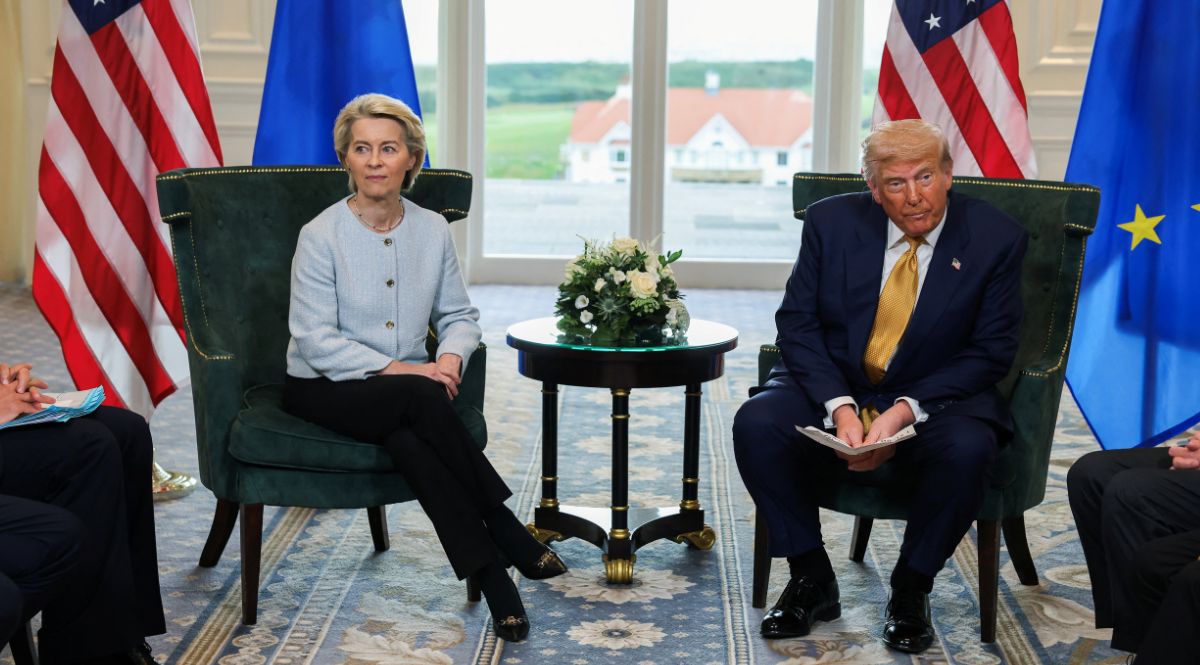
On 27 July, U.S. President Donald Trump and European Commission President Ursula von der Leyen announced during a meeting in Scotland that they had reached a political agreement on a framework for a trade deal between the EU and the U.S. Under the agreement, most goods coming from the EU to the U.S. will be subject to a 15% tariff. The agreement provides an opportunity to stabilise EU-U.S. relations and bring the two sides closer together in the face of common challenges, including China’s economic policy and Russian aggression in Ukraine. The agreement is not legally binding, which may affect its implementation and durability.
 Evelyn Hockstein / Reuters / Forum
In April, the Trump administration announced the introduction of so-called reciprocal tariffs, which in the case of the EU were to amount to 20%. However, they were suspended until 9 July, while the EU postponed the introduction of its own retaliatory measures in connection with the previously imposed U.S. tariffs on steel and aluminium. These delays were intended to create space for negotiations and the conclusion of an agreement that would prevent the escalation of customs disputes. The European Commission (EC) proposed, among other things, the elimination of tariffs on industrial products. At the beginning of July, however, President Trump threatened to impose tariffs of 30% on the EU if no agreement was reached. At the same time, the deadline for completing the negotiations was postponed to 1 August, as was the case with many other U.S. trading partners. The EU emphasised its willingness to reach a compromise, but if it could not be reached, it announced the introduction of its own retaliatory measures on imports of a diverse basket of products worth over €90 billion.
Content of the Agreement
The parties announced the main provisions of the agreement, but still have to agree on the details. The deal provides for 15% tariffs on most goods exported from the EU to the U.S., including cars and car parts (previously subject to an additional 25% tariffs imposed by the Trump administration), medicines, which are one of the most important goods sold by EU companies to the U.S. market, and semiconductors. Import duties on steel, aluminium, and copper will remain at an increased level of 50% (tariffs on copper are to be in place from the beginning of August). At a later stage, a quota system with a lower rate may be introduced. At the same time, trade in a number of “strategic products” will be duty-free, including aircraft and aircraft parts, selected chemicals, and critical raw materials (the list may be updated and expanded). The agreement also stipulates that EU entities are to purchase $750 billion worth of energy products and $40 billion worth of AI chips from the U.S. by the end of Trump’s term in 2029, and increase their investments in the U.S. market by $600 billion. The EU also announced an expansion of purchases of U.S. military equipment. The EU is to abolish customs duties on industrial goods from the U.S., which are already at a low level. Reduced customs duties will apply to selected agri-food products, among other things, imported into the EU.
Effects of the Agreement for the EU and the U.S.
The agreement averts the prospect of a potentially costly trade war and increases predictability in transatlantic economic relations, the lack of which has generated significant costs for businesses and caused investment to be put on hold. It also paves the way for closer cooperation on common challenges, such as addressing China’s exports of overproduction and unfair trade practices, increasing the resilience of supply chains for strategic products, and implementing investment screening and export controls, as provided for in the agreement.
However, after initial optimism on EU markets to the announcement, investor sentiment quickly deteriorated in part due to the specifics of the agreement, which was reflected in lower stock prices in EU countries and the biggest drop in the euro against the dollar since May. Although the tariff rate on most EU goods is lower than what was set to come into effect, it is significantly higher than before Trump took office (in January this year, the average tariff rate in the U.S. was around 1.5%). In its current form, the agreement will be costly for the EU due to a significant reduction in the competitiveness of EU exporters, among other things. It may also prompt some EU companies to invest in the U.S., which is one of the Trump administration’s goals. Taking this into account, as well as the lack of major concessions from the U.S. side and the EU’s decision not to introduce retaliatory measures, the agreement can be considered a relative success for the Trump administration. The EU did not use its leverage over the U.S., including restricting access to the single market, as it probably did not want to escalate disputes, not only because of the economic costs but also because of the importance of the U.S. for European security, including support for Ukraine in its fight against Russia’s aggression. Difficulties in accessing the U.S. market may prompt EU companies to diversify their exports and the EC to intensify talks on trade agreements with other partners. However, limitations should be taken into account, such as the harmful effects of China’s economic policy on the EU. The agreement with the U.S. may also be an incentive for reforms of the single market to make the EU less dependent on exports.
International Significance of the Agreement
The framework deal between the world’s two largest trading partners (in 2024, their trade in goods was worth almost €850 billion and in services almost €750 billion), accounting for around one-third of international trade and over 40% of global GDP, will have a positive impact on the stability of the global economy. However, the agreement with the EU proves that the Trump administration’s trade policy, including pressure and threats to raise tariffs, can be effective even against economically strong partners, which indicates that it may be continued against other entities. Thus, most investors and U.S. trading partners have probably come to terms with the increased U.S. tariffs, as predictability of business operations is key for them. The position of third-country entities on the U.S. market in relation to EU companies will be influenced by their own agreements with the United States. The 15% rate set for the EU, and previously also for Japan, may become a benchmark for the level of tariffs that the U.S. is prepared to impose on other countries with which it is conducting trade talks. It was suggested by Trump himself, who indicated that a range of 15-20% would be adopted in future agreements.
Challenges for the Implementation of the Agreement and EU-U.S. Relations
Although the political agreement is not legally binding, it is possible that once the details have been agreed, the EC will submit it for ratification by the European Parliament and EU Member States. This may spark a debate about its effectiveness, as the agreement already has been criticised by some top politicians (e.g., the French prime minister) and business circles, including in Germany. Moderate support for the agreement has been expressed by the prime ministers of Italy, Spain, and some others. However, most Member States will probably not want to escalate disputes with the U.S. and are therefore likely to accept the provisions of the agreement, at least in the short term. However, there may be problems with its implementation, including achieving the planned level of investment in the U.S. in a relatively short period. It cannot be ruled out that if there are problems with the implementation of the deal, pressure and threats from the U.S. may return and trade disputes may intensify, which could impact cooperation in other areas. In addition, tariffs on goods from the EU, together with increased duties on products from other countries, may lead to price increases in the U.S, and higher costs for American companies, for example, through higher component prices, which could reduce support for the Trump administration’s trade policy.
From Poland’s perspective, it is crucial to stabilise transatlantic relations in the economic dimension, which could have a positive impact on cooperation between the EU and the U.S. on security issues. However, increased U.S. tariffs will hit Polish exporters, both directly (although exports to the U.S, account for only about 4% of Poland’s foreign sales) and, above all, through companies involved in the supply chains of other EU entities (mainly from Germany). According to preliminary estimates provided by Prime Minister Donald Tusk, Poland may lose around PLN 8 billion (around €2 billion) in customs duties. Some companies may try to redirect their exports to other markets to mitigate the effects of U.S. tariffs.


(1).png)
(2).png)
.png)