Yatsenyuk’s Resignation and the Formation of Ukraine’s Next Government
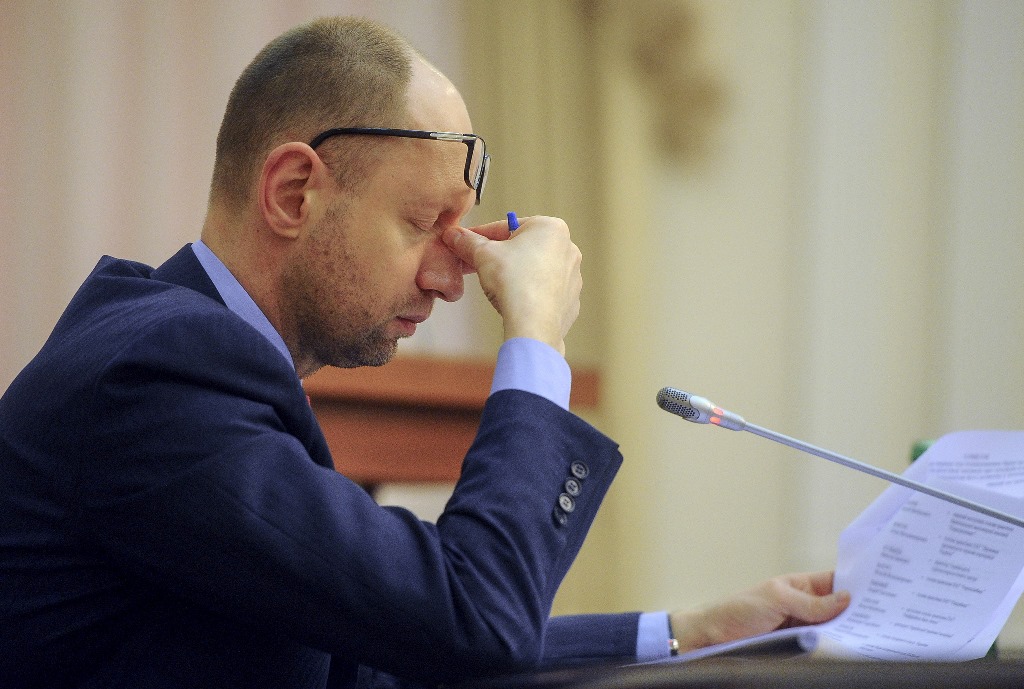
On 10 April, after two years in office, Ukrainian Prime Minister Arseniy Yatsenyuk resigned. President Petro Poroshenko nominated the speaker of parliament, Volodymyr Hroysman, to become the new PM. Both Yatsenyuk’s resignation and Hroysman’s nomination are intended to end the political crisis within the ruling coalition and avoid early parliamentary elections. Polls show that only 11% of the country’s citizens support the president’s party, Petro Poroshenko Bloc “Solidarity” (PPB), and just 2% support the People’s Front (PF). Were early elections to be held, the president would lose influence and Yatsenyuk’s party would not even get into parliament.
Creating a Parliamentary Majority
A new government now will be formed by those two parties. However, it was necessary to accept into both parties’ ranks some non-faction deputies. In accordance with Ukraine’s constitution and the Constitutional Tribunal, a government can be approved only by a parliamentary faction that holds an absolute majority. This is meant to exclude factions that don’t hold an absolute majority but enjoy casual support from independent MPs. Because some parliamentary seats are empty as a result of Russia’s occupation of Crimea and Donbas, the threshold to form a parliamentary majority is, in practice, higher than the usual 50% plus one. While the minimum number of deputies needed to form a coalition is 226, the ruling parties jointly have 217 deputies. Therefore, the president and his associates have adopted methods used by the former, compromised political teams, that is, political and financial pressure (corruption) to attract so-called tushki, or deputies eager to change factions in order to pursue their own interests.
Negotiations on a new government have been taking place for a few weeks. One of the reasons why the political crisis has continued is that MPs’ behaviour is determined not only by their party membership but also, in most cases, by their loyalty to politico-economic patrons, usually oligarchs, who use them to try to achieve their own particular economic goals, or ones completely different from the public interest. Reliable sources say Poroshenko has been holding such talks with Ihor Kolomoyskyi and Rinat Akhmetov. While Kolomoyskyi is said to have obtained the possibility of restructuring his PrivatBank’s obligations in exchange for his consent that Yatsenyuk be removed from power, Akhmetov is believed will benefit from the privatisation of state-owned energy enterprises in which he holds controlling stakes.
A New PM and the Future of the Coalition
Hroysman, 38, if selected as the new prime minister would move up after serving as speaker of parliament. He is believed to be a reformer and one of the closest and most loyal associates of Poroshenko. In 2006–2014, he was mayor of Vinnytsia and enjoyed strong public support (and in 2011, he was awarded the Order of Merit of the Republic of Poland for his contribution to Poland-Ukraine cooperation). From February to November 2014, he served as deputy prime minister, working on such things as decentralisation in cooperation with Polish experts.
The new cabinet will be dominated by people connected to the president, including the likely first deputy prime minister, Stepan Kubiv. Some of the ministers associated with Yatsenyuk (e.g., Interior Minister Arsen Avakov and Justice Minister Pavlo Petrenko) will continue with the new government. Contrary to expectations, Natalie Jaresko, the reformist finance minister, will be replaced. Staying outside of the new government will be two politicians who enjoy the most public support. Andriy Sadovyi refuses to become prime minister and his party, Samopomich (Self-Reliance), will be in the opposition. Mikheil Saakashvili asked his MPs to vote against Hroysman’s candidacy and called on Poroshenko to form a reformist national unity government.
The composition of the new coalition may serve as ballast for the new government. Both PPB and PF are, first of all, the parties in power and their goal is to remain so. Therefore, the stability of the coalition may be weakened by the diversity of the political and economic interests of its members, as well as by the oligarchs who back them. Moreover, if the new government is seen as the result of compromise with the country’s biggest oligarchs, it is likely that the opposition, mostly former coalition partners of PBB and PF, that is, the Radical Party and Batkivshchyna, will formulate more radical demands, both in parliament and outside it. That Poroshenko was mentioned in the “Panama Papers” just gives them an additional argument.
It’s likely the new government will have little public support. More than 50% of Ukrainians do not support the current parliament and are in favour of early elections. However, elections may strengthen pro-Russian political forces because right now more Ukrainians (13%) support Opposition Bloc (the former Party of Regions under ex-President Viktor Yanukovych) than Poroshenko’s party.
Problems with the Reforms
The declared goal of Hroysman’s cabinet will be to implement much-needed reforms. The U.S. and the EU, especially, put pressure on Ukraine to continue down the track of reforms as a condition for allocating more financial support. It will be necessary to enact such measures as raising energy tariffs on individual consumers—IMF demand—as well as to reform social policy, including some changes to the ineffective distribution system for social payments, which is a burden on the country’s budget. Due to the low public support, the parties forming the coalition may try to delay the reforms, fearing their negative effects will result in a further drop in the polls. As a result, it is likely that populist demands in Ukraine will rise, namely increased spending. If Ukraine’s government gives in to such demands it would make it impossible to obtain further financial support from the international financial institutions, leading to an economy in a similar state as during the presidency of Leonid Kuchma.
In 2016, the mass privatisation of state-owned enterprises (SOEs) is planned. More than 400 SOEs will be sold with the profit expected to exceed $650 million. However, the scope and pace of the privatisation will be influenced by the oligarchs who control the SOEs and now extract subsidies from the state budget. Privatisation runs against their interest so they will aim to block the sale of assets from which they make a profit (e.g., Ostchem Holding Ltd, belonging to Dmytro Firtash, blocked privatisation of the Odesa Port Plant) or to take ownership of some SOEs at a reduced price.
Continuation of Foreign Policy
The new government most likely will continue the foreign policy of Yatsenyuk’s cabinet, aiming to deepen cooperation with the European Union and NATO. Pavlo Klimkin, a Poroshenko ally, is likely to stay as foreign minister. A significant role will be played by the new deputy prime minister for European integration. Ivanna Klympush-Tsintsadze, who since 2011 has been director of the Yalta European Strategy, one of the NGOs of oligarch Viktor Pinchuk, may be the leading candidate for this post.
The role of the new cabinet will be to resume cooperation with Ukraine’s international creditors. The political crisis in the country has left the ruling coalition an unclear leader in foreign eyes and is one of the reasons why the IMF’s next tranche of $1.7 billion has been delayed. Moreover, a new government should allow Ukraine to get $1 billion in financial support from the U.S. in the form of credit guarantees.
Ukraine’s government will seek further support from the EU. However, it will be much more difficult since the rejection by Dutch voters in early April of ratification of the EU-Ukraine Association Agreement. An important test of Ukraine’s new government will be achieving visa-free travel with the EU. It is likely that the European Commission will signal the green light to EU Member States as soon as the end of this month. The EU’s decision on this matter should encourage the coalition to make further progress in its reforms.
Hroysman has years of experience in cooperation with Poland, both as mayor and as deputy prime minister. Also, the likely next first deputy prime minister, Kubiv, is the former CEO of Polish-owned Kredo Bank (from 2000 to 2008), and the next education minister, Liliya Hrynevych, was born in Lviv, completed an internship at the University of Warsaw, and wrote her Ph.D. thesis on the Polish education system. This means that the intensification of cooperation between the two countries is possible.