Lithuania: Ukraine’s Advocate in the International Arena
Political Support in the EU and NATO
The support for Ukraine is a manifestation of Lithuania’s aspirations to be a regional leader in shaping the EU’s eastern policy. Lithuania is one of the countries most involved in the development of the Eastern Partnership (EaP). It also advocates giving EaP countries the prospect of EU membership, even though most EU countries are against it for now. Lithuania, though, consistently promotes this idea, seeing it as an instrument for stabilising its neighbourhood.
Lithuanian politicians initiated the so-called “Marshall Plan for Ukraine” and courted the largest EU countries and the U.S. to join. The plan assumed separate, additional funds (including 3% of the EU budget for 2021–2027) for investment in Ukraine’s economy. However, the idea did not gain sufficient political support in the EU, with its opponents underlining the low institutional capacity of Ukraine to absorb such significant financial resources.
Meanwhile, Lithuanian MPs have criticised Hungarian authorities for attempting to block Ukraine’s cooperation with NATO. At the end of last year, 37 members of Lithuania’s parliament signed a letter condemning the decision in Hungary to block meetings of the NATO-Ukraine Commission. The government in Budapest took it in response to changes to education law, specifically the language allowed for teaching, made by Ukraine’s parliament. Hungary is demanding the law be reverted to maintain the status quo in teaching in the languages of national minorities.
Military Cooperation
Lithuania recognises Russia as the main threat to the security of the state and the region. Despite its limited military capabilities, Lithuania supports Ukraine in the fight against Russian aggression. So far, they have implemented the only direct supply of weaponry to the Ukrainian army (in December 2017, the U.S. announced it would authorise the sale of lethal weapons). An agreement on military and technical support was signed by Lithuania and Ukraine in November 2014. In 2018, Lithuania intends to give Ukraine about 7,000 weapons, including AK-type rifles and anti-tank weapons, and about 2 million rounds of ammunition. According to a Lithuanian government resolution of 29 November 2017, the supplied arms will amount to more than €3 million.
Lithuania is also involved in training the Ukrainian armed forces. The programme, launched in 2017, assumes that in 2017-2019, about 60 Lithuanian instructors will be sent to Ukraine. Currently, 30 Lithuanian soldiers participate in training missions and are stationed mainly at the International Peacekeeping and Security Centre (IPSC) in Yavoriv near Lviv and in the 142nd Special Forces Training Centre in Berdychiv. Lithuania also finances training of Ukrainian personnel at the Baltic Defence College in Tartu (Estonia) and offers courses within military units in its own country (e.g., at the Lithuanian Military Academy).
Lithuania’s support for Ukraine also has a multilateral dimension. A Lithuanian is a member of the international advisory group on security-sector reform at Ukraine’s Ministry of Defence of Ukraine alongside representatives of the U.S., Canada, UK, and Poland. In addition, Lithuania provides financial assistance to the NATO Trust Funds for Ukraine, including a medical rehabilitation fund. Lithuanian soldiers also cooperate with Ukrainian units as part of the tripartite Lithuanian-Polish-Ukrainian Brigade (LITPOLUKRBRIG).
Energy Security
A key goal for Lithuania, like Ukraine, is energy independence from Russia and increasing its own energy security. Both countries strive to synchronise their electricity and energy systems with the EU and leave the Soviet-era IPS/UPS grid. They also oppose the construction of the Nord Stream 2 gas pipeline, which would route most gas supplies from Russia away from Ukraine. Lithuania-Ukraine memoranda signed in December last year assume the further strengthening of cooperation in the nuclear energy sector, including the decommissioning of nuclear power plants, and in the gas industry. Lithuania also counts on Ukraine’s support in blocking electricity imports from the Astravyets, Belarus, power plant near the Lithuanian border. That project is controlled by the Russian energy company Rosatom, but the Lithuanian government says it does not meet the environmental security criteria of the Espoo Convention.
The Lithuanian government also supports the inclusion of Ukraine in the activities of the NATO Energy Security Centre of Excellence (NATO ENSECCOE) in Vilnius. Ukrainian energy operator Ukrenerho and the National Institute for Strategic Studies work with centre, mainly on analysis of potential threat scenarios. As part of the Coherent Resilience 2017 exercise, the centre simulated threats to critical Ukrainian infrastructure, ranging from telephone and IT disruptions to a failure of power-grid management systems. Ukraine, however, aims to broaden the spectrum of activities coordinated with the centre and to formalise them. During a visit by Lithuanian Deputy Defence Minister Vytautas Umbrasas in Kyiv in December 2017, his Ukrainian counterpart handed him an official letter seeking to upgrade the status to partner country.
Hybrid Threats
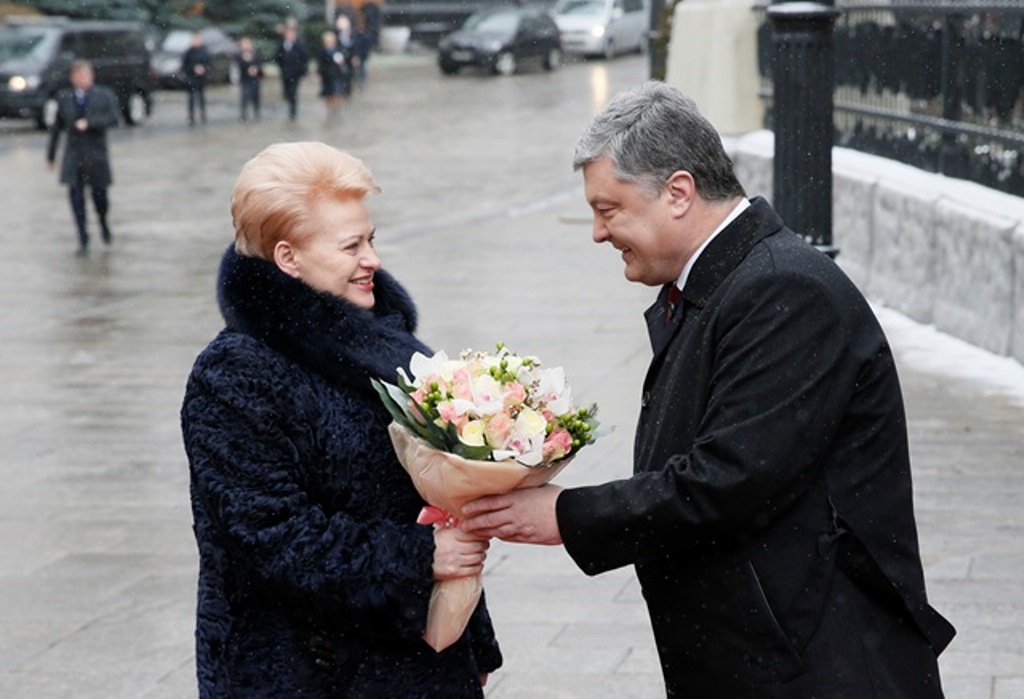
Both Lithuania and Ukraine are exposed to Russian hybrid activities, the aim of which is to undermine bilateral cooperation and weaken NATO cohesion (e.g., in September last year, one representative of the Russian-controlled occupation authorities in Donbas accused Ukrainian soldiers of allegedly beating Lithuanian military instructors in the Luhansk region). Lithuania fears that Russian hybrid activities may lay the groundwork for military aggression. Both Lithuania and Ukraine thus cooperate in combating threats deemed below the threshold of war, including those related to Russian propaganda activities. For example, during a visit by Ukrainian President Petro Poroshenko to Vilnius in December 2017, Lithuanian President Dalia Grybauskaitė agreed to transfer to Ukraine digital TV signal amplifiers to enable Ukrainian TV channels to broadcast to areas of Donbas occupied by Russian irregular forces.
Lithuania’s commitment to Ukraine also translates into stronger support for Lithuania from its foreign partners, evidenced by the November 2017 backing for its initiative to strengthen EU cybersecurity cooperation through the PESCO programme (supported by 25 EU countries). The country has also proposed the creation of a special rapid-response group to identify cyberthreats, expanding the spectrum of tasks beyond existing information exchanges on detected attacks. In principle, this would contribute to increasing the ability to respond to the Russian actions, including in Ukraine.
Conclusions and Perspectives
Despite limited resources and opportunities, Lithuania will remain actively involved in supporting Ukraine. This cooperation is perceived as an instrument to increase both Lithuanian security and strengthen its international position, including in a constructive approach to dialogue with NATO partners. The common perception of threats is conducive to strengthening Ukraine-Lithuania bilateral relations. Both sides will strive to deepen cooperation between their defence industries and in the energy sector.
Stronger Lithuania-Ukraine relations in the defence sector is beneficial for Poland. It increases the defence capabilities of the Ukrainian armed forces and favours their adaptation to NATO standards. These are some of the main goals of Polish foreign policy—to develop joint activities in political-military cooperation and in energy security. Given the needs of the Ukrainian military, especially for training and material, the Lithuanian activities complement Polish policy and are partially implemented with Polish military units.
At the same time, given current Poland–Ukraine relations, Lithuania will try to position itself as Ukraine’s main advocate on the international arena, especially since the Lithuanians and Ukrainians share the same perspective that security cooperation should not be burdened by contentious issues in bilateral relations.