
İmamoğlu Arrested: Türkiye Shifting to Autocracy
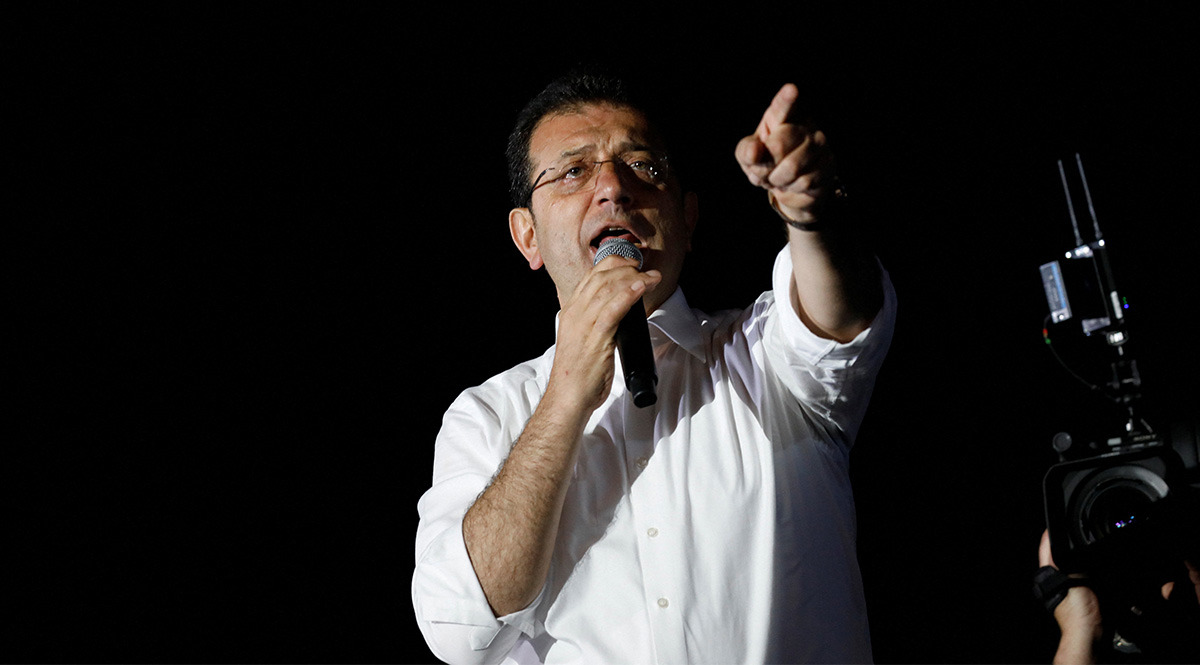
Demonstrations in Türkiye erupted in March when the Istanbul prosecutor’s office launched an investigation of that city’s mayor, Ekrem İmamoğlu of the Republican People’s Party (CHP), the main opponent of current head of state Recep Tayyip Erdoğan in the 2028 presidential contest. The attack on the opposition candidate appears to be a turning point indicating Türkiye’s entry onto the path of authoritarianism, which will negatively affect the state of Turkish-EU relations.
.png) Umit Bektas / Reuters / Forum
Umit Bektas / Reuters / Forum
Pressure from law enforcement agencies prompted Istanbul University authorities to revoke İmamoğlu’s diploma, depriving him of the opportunity to compete for the country’s highest office. On 23 March, the day of the CHP presidential primaries, the Istanbul mayor was detained on charges of “forming and leading a criminal organisation, accepting bribes, embezzlement, illegally recording personal data and falsifying public tenders in connection with a financial investigation”. A month after his detention, İmamoğlu is still being held in Silivri Prison, and the prosecutor’s office is also investigating his possible ties to terrorist organisations. Although the intensity of public protests has declined, the CHP has consolidated its position after an extraordinary congress on 6 April and continues to hold anti-government demonstrations. Opposition activity is not limited to the metropolis and is also evident in conservative localities such as Yozgat, a traditional bastion of support for the government camp.
Opposition Actions and the Course of Protests
Özgür Özel, chairman of the CHP, called the detention of Istanbul’s mayor a “civilian coup”. The pro-Kurdish People’s Equality and Democracy Party (DEM) called it a “blow against justice and democracy”, and DEM politician Meral Danış Beştaş declared that İmamoğlu’s detention is sabotaging the process associated with the new Kurdish opening, an attempt at a political solution to the armed conflict between Türkiye and the Kurdistan Workers’ Party (PKK). Demonstrations organised by the CHP have been taking place in Türkiye since 19 March. Protesters are convinced that the allegations made against İmamoğlu are false and an attempt to remove him from contention for the presidency. The most intense phase of the protests occurred at the end of March in metropolitan areas such as Istanbul, Ankara, and Izmir, as well as in Konya, Trabzon, and Rize. The detention of Istanbul’s mayor unleashed nationwide layers of public discontent over government policies.
On 23 March, the CHP allowed any citizen who wanted to show solidarity with İmamoğlu to participate in the presidential primaries. The decision prompted 15 million people, including 1.7 million registered party members, to cast a vote in support of his presidential candidacy. Özel also called on opponents of the power camp to boycott the popular Espressolab coffee shop chain due to its founder’s close ties to Türkiye’s ruling Justice and Development Party (AKP), from which Erdoğan hails. Also on the list of boycotted institutions was the D&R bookstore chain, which is under the control of the pro-government Turkuvaz Media Group. It also includes several stations of Haber TV, which has stopped broadcasting the protests. President Erdoğan considers the demonstrations a kind of street terror, but the attitude of the participants is overwhelmingly peaceful. Among those taking part in the protests are trade unionists, pensioners, members of feminist organisations, and academics. The largest group of protesters are students, who are demanding the resignation of the government and the release of İmamoğlu. In an act of defiance against police violence, the young demonstrators are, among other things, reading Nutuk (Great Speech) by Mustafa Kemal Atatürk, the founder of the Republic of Türkiye, on the streets and university campuses as a show of defiance against the conservative power camp and a reminder of the secular foundations of the state.
Government Camp’s Response
The government has taken measures to stop the demonstrations. In the early stages of the protests, police used water cannons and rubber bullets. Authorities restricted public gatherings and access to social media. The AKP’s official narrative takes a moderate stance and holds the opposition responsible for the protests and clashes with police. The group’s spokesman Ömer Çelik argued that the CHP is abusing the democratic right to demonstrate to quell conflicts within the party. The government camp also seeks to split the opposition and divide the CHP and the pro-Kurdish DEM. Voters of the latter grouping supported İmamoğlu during last year’s Istanbul local elections. The DEM is currently in a difficult position, as it opposes İmamoğlu’s detention while negotiating with the AKP’s coalition partner, the Nationalist Action Party (MHP), to end the isolation of arrested PKK leader Abdullah Öcalan.
International Reaction to the Protests
The repressive actions of the Turkish government have not met with clear opposition beyond rhetoric from the international community. On 20 March, the outgoing German Chancellor Olaf Scholz expressed his disappointment with the Turkish government’s policy. He described İmamoğlu’s detention as a depressing development for Turkish democracy. A White House communiqué released on 25 March, following a meeting between Turkish diplomatic chief Hakan Fidan and Secretary of State Marco Rubio, included only one sentence expressing U.S. concern about the arrests and demonstrations in Türkiye. Deep concern over the detention of Istanbul’s mayor was expressed by European Commission President Ursula von der Leyen, who stated also that “as a member of the Council of Europe and an EU candidate country, Turkey must respect democratic values [...]”. On 28 March, the Congress of Local and Regional Authorities of the Council of Europe called on the Turkish authorities to immediately release İmamoğlu. On 29 March, EU Enlargement Commissioner Marta Kos demanded “protection of independent journalism and respect for freedom of expression” in Türkiye.
Conclusions and Outlook
The demonstrations against İmamoğlu's detention have created a public stir not seen since the anti-government protests in Istanbul’s Gezi Park in 2013. The persistence and nature of the demonstrations in the coming months will depend on the opposition, whose goal is to weaken the ruling camp and bring about early elections. Erdoğan is counting on discouraging participants, which will lead to the demonstrations dying out on their own. The DEM’s support for the CHP could invalidate the progress of the new Kurdish peace process. Increased repression of the opposition can be expected to adversely affect the state of the Turkish economy (according to state statistics agency TÜIK, Turkey’s annual inflation in March this year was 38.1%, unemployment stands at 8.2%, and according to a UN report, the projected growth of the CHP this year will be 3.1%), and continued domestic instability will undermine investor confidence.
The tightening of authoritarian tendencies in Türkiye is a consequence of long-term processes that began in 2013 and accelerated after the failed coup attempt in 2016 and Türkiye’s transition from a parliamentary-cabinet system to a presidential one in 2018. The authorities successively weakened democratic institutions, politicised the judiciary and began to use it to persecute critics of the government. Erdoğan took advantage of favourable international conditions related to Donald Trump’s assumption of power in the U.S., which shows no interest in democratic standards in other countries.
The actions against İmamoğlu are part of the government’s long-standing and systematic anti-democratic policy against the opposition. This includes the arrests of journalists, businessmen, academics and the removal of mayors—DEM members—from their posts and their replacement by government appointees.
The lack of harsh international criticism indicates that both the U.S. and EU administrations are unwilling to confront the Turkish government. Although the intensification of authoritarian tendencies will exacerbate Turkish-EU relations, the EU is unlikely to press Türkiye to abandon its authoritarian course in domestic politics. This is due to the EU’s perception of it as an indispensable partner that, due to its military potential, will influence the shape of the European security architecture, given the U.S. administration’s unwillingness to provide security guarantees for Ukraine. Türkiye’s importance in international forums and its involvement in Ukraine and Syria were the main rationale for Prime Minister Donald Tusk’s visit to Ankara in March.


(1).png)