Türkiye Aims to Join the Shanghai Cooperation Organisation
President Recep Tayyip Erdoğan once again declared his intent to join Turkey to the Shanghai Cooperation Organisation (SCO). Erdoğan's earlier announcements in 2012 and 2016 did not lead to membership in the organisation. The declaration aims to mobilise conservative-nationalist voters and serves as a diplomatic tool towards Russia and Western countries.
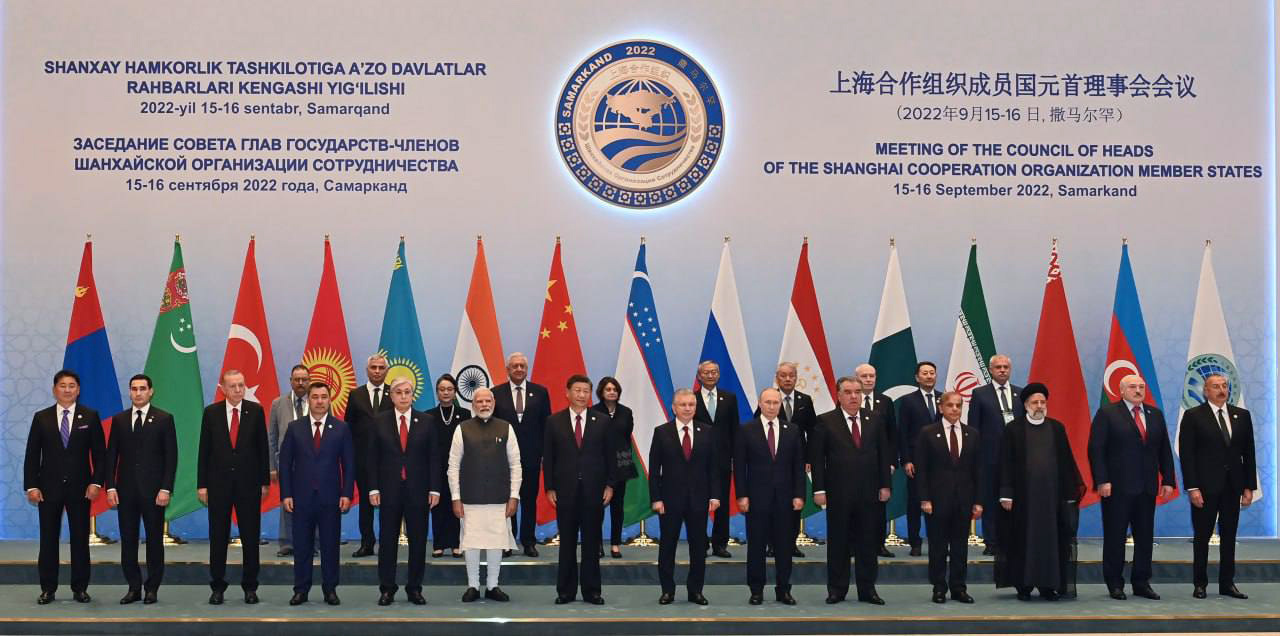 Iranian Presidency/ Zuma Press/ FORUM
On 15-16 September, Erdoğan, at the invitation of Vladimir Putin, participated for the first time in the summit of the Heads of the Council of States of the SCO, held in Samarkand, Uzbekistan. Türkiye participated in it with the status of a Partner in Dialogue, like the countries of Armenia, Azerbaijan, Cambodia, Nepal, and Sri Lanka. Currently, the SCO is not a real counterbalance to Western influence, nor is it a military alliance like NATO or the Collective Security Treaty Organization (CSTO). However, it legitimises Russian military influence, as well as China's economic expansion in Central Asia. Moreover, the members of the organisation view a multipolar international order as an alternative to the dominant position of Western countries.
Türkiye’s Relations with SCO Countries
President Erdoğan, without specifying a date, declared Türkiye’s willingness to join the organisation in which China and Russia play a dominant role. The declarations of the Turkish side are an expression of aspirations for stronger empowerment in Asia, an idea promoted by advisor to the president, İbrahim Kalın, pointing to a “paradigmatic change” in Türkiye's relations with this continent. Turkey is interested in the SCO because of the country’s willingness to deepen economic ties with the organisation’s member states, cooperation in the field of security, and the search for alternative forms of cooperation with emerging regional powers, which is in line with the Turkish vision of a multi-dimensional foreign policy strategy. It is true that the government camp declares that it wants the process of Türkiye’s accession to the EU to continue, nevertheless it expects that joining the community will not take place at the expense of membership in other organisations. The arguments of Turkish decision-makers fit in with the narrative on the decline of the Western-centric international order, popular among China, Russia, Iran, India, and Pakistan. They perceive the SCO as an organisation that can constitute an alternative political and economic point of reference to the West. China and Russia are unequivocally striving to undermine the role of the U.S. in the global balance of power, and Iran points out that the SCO is obliged to develop new solutions and implement measures to counter the EU’s unilateral policies and sanctions.
Turkish Instruments of Influence in Central Asia
After the collapse of the USSR, among Turkish decision-makers the conviction spread that Türkiye could play an important role in shaping the new international order. The expression of this was popularisation of the Turkish political and development model among the linguistically related emerging republics in Central Asia and the Caucasus, most of which today belong to the SCO. The concept was approved by the West because it was to counterbalance Iran’s ideological influences and at the same time, to help the countries of the region establish a free-market economy and a secular government model. Over time, Western support weakened as concerns began to mount about the excessive strengthening of the Pan-Turkism movement, which could generate conflicts. However, Türkiye has not given up its efforts to increase its influence in Central Asia and attempts to create a counterbalance to Russia and China, which is particularly visible on the security level.
At the end of March this year, Erdoğan participated in the second meeting of the High-Level Strategic Cooperation Council in Uzbekistan. During the meeting, Türkiye and Uzbekistan signed nine agreements, including a preferential trade agreement and a framework agreement on military cooperation. In April, Türkiye and Tajikistan agreed the same. The countries’ representatives referred to historical and cultural ties, expressed their readiness to share their experiences in border security issues and combating terrorism, and stressed the need to strengthen cooperation in the field of military education between the two countries. The sale of Turkish arms industry products to the countries of the region is also important. In December 2020, Turkmenistan became the first Central Asian republic to purchase Bayraktar TB2 unmanned aerial vehicles (UAVs). In December 2021, Kyrgyzstan bought the Turkish UAVs, and controversy came quickly after they were allegedly used in border clashes with Tajikistan. The most important result of the first visit of the President of Kazakhstan Kassym-Jomart Tokayev to Türkiye was the signing of an agreement on the commencement of the co-production of Turkish Anka UAVs in Kazakhstan.
Türkiye also uses soft-power tools to develop relations with the countries of the region. This is achieved, for example, by the popularity of Turkish series in Central Asian republics and the organisation of sports events aimed at them. In addition, Türkiye is involved in the activities of the Organisation of Turkish States. During last year’s summit of the organisation uniting Türkiye, Kazakhstan, Azerbaijan, Kyrgyzstan, and Uzbekistan, leaders adopted a strategic document entitled “Turkic World Vision-2040”. The document focuses on strengthening foreign policy coordination, cooperation in the field of security, and the signing of free trade agreements between member states.
Relations with Russia and the West
Erdoğan is using his message expressing Türkiye’s willingness to join the SCO as a gesture towards Russia, with which Türkiye has ties in the economic, energy, and tourism sector, as well as tactical cooperation in Syria. Erdoğan also used his participation in the SCO summit to hold a bilateral meeting with Putin, during which it was agreed that Türkiye would make 25% of the payments for gas in roubles. In the face of the crisis in the Turkish economy, the achievement of economic benefits in relations with Russia may affect Erdoğan’s political survival in next year’s elections. For Western countries, concerned about Türkiye’s planned accession to the SCO, Turkish decision-makers justify this rapprochement with the necessity to diversify economic and security opportunities in order to pursue Turkish national interests.
The Turks themselves are trying to allay Western fears that rapprochement with the SCO would weaken Turkish support for Ukraine’s security. This is evidenced by further attempts to organise ceasefire negotiations and the refusal to sell winter clothing to the Russian military.
Conclusions and Perspectives
Membership in the SCO would mean that Türkiye would have to align its policy in the region with China and the U.S., which would limit its ability to act independently. The benefits of membership in the SCO would be much smaller compared to membership in NATO and potentially the EU. Despite the articulated willingness to join the SCO, Türkiye’s accession to the organisation as a full member is unlikely. Erdoğan used his visit to Samarkand to mobilise the conservative-nationalist electorate, which believes that Turkish foreign policy should be oriented towards China and Russia rather than towards the EU and the U.S. According to a survey conducted in September this year; this argument may have partly contributed to the increase in the number of Turks approving the way Erdoğan conducts politics (an increase of 2.4 percentage points to 46.6%). The aim to join the SCO is a signal to the West that Türkiye under Justice and Development Party (JDP) rule is not giving up its multi-dimensional foreign policy strategy and is continuing to strive to expand its ability to act in the international forum instead of relying solely on the West. If the current government coalition of the AKP and the Nationalist Movement Party (NMP) regains victory in next year’s parliamentary and presidential elections, it can be expected that the willingness to join the SCO will become entrenched in the Turkish discourse on the vision of Turkish foreign policy. This may increase the allies’ distrust of Türkiye’s position in Euro-Atlantic structures.