The EU and Australia strengthen trade and security partnership
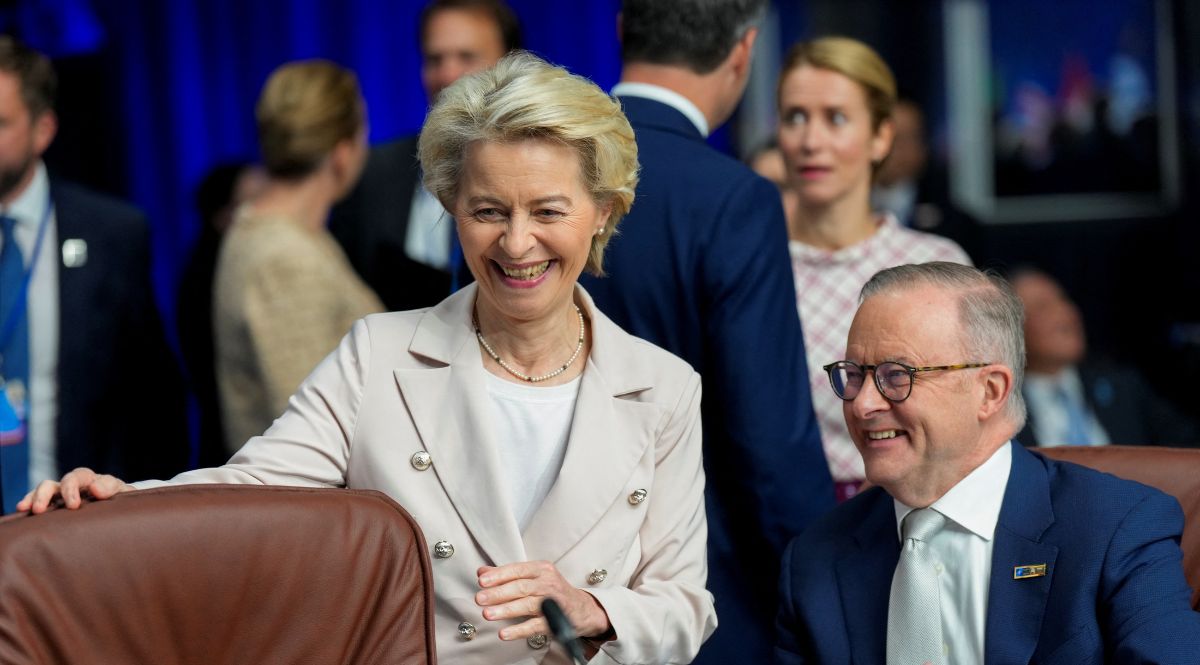
On 24 March, during a visit to Australia, European Commission President Ursula von der Leyen and Prime Minister Anthony Albanese announced the conclusion of negotiations on a free trade agreement and the establishment of a Security and Defence Partnership. These agreements are intended to help both sides diversify their trade, reducing dependence on China, whilst increasing resilience to US political and economic pressure. It also presents an opportunity for Poland to intensify its cooperation with Australia.
 INTS KALNINS / Reuters / Forum
Stronger economic cooperation
It took eight years and 15 rounds of negotiations to finalise the Free Trade Agreement (FTA). Talks gained momentum last year following the 2025 Australian elections and in the face of trade and political pressure from the US following Donald Trump’s return to the presidency. The agreement will enter into force once it has been signed and approved by the European Parliament, the Council of the EU and the Australian side, which could happen by the end of the year.
The agreement will eliminate tariffs on 99% of trade in goods (approximately 97% upon entry into force, with the remainder phased out over a period of up to seven years), with exceptions for sensitive products such as steel and certain agricultural products. In 2024, the value of EU-Australia trade stood at €87.5 billion, comprising €49.4 billion in goods and €38.1 billion in services. The EU has a trade surplus with Australia, exporting almost four times as much (€38.7 billion in 2024) as it imports (€10.7 billion) from the country. The EU estimates that the agreement will increase exports to Australia by 33% over the course of a decade. EU exporters are set to save €1 billion a year through the elimination of tariffs and reduced red tape, whilst the EU’s GDP is expected to gain an additional €4 billion by 2030. According to the European Commission, EU investment in Australia could rise by 87% from the current €125 billion.
The FTA will strengthen Australia’s position as an EU partner. In 2024, it ranked only 20th in EU goods trade and accounted for 1% of EU trade. Australia is a more important export partner (15th place and a 1.5% share of exports from the EU) than an import partner (36th place and a 0.4% share). For Australia, the EU is the third-largest trading partner, accounting for 8.6% of trade value (including just 3.3% of exports and as much as 14.7% of imports). The significance of the agreement is limited by the fact that tariff rates were already at a relatively low level (around 5% for most product categories).
The greatest benefits will accrue to EU companies that already sell the most to Australia, namely those in the machinery and equipment sector (€9.7 billion and 25% of total EU exports in 2024), the transport equipment sector (€7.2 billion, 18.7%), and the chemical industry (€7.5 billion, 19.5%). Agri-food producers will also benefit (the sector has so far exported goods worth €4.1 billion, 10.7% of EU exports), including alcoholic beverages, cheese, milk and chocolate. A compromise favourable to the EU has finally been reached on the most contentious issue, which had stalled negotiations since November 2023—namely, imports of red meat from Australia. A target quota for additional imports of beef into the EU was set at 30,600 tonnes (of which 55% will be subject to a 0% tariff and 45% to a 7% tariff – the maximum quotas will be phased in over 7 years) and 27,000 tonnes for lamb (with limits also being increased gradually over 7 years).
These quotas are lower than Australia’s original targets (50,000 tonnes for beef and 67,000 tonnes for lamb) or those agreed in the EU’s agreement with New Zealand. This means that the EU is not at risk of being ‘flooded’ with Australian beef, as these quotas account for only 0.5% of beef consumption in the EU and less than 2% of Australia’s beef exports. Furthermore, the single market is protected by stringent food quality standards, and in the event of an excessive influx of products, the EU will be able to suspend the application of the agreement. The FTA also establishes, amongst other things, ambitious and legally binding rules on sustainable development, including environmental protection and climate issues, as well as labour standards. Despite criticism of the agreement, primarily from Australian and EU (mainly French) farmers, it does not appear to have provoked the same level of resistance as the FTA with Mercosur. The difficulties in adopting the latter agreement may actually have helped in reaching a compromise by Australia agreeing to lower meat quotas.
Partnership on critical raw materials
A key aspect of the FTA is to facilitate trade in critical raw materials in order to reduce both parties’ dependence on China. Australia is a major producer of lithium (the world’s largest), manganese and aluminium, which are needed to manufacture, amongst other things, batteries for electric vehicles and wind turbines. Most of Australia’s mineral production is exported to China, where it is processed and resold, including to Europe. By removing tariffs and export restrictions, the EU and Australia are easing the implementation of the strategic partnership on critical raw materials already adopted in 2024. The EU will be able to import more of these minerals more easily, invest in their extraction and processing in Australia, and support trilateral initiatives for processing in Southeast Asian countries.
Another way to strengthen cooperation on critical technologies is the announcement of negotiations on Australia’s accession to the Horizon Europe research programme. This would boost cooperation in areas such as clean hydrogen technology, artificial intelligence and quantum computing. The FTA will also facilitate the mobility of researchers and scientists, trade in digital goods and services, and mutual investment, whilst strengthening the protection of intellectual property and geographical indications, thereby creating the conditions to boost innovation in both economies.
Security Agreement
The parties signed a Security and Defence Partnership (SDP) on 18 March this year. With this agreement, Australia became the EU’s eleventh partner worldwide and the fourth in the Indo-Pacific region (after Japan, South Korea and India). This initiative was launched under the EU’s 2022 Strategic Compass, which sets out a framework for strengthening cooperation with key like-minded partners who share a common assessment of threats. The SDP will cover the areas already mentioned in the Framework Agreement in force since 2022, including maritime and digital security, but places greater emphasis on hybrid threats, disinformation and the use of new technologies such as artificial intelligence.
A key element of this partnership is the announcement of defence sector cooperation. The Australian side hopes this will enable it to participate in the modernisation of armaments in EU countries and even provide access to funds under the SAFE programme. Australia additionally seeks greater EU engagement in the Indo-Pacific security sphere. The agreement also paves the way for more effective coordination of activities and the exchange of experiences regarding the war in Ukraine, with both sides now more willing to share their assessments of threats from China and Russia.
Conclusions and recommendations
The conclusion of the FTA negotiations opens up new opportunities for economic and technological cooperation and confirms the strong political will to bring the EU and Australia closer together. By signing the SDP, Australia joins a select group of Asian partners with whom the EU sees potential for developing cooperation on defence and security issues. This means that the partnership with Australia extends beyond the economy and increasingly encompasses strategic issues. The effective implementation of the agreements and the realisation of their potential by Australia and EU member states will be key. To counter pressure from China and the US, the parties will increasingly exploit opportunities for economic and technological cooperation, including the restructuring of supply chains for critical raw materials.
Australia’s strong support for Ukraine and the EU’s readiness to increase its engagement in the Indo-Pacific are the foundation for closer security ties and cooperation between their defence industries. At the same time, the latest trade agreement signed by the EU is countering the US-promoted protectionist tendencies in the global economy. The EU-Australia partnership thus becomes a key element in supporting free trade and multilateralism based on international law, which is under threat from the major powers. It forms the framework of a coalition of ‘middle powers’ interested in stabilising and reforming the international order—a coalition that other countries, such as Canada, Japan and India, may eventually join.
The EU’s actions should encourage Poland to intensify its cooperation with Australia on political, economic and security issues. Support for Ukraine and the modernisation of the Polish armed forces create significant potential for cooperation between defence industries. Both sides may be particularly interested in exchanging experiences regarding the countering of hybrid threats from Russia and China. The reduction of customs duties and the wider opening of the Australian market also create new economic opportunities for Polish companies and farmers. Polish entities should also invest in Australia’s critical materials sector. A preparatory meeting of foreign ministers, culminating in the first prime ministerial visit in decades, would provide a crucial opportunity to elevate bilateral relations.