Russia and Belarus Creating Drone Corps
Russia was quick to catch up with unmanned aerial vehicle (UAV, drone) production and the use of them, which has become apparent in the years since its full-scale invasion of Ukraine. In late 2024, it established a troop corps for unmanned systems. Belarus followed in 2025. For NATO countries, this change implies a need to further increase investment in unmanned systems for its members’ armed forces, an increase in drone capabilities, and a revision of the approach to border protection, as Belarus and Russia are already using drones of various types to conduct hostile hybrid activity against Alliance countries.
 credit: Vasily Fedosenko / Reuters / Forum
Russia’s Approach. In the Russian operations against Ukraine, unmanned systems are playing an increasingly important role. The Russian army uses around 3,500 of them daily to identify and strike targets, including civilian ones, conduct reconnaissance, radio-electronic warfare, combat enemy artillery, as well as mine and mine clearance and logistics. The use of such a large number of drones each day has forced Russia to rapidly develop their production. It is currently producing aerial reconnaissance drones (e.g., Orion, Zala), strike drones (Shahed-136/Gieran-2), and multi-role drones (Orlan-10), among others, and is working on maritime drones (Orkan, BEK-1000), and ground drones (Shanghai, Lyagushka). It is concentrating on aerial strike drones, aiming to produce 500 a day (currently around 100). Because of Ukraine’s developing capabilities to jam and paralyse radio-guided drones, Russia has also invested in fibre-optic cable-controlled drones resistant to radio signal interference. Their increasing payload capabilities give them an ever-increasing range, although they are still limited to the immediate frontline, in part because of the need for fibre wire guidance.
Russia is being assisted in the production of drones by China, which is basically donating the technology and necessary components, and by Iran, which exports not only ready-to-use drones but also has licenced the production of the Shahed type, allowing Russia to open a factory for them in Yelabuga (Tatarstan). However, despite such significant progress in production capabilities and purchases (the Russian armed forces received more than 1.5 million drones in 2024), Vladimir Putin stressed at a meeting of the military-industrial commission on 23 April that their numbers proved insufficient to provide frontline superiority.
Putin’s announcements indicate that Russian industry will also focus on battlefield robotisation projects and the development of artificial intelligence (AI), which will be tasked with collecting and analysing data acquired by drones used on a massive scale, among other things.
The growing role of drones for the Russian military has also led the leadership to create a troop corps for unmanned systems, which will be a separate type of armed forces. In December 2024, Defence Minister Andrei Belousov announced that they should reach operational capability by the end of Q3 2025. This indicates that Russia is not only developing its capability to produce and upgrade drones but also to using them effectively, including in surveillance, diversion, and sabotage operations.
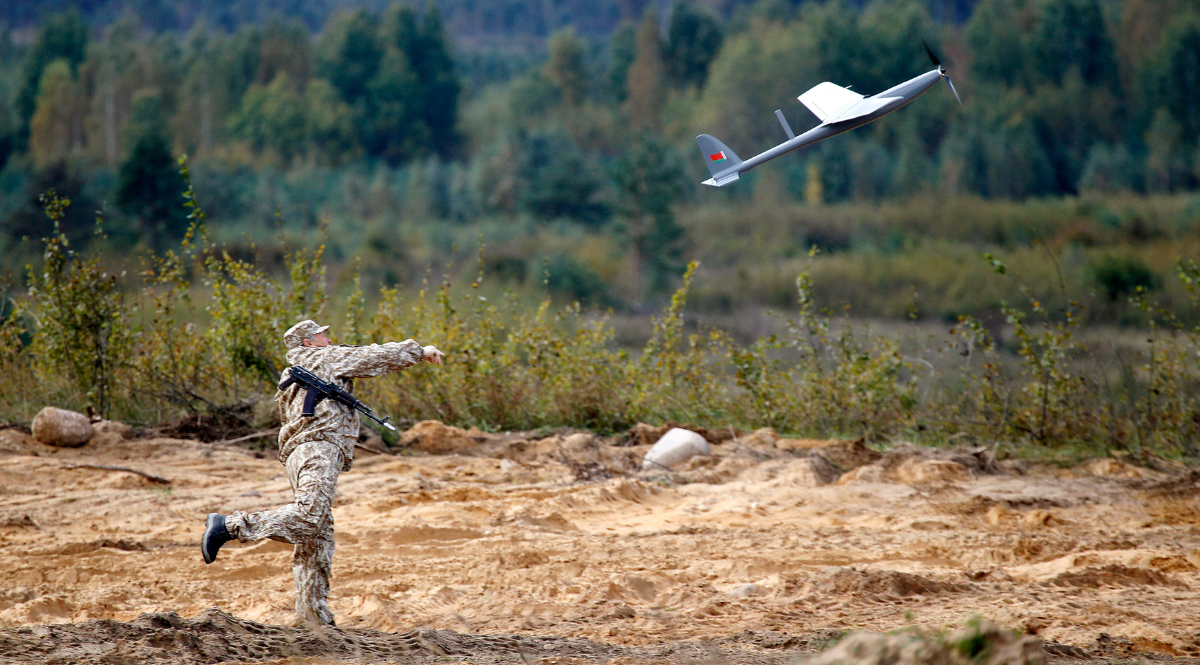
Belarus’ Approach. Drone production became one of Belarus’ priorities in the early 2010s as part of its 2011-2015 modernisation programme. This was driven by the need to increase the state’s defence capabilities with a relatively small budget, the equivalent of around $500 million at the time. Belarusian arms companies and universities, such as the Armed Forces Military Academy and the Physical-Technical Institute of the National Academy of Sciences, were involved in the production of drones. As a result, Belarus is producing drones for a variety of applications—training (i.e., Condor), target acquisition (Chekaan), reconnaissance (recon; Moskit, Bekard), and recon-strike (Hunter).
Belarus is keen to sell its production capacity to Russia, which has proposed to its authorities the construction of a drone production facility capable of producing around 100,000 drones per year. The project has been approved by both leaders, Putin and Alexander Lukashenka, indicating that the two countries will coordinate the production of drones and the ways in which they can be used.
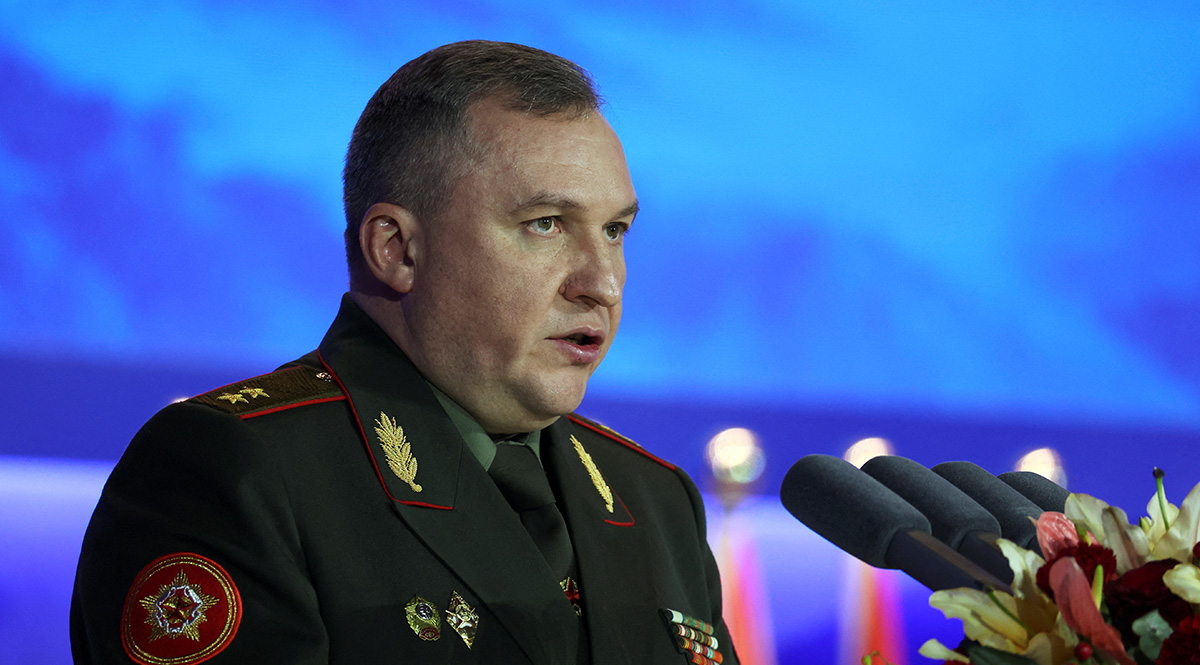
Similar to Russia, Belarus has also decided to establish a troop corps for unmanned systems. They are an autonomous component of the special forces, but drone units are also being set up in the artillery and mechanised brigades. Their purpose is, among other things, to carry out reconnaissance, inflict losses on the enemy, and support for artillery, engineering, transport, and communications security. Belarus is also developing radio-electronic warfare systems to further enhance its security. Progress in the production of drones and the creation of troops of unmanned systems is of interest to Lukashenka, who, unlike Putin, does not believe that drones will be a solution to dominate the modern battlefield.
A New Dimension to the Drone Threat. By investing in the development of unmanned systems, Russia and Belarus are seeking to neutralise the technological advantage held by NATO members, which they consider hostile. Therefore, coordination in training and the operational modalities of the two countries’ emerging drone forces can be expected, which will raise additional challenges for NATO allies.
Russia and Belarus, using the experience of the war in Ukraine, will also focus on the development of drones that directly threaten soldiers fighting on the front line (e.g., attacks on entrenched troops) and that make evacuation (especially of the wounded) and resupply extremely difficult. These developments will not only increase the sense of threat among the Alliance countries but also will necessitate the redesign of shelters, fortifications, and medical security.
Drones are also an increasingly important tool in the conduct of hostile hybrid activities by Belarus and Russia against NATO countries. They can be used for sabotage activities targeting critical infrastructure, including especially ports, power plants, and railway hubs. There is also a growing risk to undersea infrastructure, such as pipelines and fibre-optic cables, especially in the Baltic Sea.
Drones are also used for reconnaissance activities in border areas. The activity of Belarusian drones has been observed on the border with Poland, with the aim it seems of tracking Polish patrols and monitoring the defence infrastructure there, which, among other things, allows the Belarusian side to more effectively direct and control migrants who try to cross the external EU/NATO border there. Due to the ease of operating drones, an intensification of their use can therefore be expected, which will cause additional security challenges, and not only for the countries on NATO’s Eastern Flank.
Conclusions and Recommendations. The actions of Belarus and Russia, which are planning to greatly develop drone-production capabilities, will create a number of new challenges for the Alliance. One of the most important will be the need to also increase the production of drones, which will require political decisions, an adequate level of funding, the involvement of the local arms industry, and cooperation with Ukraine, which has enormous experience in their cheap and rapid production and use. The significance of the wide use of drones on the battlefield also implies the need to better secure one’s own equipment, especially the more expensive kind, such as tanks, artillery, or missile and air-defence systems. It should also factor into the design of safety and security measures for soldiers, as well as in evacuations and resupply.
The use of unmanned systems to conduct hostile hybrid activity also raises the need to adequately secure facilities that are key to the security of the state, such as ports, power stations, airports (including military airports), or large logistical hubs. It also will be necessary to develop radio-electronic warfare systems and implement modern anti-drone systems that will protect such facilities, as well as to adequately secure border areas. Simultaneously, Alliance countries should invest in capabilities for the use of AI in which drones are part of a large system of data collection and analysis, not only to monitor the activity of an adversary directly but also to spot gaps in members’ own defences.
The establishment of troop corps for unmanned systems by Belarus and Russia also implies the need to intensify the building of similar capabilities among the armed forces of Alliance members, which are currently at various stages of such development. It would also be worthwhile for NATO countries to increase cooperation with each other in this regard, sharing experiences and conducting joint exercises to increase the interoperability of forces. It may also be necessary to inform and train civilians (e.g., as part of Poland’s emerging civil defence) so they can effectively support the country’s uniformed services in a crisis.