Protection of Digital Platform Workers in the EU
The European Commission (EC) has proposed a directive that provides protection of people performing work for digital platforms, especially in professions that do not require specialist qualifications. If the proposal is accepted in the shape presented by the EC, it will be a breakthrough solution on a global scale that adjusts labour law to the challenges of the digital economy. It will also strengthen the EU’s position in relations with platforms.
 Fot. Reuters/ALBERT GEA/ FORUM
On 9 December, the EC proposed a directive regulating the principles of working conditions of digital (online) labour platforms. According to estimates, around 28 million people currently work on more than 500 digital platforms in the EU. Most of these employed have the status of self-employed (entrepreneurs). However, according to the Commission, for around 5.5 million of them it may be an inadequate form of “employment” because it deprives them of proper employment rights such as leave, health benefits, or pension contributions.
The problem of the lack of a legal framework for this type of work currently affects a small number of economically active people (less than 2%) in the EU, but forecasts show that the demand for platform workers is growing at a rate of around 20% per year.
Characteristics of Platform Work
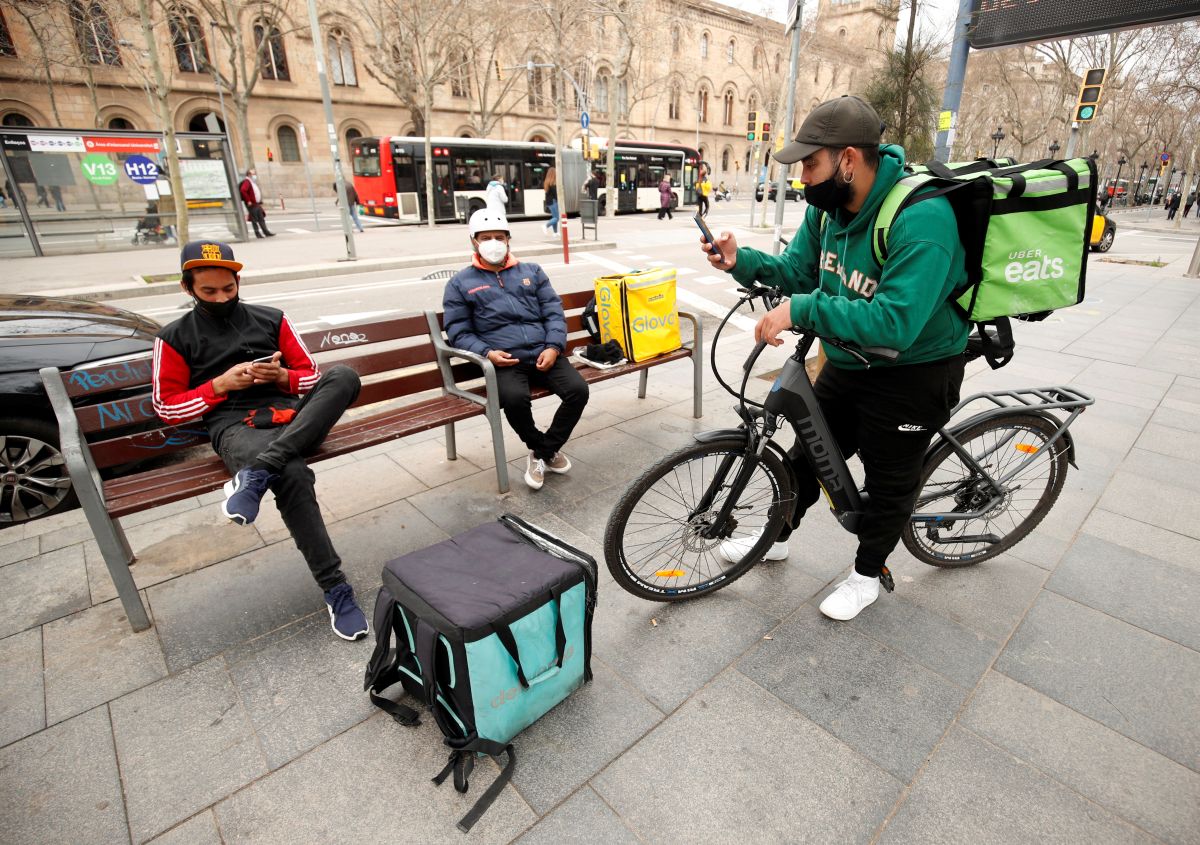
Digital labour platforms are intermediaries for different types of work. For example, commissions for people with specific qualifications and knowledge in the field of graphics or programming that can be performed remotely by submitting an offer to a client. However, platform work provided locally (on site), such as passenger transport (Uber, Bolt), supplies (UberEats, Glovo), or home services (e.g., electric, renovation, and construction) have a greater share of the European market. Despite the different types of labour platforms, their business models have many common elements. The majority of people performing platform work is not bound by an employment agreement, either with the platform or with the ordering party.
At the same time, the principles of cooperation and work management are unilaterally determined by the platform, which usually charges a commission from the contractor for its services (connecting two sides of the market). Another element is the algorithmic management of allocation, evaluation, and monitoring of the work performed. As a result, contractors have variable, unpredictable remuneration based on unknown criteria (platforms do not provide details about their algorithms). Devices that monitor and track the work process and performance are also widely used.
Self-employment as a legal form of providing work for the platform deprives such workers of the institutional protection of employees rights, such as trade union associations. Those who are dependent on income generated in this way are particularly at risk. With the increasing demand for platform work, the lack of regulation means an increasing number of people without social security.
Solutions Adopted in European Countries
France was the first country in the EU to undertake the regulation of platform work. In 2016, it introduced a definition of a digital labour platform and covered people who work through them with social insurance (provided they have a certain income). It has granted them the right to associate with trade unions and to strike, forbidding platforms from terminating their employment contracts for this reason. In Italy, legislation was set in 2019 on the working conditions of self-employed people working via platforms in food and parcel delivery services. In turn, in 2021, Spain introduced a law under which drivers delivering food and parcels are considered employees by default.
In Austria and the Netherlands, online job platforms are increasingly considered temporary employment agencies, especially in certain sectors of the economy, such as home services, where work is performed for a single client on a regular or continuous basis. Moreover, in several countries (Denmark, France, Spain, Italy, Slovakia, Sweden) there have been initiatives by trade unions to represent the self-employed in negotiating employment conditions with platforms.
According to research, the problem of inadequacy of employment status of platform workers occurs especially in countries where also in traditional sectors of industry and services, people with the status of entrepreneurs perform the duties of full-time employees for a company. In the Nordic countries, where there is a very low percentage of bogus self-employment in the economy, the problem of platform workers’ rights is marginal.
In Poland, the only regulation regarding digital labour platforms so far has been the amendment to the Road Transport Act, commonly known as “Lex Uber”, adopted in 2019. The aim was to equalise the legal status of traditional taxi companies with other companies (and applications) providing transportation services.
Details of the EU Directive on Online Platform Workers
The growing challenges related to the operations of labour platforms in the Member States prompted the EC to develop a directive regulating key issues, in particular the legal status of platform “employees”. The proposal, published on 9 December, sets out five criteria according to which the online platform can be considered an employer. These are: setting the amount of remuneration or its upper limits, obliging the recipient to comply with certain conditions regarding appearance during the performance of work; supervising the performance of work or verifying the quality of work results; restricting the freedom to choose working hours or periods of absence, accepting or refusing to perform tasks, and restricting the possibility of building a customer base or performing work for other entities. It is enough for the platform to meet two of them to result in immediate reclassification of independent contractors to employees, regardless of the type of contract concluded. Doubts can be resolved in court, but it is up to the platform to prove that there is no actual employment relationship.
In addition, the EC wants greater transparency of the algorithms that determine working conditions (in particular remuneration, rules for assigning orders, working hours), ordering platforms to reliably gather and disseminate detailed information about them to contractors at the latest on the first day of their cooperation. It will also be prohibited to process personal data relating to platform employees (not only full-time employees), other than directly related to the digital work platform and necessary for the performance of the contract between the contractor and the platform. The EC also wants platforms to provide employees with unsupervised communication channels. After the directive is adopted, countries will have two years to adapt their national legislation to it.
Conclusions
The EC’s proposal was received with interest by the Member States due to the cross-border nature of online employment platforms and their growing role in the European labour market. In the EU, there are more and more court cases initiated by entrepreneurs suing online labour platforms. There is also a growing social awareness of the risk related to the monopolisation of certain sectors of the economy by technology companies, which increases the chances of introducing the EU directive. Moreover, out of the 500 or so employment platforms active in the EU, about 360 are small and medium-sized enterprises for which the new regulations may restore competition on a monopolised market.
The largest platforms are reluctant to accept the new regulations. The EC estimates that the transformation of the employment relationship under the new rules will increase the costs of platforms from €1.9 billion to €4.5 billion per year (depending on the final number of reclassification cases). The introduction of regulations is detrimental to the image of platforms that have been promoting their business model for years as giving flexibility and independence to people. The directive will force platforms to increase the transparency of their algorithms, which are treated, especially by the largest technology companies, as an important element of their protected competitive advantage.
For Poland, the EC’s proposal may constitute a starting point for the regulation of labour platforms that could be introduced faster than at the EU level. It is in the interest of the state to protect employees against forced self-employment by the strongest digital platforms on the market as it deprives them of their employment rights (including social security) and contributes to risk in certain professions, such as deliveries.