Nigeria responds to US accusations of a "Christian genocide"
The “Christian genocide” in Nigeria has become a leading topic of public debate among American conservatives. Although based on simplifications and overinterpretations, it determines US policy towards that country. It is possible that Trump's desire to take decisive action will lead to sanctions and air strikes against extremist groups in Nigeria. The Nigerian authorities are trying to dissuade the US from a confrontational approach and encourage it to cooperate in combating security threats, which is also consistent with the EU's approach.
 Sodiq Adelakun / Reuters / Forum
Security situation
Armed groups are active in many parts of Nigeria, committing acts of violence against civilians. In the north-east, two groups that grew out of what became known as Boko Haram are waging terror campaigns and fighting each other – the more extreme People of Sunnah for Dawah (Preaching) and Jihad (JASDJ) and Islamic State West Africa Province (ISWAP). While both groups have carried out attacks on Christian minorities (including the high-profile kidnapping of girls from Chibok, Borno State, in 2014), they – especially JASDJ – are fighting against anyone who does not share their vision of Islam and society. Most of their victims are Muslims, killed in terrorist attacks in public places, such as marketplaces. Across Nigeria as a whole, it is primarily the inhabitants of the northern, predominantly Muslim provinces who are at risk of violence – according to ACLED, in 2024, up to 86% of acts of violence in Nigeria took place in this part of the country.
The most serious security crisis in Nigeria today involves kidnappings for ransom, e.g. of schoolchildren, which occur mainly in the Muslim-majority provinces of Zamfara, Katsina and Kaduna. Lakurawa, a new group active in the Sokoto region, linked to extremists from the Sahel countries and recognised as a terrorist organisation by Nigeria this year, originated from mercenary self-defence units against kidnappers.
Another important area of tension is the ‘middle belt’, which conventionally separates the Muslim north from the Christian south of Nigeria. Within this area, e.g. in Benue State, there is rivalry between pastoralist communities (especially the traditionally marginalised Fulani) and farming communities. The underlying causes of these conflicts are multidimensional and linked to population growth and dwindling resources, such as land. Cases in which Christian communities are the victims of attacks motivated by religious hatred occur locally and are not organised in nature. Often, groups that attack churches also attack mosques as places of symbolic importance to the communities they are in conflict with.
The US and Nigeria’s conflicts
For years, the US has been working to stop violence by Muslim extremists against civilians from all communities. In 2013, the US designated Boko Haram as a terrorist organisation and later cooperated with Nigeria, Chad, Cameroon, Niger and Benin in creating a regional multinational military force to combat the group.
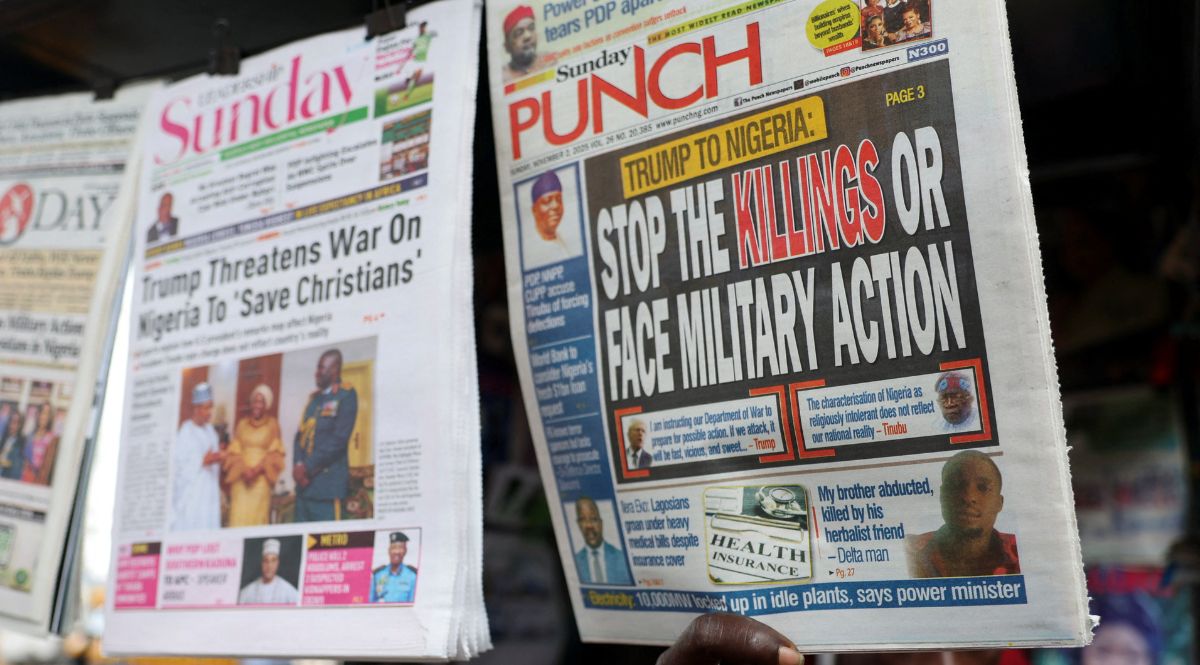
The latest wave of interest in Nigeria in the US came after Republican Senator Ted Cruz introduced the Nigeria Religious Freedom Accountability Act of 2025 to the Senate on 9 September. In it, he proposed that Nigeria be designated a country of particular concern and that sanctions be imposed on officials who “facilitate jihadist violence” against Christians. Citing a report by the Nigerian organisation Intersociety, he pointed out that since 2009, more than 52,000 Christians in Nigeria have been killed by “jihadists”. At the end of September, Cruz's claims were echoed by popular American commentator Bill Maher (who spoke of 100,000 victims), who accused the US media of ignoring actions that were “more genocidal than in Gaza.” The topic was then taken up by the largest American media outlets in a sensationalist tone, shifting the blame onto Nigerian state institutions. At the end of October, President Donald Trump approved Nigeria’s designation as a country of particular concern. In a 1 November post on Truth Social, he stated that the Nigerian government “continues to allow the killing of Christians”, announced the suspension of all aid and hinted at possible military intervention. On 7 November, a group of congressmen introduced a resolution in the House of Representatives condemning the “persecution of Christians in Nigeria” and supporting Trump in taking decisive action to protect them. On 18 November, the US ambassador to the UN spoke against Nigeria. To reinforce its message, the US authorities invited the popular singer Nicki Minaj to give a speech in “defence of Christians”.
The American narrative from Nigeria’s perspective
The data cited by Cruz and, following him, the American media, is far from objective. The Intersociety report cited repeated biased and false statements describing former President Buhari as an alleged extremist protecting “jihadist Fulani herdsmen”. This reflected the conspiracy theories, unauthorised generalisations and ethnic prejudices that are common in Nigeria. This narrative contradicts the guiding principle of Nigerian politics after the Biafran secession attempt and the civil war of 1967-70, which is based on neutralising ethno-cultural and regional divisions. This has resulted in efforts to ensure that all regions and communities are represented in political parties, institutions, the army, etc.
The narrative of “genocide” was protested by, among others, the Christian Association of Nigeria (CAN), the largest association of churches in Nigeria, whose president emphasised that both Christians and Muslims are victims of terrorism and crime. The Vatican Secretary of State, Cardinal Pietro Parolin, also spoke out, emphasising the social rather than religious roots of the conflicts in Nigeria. Nigerian President Bola Tinubu, in turn, pointed out that the state combats, not fuels, religious persecution. Following the speech at the UN, Nigeria sent a delegation to Washington, led by National Security Adviser Nuhu Ribadu, to explain the broader context of violence in Nigeria to the American authorities.
From the perspective of extremist or criminal groups, the discussion in the US, and especially Trump’s threats, has raised the symbolic and economic value of targets identified as Christian. ISWAP has increasingly emphasised the religion of its victims in its statements about attacks, and kidnappers in Kaduna have targeted clergy in the hope of obtaining a higher ransom.
Lobbying
Pro-Israel circles, which include Cruz and Maher, are alleged to have used the narrative of other, “forgotten” genocides to divert attention from accusations that Israel is committing genocide against Palestinians in the Gaza Strip, as stated by a UN commission of inquiry, among others. However, the groundwork for the allegations against Nigeria had already been laid earlier. A long-time proponent of the story of genocide in Nigeria is the French intellectual Bernard-Henri Levy, who is well-regarded among American conservatives and who has demonised the Fulanis in his accounts. The idea of military intervention is promoted by Eric Prince, founder of the Blackwater mercenary group, who has done business in Nigeria in the past. He offers to use his forces to “protect Christians”. Cruz, meanwhile, met in 2024 with anti-Muslim activists seeking to establish a separatist Biafra state for the Igbo people in Nigeria, including an associate of Simon Ekpo, a radical later convicted of terrorism.
Forecast
The Nigerian authorities are seeking to de-escalate the situation, with Tinubu emphasising the successes in freeing Christian hostages, the announcement of a nationwide security emergency, and promises to increase military and police capacities. Nevertheless, the involvement of the US authorities (including Trump himself) in constructing a narrative of “Christian genocide” may lead to demonstrative use of force. The likely scenario is air strikes against extremist groups, e.g. using drones, similar to the actions by US forces in Puntland, Somalia. It would be beneficial if, after calming diplomatic relations with Nigeria, the Americans redirected their efforts towards strengthening the capabilities of the Nigerian forces, e.g. by providing intelligence data against extremist and criminal groups. It would also be desirable to simultaneously support the expansion of reintegration programmes for former combatants.
However, US sanctions are still possible against selected officials, such as the governors of those provinces in northern Nigeria that have adopted elements of Sharia law or the Miyetti Allah Cattle Breeders Association representing herders. Their imposition would lead to a deepening of divisions and tensions in Nigeria. There are, however, signs that the debate is moving towards a more balanced direction, for example, the suggestion by Jim Risch, chairman of the Senate Foreign Relations Committee, that Nigeria should be required to protect the most vulnerable, such as schoolchildren, from extremists and bandits. This approach to the issue is realistic and does not cause antagonism. It would gain the support of the EU, which has signalled the need to support all communities threatened by violence, regardless of their religion.