NATO Launches the Arctic Sentry Mission
On February 11, NATO launched the Arctic Sentry mission, which aims to strengthen the Alliance's defence and deterrence capabilities in the High North. Although its main strategic task is to deter Russian and Chinese expansion in the Arctic, in practice, it is an attempt to respond to US claims on Danish Greenland. The mission will increase NATO’s ability to provide situational awareness and respond in the Arctic, but it does not necessarily mean that the US will abandon its efforts to gain control over Greenland.
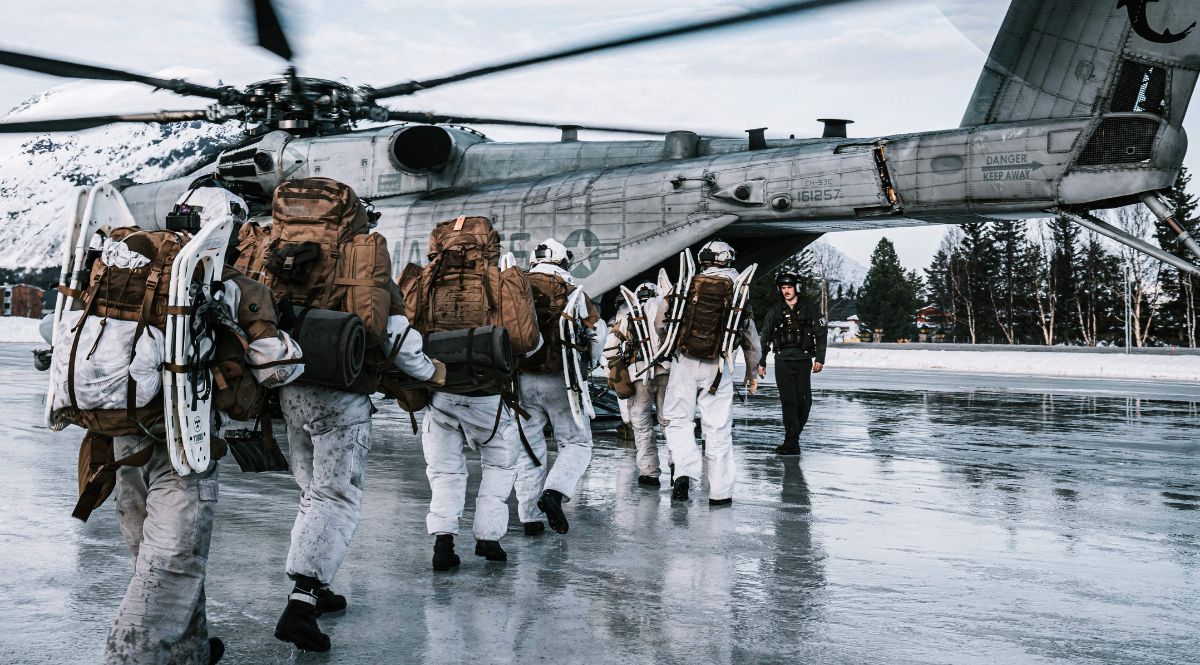 Sgt. William Chockey/U.S. Marine / Zuma Press / Forum
Why is NATO launching this mission?
The decision to establish Arctic Sentry was made at the Davos summit on January 22 this year in order to defuse the conflict surrounding President Trump’s claims to Greenland, which threatened to cause a serious crisis within the Alliance. However, the rationale for establishing the mission has deeper strategic roots related to the intensifying rivalry in the Arctic involving Russia and China. According to forecasts, by 2040, melting ice caps will enable year-round use of the Northern Sea Route and greatly facilitate the exploitation of natural resources located there. For years, the Arctic members of the Alliance have been unable to reach a consensus on their approach to the region, driven by national interests and a desire to maintain full sovereignty in shaping this dimension of security policy. They are opposed to the militarisation of the Arctic Circle and face tensions in relations with Russia. As a result, issues related to the High North were not included in NATO’s 2022 Strategic Concept. Therefore, one of the current objectives of Arctic Sentry is to develop a coherent operational approach to defence and deterrence in the region, which is crucial given Russia’s claims to the Norwegian demilitarised zone of Svalbard and the unregulated status of the Arctic continental shelf, which may become a source of disputes between Russia and NATO countries in the future.
What challenges do Russia and China pose in the High North?
For over a decade, Russia has been expanding its military capabilities in the Arctic by reactivating air bases, deploying S-400 air defence systems and Bastion anti-ship missiles. New types of weapons are being tested at the Novaya Zemlya training ground, and electronic warfare systems deployed on the Kola Peninsula since 2022 are being used to jam GPS signals. The shortest flight route for Russian bombers and ballistic missiles targeting the US passes through the Arctic Circle. With nearly 30 submarines, the Northern Fleet provides Russia with the capability to carry out strategic strikes, attack critical undersea infrastructure, and control maritime lines of communication (including the GIUK area – Greenland, Iceland, United Kingdom), which in the event of a direct conflict with NATO could be crucial for maintaining the ability to transfer troops from the US and Canada to Europe. China, on the other hand, is focusing on economic expansion (especially access to maritime trade routes and the extraction of natural resources), but has ambitions to develop the civil and military capabilities to conduct independent maritime operations in the Arctic. To this end, China is developing their fleet of polar research vessels, icebreakers, and submarines. Since 2024, Russia and China have significantly strengthened cooperation, including joint patrols of strategic bombers north of the Bering Strait, coast guards in the Arctic Ocean, and, since 2025, joint research expeditions. Both countries are closely monitoring developments related to the US attempts to take control of Greenland, which they may use as a pretext for offensive action.
What is the mandate of Arctic Sentry, and who participates in it?
Arctic Sentry will consist of increased multi-domain military activity in the region, carried out on the basis of allied exercises, including the ongoing “Arctic Endurance” series in Greenland and “Cold Response” planned for March in Norway, in which 25,000 soldiers from 14 countries will take part. Most likely, Arctic Sentry will include the “Lion Protector” exercise planned for September, involving the UK-led Joint Expeditionary Force (JEF), as well as other exercises that take place regularly in the region. The Allied Joint Force Command Norfolk (JFC Norfolk) is responsible for the mission, in cooperation with the Allied Command Operations (ACO) and the Allied Command Transformation (ACT), and in coordination with the US-Canadian North American Aerospace Defense Command (NORAD), the US Northern Command (USNORTHCOM), and the US European Command (EUCOM). In early February, the United Kingdom took over command of JFC Norfolk, replacing the US in this role, and announced that it would increase its military presence in Norway to 2,000 troops within three years. In addition, the NATO Secretary General called on member states to contribute forces to this mission. So far, Sweden has declared that it will Sweden has declared that it will deploy the JAS-39 Gripen aircraft currently on duty in Iceland (as part of air policing mission), Denmark will send four F-35 aircraft, and Germany will send four Eurofighter jets and logistical support (including air-to-air refuelling capabilities).
How might the mission affect the Alliance?
The launch of the mission could have a significant impact on the development of NATO’s ability to conduct military operations in difficult Arctic conditions. Patrolling sea lanes, detecting foreign submarines, countering acts of sabotage against critical maritime infrastructure, and monitoring airspace will increase the interoperability of forces assigned to the northern regional defence plan. It will also enable the command system created in 2018 by JFC Norfolk to be tested. The increased activity of allied forces should raise situational awareness in the High North and response to potential hostile actions. However, its future and significance will depend on whether the US ultimately abandons its attempts to acquire Greenland, which was included as one of the objectives of the US National Defense Strategy (NDS) of January 2026. Changing this position will require continued diplomatic engagement with allies to contain the Trump administration. Continuation of the US revisionist approach on this issue could lead to the sudden termination of the mission and a further escalation of internal disputes. In order to preserve allied unity, member states may seek to make the mission permanent at the NATO summit in Ankara. Such a scenario could have a positive impact on similar missions on the eastern flank (Baltic Sentry and Eastern Sentry), which would be beneficial for Poland’s security interests.


.png)