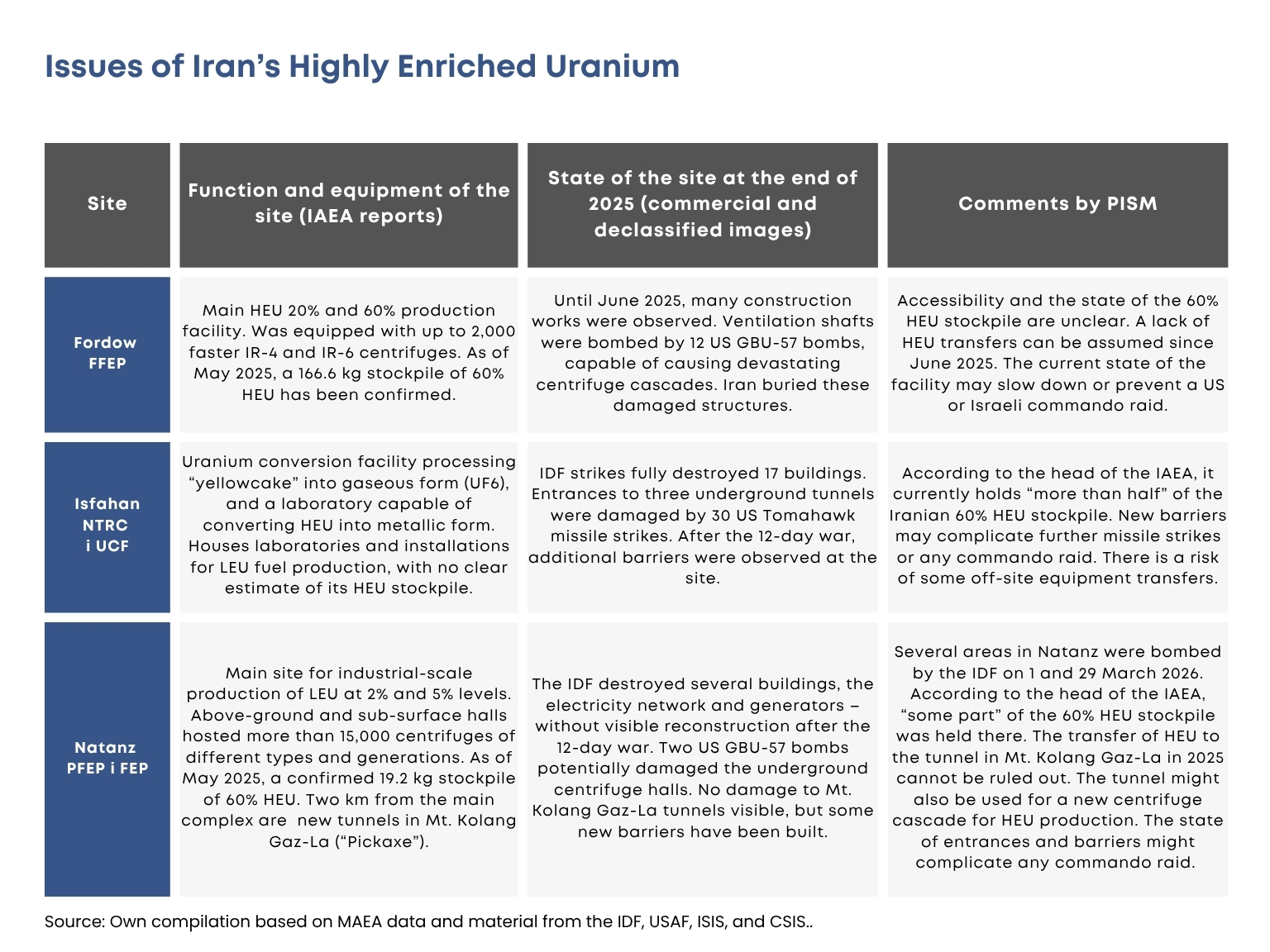
Issues of Iran's Highly Enriched Uranium
One of the desired goals of current Israeli and US operations against Iran is to deny it the use of its stockpile of highly-enriched uranium, accumulated at a level and scale useful for building nuclear warheads. Moreover, the ongoing war seems to illustrate the folly of Iran’s policy of maintaining “nuclear threshold status.” In this context, the Iranian regime faces the dilemma of choosing between limiting its nuclear ambitions and capabilities, and restarting its weaponisation programme.
.png) Tami Chappell / Reuters / Forum
Tami Chappell / Reuters / Forum
What were the nuclear capabilities of Iran before the current strikes by Israel and the US?
Since 2021, Iran has been accumulating stockpiles of highly-enriched uranium (HEU). According to the IAEA, it possessed over 9 tons of uranium in different forms, including over 400 kg of 60% HEU. Technically, this would permit Iran to build eight to nine cores for nuclear devices in a few months if it decided to do so; in a permissive context with full use of its capabilities, this material could even be sufficient for 20 to 22 nuclear warheads. According to US intelligence, Iran had decided not to renew its nuclear weaponisation programme and was satisfied with its “nuclear threshold status,” serving as a deterrent to Israel and the US. However, its capabilities and status were already perceived by Israel as a growing existential threat, which led to a decision to strike Iran in June 2025, soon also supported by US strikes. During these operations, three Iranian sites, designated as involved in the production and accumulation of 60% HEU (see details in Table 1), were seriously damaged. Further, Israel killed an estimated 14 Iranian nuclear scientists and struck several other sites identified as useful in future nuclear weaponisation by Iran. Damage assessment after the strikes created controversy within the Donald Trump administration and the US intelligence community. According to the US president, the nuclear capabilities of Iran were “totally obliterated”, but in the Defense Intelligence Agency’s they could be reconstituted in 3-4 months. The CIA concluded that with the existing stockpile of HEU and damage done to centrifuges, Iran would be unable to build its first nuclear warhead faster than a 12-24 month period. Some non-governmental experts presented a different timeframe, assuming a more realistic period of 8-12 months.
Where are the current Iranian HEU stockpiles?
Following the strikes, the fate of the over 400 kg stockpile of HEU also became a priority issue for the US. After June 2025, the IAEA and US and Israeli intelligence were unable to confirm the location and state of cylinders containing Iran’s gaseous HEU. It was speculated in open sources that the majority of these were buried in the heavily bombarded mountain tunnels of Fordow and within the damaged installations of Isfahan. At the same time, there were also concerns about the worst-case scenarios of an Iranian sprint from HEU to weapons-grade uranium (90%) in metal form, and even the construction of improvised or crude nuclear devices. For many months, there were gaps in verified information on these possibilities, but on 9 March 2026, Rafael Grossi, the head of the IAEA, declared that “more than half” of the Iranian HEU stockpile was located in Isfahan. Comments by Grossi suggested that cylinders in Fordow and Natanz were damaged or buried under rubble and were hard to access. It was still far from a full picture of the disposition of the HEU stockpile, but at least confirmed that HEU had not been transferred outside the three main sites since May-June 2025. From commercial satellite imagery of Isfahan and Natanz, it can be assumed that so far, Iran has not recovered its HEU. Some of these images might also be interpreted as evidence of a lack of hurry and determination by Iran to recover even a small part of its valuable HEU stockpile.
What factors will condition the future nuclear policy of Iran?
The ongoing war complicates any conclusions about Iran's future comprehensive nuclear strategy. Contrary to its technical capabilities and the concerns of many experts, Iran now seems to be undecided about recovering HEU from damaged sites. In the short term, Iran’s experience with the Trump administration may be a reason for avoiding radical moves towards obtaining a nuclear arsenal, as well as seeking quick diplomatic solutions. It can be assumed that the Iranian regime sees physical access and recovery of the HEU stockpile as technically challenging and not worth provoking more military operations by the US and Israel. Depending on the results of the current conflict, some influential factions may become more vocal and likely to conclude that deterrence towards Israel and the US has failed if Iran merely regains threshold capabilities. In the autumn of 2025, there were already some public voices speaking in favour of a quick sprint to a fully operational nuclear arsenal; however, these opinions did not reflect all advisors or the personal point of view of Ali Khamenei, the supreme leader of Iran. Following his death, he was succeeded by his son Mojtaba Khamenei, who is well-connected to Revolutionary Guards, regular armed forces, Shia clergy, and secular politicians within the regime. It is worth remembering that for over three decades, his father was in control of the nuclear strategy of Iran. In 2003, a fatwa (religious opinion) against nuclear weapons was declared, and a halt was ordered on covert nuclear weaponisation works. Without certainty over the future decisions or shape of the regime, in the longer term period Iran might be more inclined to make another attempt to build a nuclear arsenal, as the ultimate deterrent against Israel and the US. Moreover, the nuclear ambitions of Iran predate the Islamic Revolution, and it can not be ruled out that even a future secular and democratic government in Tehran might be in favour of preserving its nuclear knowledge, scientific, and industrial capabilities.
Could the US and Israel forcibly seize the Iranian HEU stockpile?
So far, the intensive air and missile campaign of the US and Israel has avoided further damage to Fordow and Isfahan, with only two strikes on the Natanz site. With the heightened urgency of finishing the war, there might be an increase in pressure from the White House on the Pentagon to take control of the Iranian HEU stockpile. A successful military operation would deny Iran two things: the use of its HEU as a bargaining chip in future negotiations, and access to fissile material should it restart its weaponisation path. This scenario's likelihood depends on many factors, such as comprehensive intelligence on all or the majority of the HEU cylinders, full control of the airspace over Iran, and the temporary occupation of selected nuclear sites and their surroundings by the US forces. Even an operation limited to US commandos capturing the HEU stored in Isfahan would require the assistance of nuclear and technical experts and deploying heavy equipment. With complicated and time-consuming recovery works and the safety requirements of any HEU transfers, there would be a high risk of Iranian counterattacks, so the commando and expert teams would need an additional security perimeter of at least a battalion of US Rangers or paratroopers. And to succeed, such a complex and unprecedented military operation requires a realistic rehearsal to resolve the many logistical issues with the extraction of troops and HEU. Even if Israeli troops joined this operation to limit US losses and extend the scope to include the Natanz site, these options also need bilateral coordination at all political and military levels, with a high risk of the plans being compromised by media leaks. The biggest issue after a successful operation is a lack of confidence that Iran will agree to limit its capabilities, especially if it still retains part of its HEU stockpile (enough for 3-4 warhead cores) and over 8 tons of low-enriched uranium. Nevertheless, recent decisions by the leadership of the US and Israel show they favour high-risk actions, even when these are contrary to recommendations by their military planners and intelligence agencies.