International Echoes of El Salvador's Public Security Model
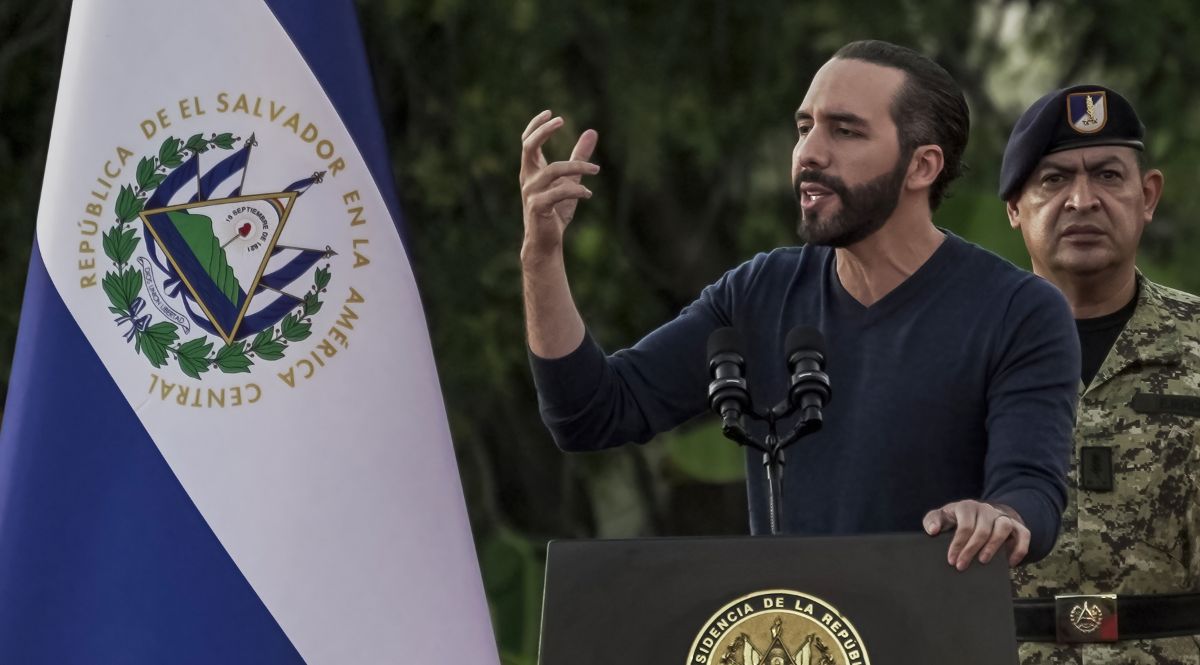
El Salvador President Nayib Bukele’s success in improving domestic security results from implementing draconian measures (including mass arrests and a state of emergency that has lasted for four years) and from the dismantling of democratic mechanisms. While Honduras and Ecuador, for example, encountered limitations in copying that approach, the Salvadoran counter-crime model won strong endorsement from US President Donald Trump. This support, however, may foster a revival of authoritarian tendencies in Latin America, as his administration rewards authorities that cooperate closely with advancing US interests, regardless of whether or not they adhere to the rule of law.
 Camilo Freedman / Zuma Press / Forum
The Specifics of the Crime Problem in El Salvador
With 6 million people, El Salvador’s violence rates long ranked among the highest globally, driven by two gangs known as maras: Barrio 18 and Mara Salvatrucha (MS-13). These groups began in the US among refugees fleeing El Salvador’s civil war (1980–1992). After peace, they expanded their activities in their home country, a country weakened by conflict and one that was striving to rebuild its democratic institutions. The maras mainly extorted and terrorised society, and their feud drove a homicide rate peaking at 105 per 100,000 people in 2015.
In a state dominated since the 1990s by two parties—the right-wing ARENA and the left-wing FMLN—various governments tried to limit violence by striking deals with the maras or applying “iron fist” methods. The latter included a harsher penal code, regular police raids on gang-controlled areas, or military involvement. Mechanisms of mutual control between the authorities and the opposition prevented the use of measures that would undermine the democratic order. In 2019, Nayib Bukele won the presidential election riding a wave of growing public rejection of the dominant parties due to their corruption. While he presented himself as an anti-establishment candidate, he had previously been a member of the FMLN. Initially, his government continued the anti-crime approach applied by its predecessors.
Fundamentals of the New Public Security Model and its Balance
The turning point in Bukele’s approach to fighting crime came in March 2022, when the maras broke an informal pact with the authorities and committed 87 murders in less than 72 hours. The government introduced a state of emergency, which became the central element of a new, hardened public security policy. According to the constitution, this measure can be introduced for only a month, but the Legislative Assembly (AL) has already extended its validity 46 times—most recently on 23 December, 2025.
With constitutional guarantees—including the principle of presumption of innocence and other civil rights—limited, the military and police carried out mass arrests of individuals suspected of gang ties. In January 2023, the government opened the showcase CECOT prison, capable of holding up to 40,000 inmates. Two years later, the total number of prisoners in El Salvador reached 119,000 people, or 1.9% of the country’s population (for comparison, in Poland, the prison population is approximately 0.19%). According to IISS Military Balance data, between 2019 and 2025, the Bukele government also increased the size of the police force from 17,000 to 26,000 and doubled the defence budget from $145 million to $314 million (in current prices).
According to government data, in 2024 the homicide rate fell to 1.9 per 100,000 inhabitants, although independent media and NGOs claim the data is underreported. Nevertheless, in the 2024 Gallup Global Safety poll, 87% of Salvadorans reported feeling safe in the country, the highest percentage among Latin American societies. This explains Bukele’s high social support since 2019, which is currently over 90%.
The current security model in El Salvador couldn’t have been developed if Bukele hadn’t concentrated power and dismantled democratic checks and balance mechanisms. He had little representation in the AL when he took over in 2019. In 2020, he even sent armed police and soldiers into parliament to force a vote in favour of additional government funding. A year later, his party, Nuevas Ideas, won 56 out of 84 seats in parliament and could easily adopt reforms giving the president control over the judiciary, including nominations to the Supreme Court. The same court allowed Bukele to run for another term in 2024, providing a controversial interpretation of the constitutional ban on direct presidential re-election. He won almost 85% of the votes, and his party obtained 57 of the 60 parliamentary seats—the total number having been reduced a year earlier at Bukele’s initiative. Such a majority was enough to abolish the presidential term limit in the constitution, among other decisions.
Critics of the Bukele model (including Amnesty International) point out that it has involved a high degree of arbitrary arrests, irregularities in court proceedings, and cases of deaths in overcrowded prisons. They also accuse the authorities of limiting access to public information and suppressing independent media.
Legitimisation of El Salvador’s Policy by the US
The Biden administration looked at Bukele’s model negatively. In 2021, the US President even refused to meet the Salvadoran leader, imposed sanctions on his inner circle, and redirected foreign aid to NGOs. A change of approach came in response to the growing importance of internal security and migration in the 2024 US presidential campaign. Biden sent a high-level delegation to El Salvador for the inauguration of Bukele’s second, legally controversial term.
Donald Trump’s victory brought a further shift in US relations with El Salvador. In February 2025, during his inaugural travel abroad, Secretary of State Marco Rubio visited El Salvador, among other countries. At that time, Bukele proposed to host prisoners deported from the US in CECOT, effectively assuming the role of a ‘subcontractor’ for US penitentiary policy. So far, 252 prisoners accused of belonging to the Tren de Aragua gang have been deported to El Salvador. That cooperation, however, serves the Trump administration’s propaganda purposes, expanding the deterrence of irregular migrants.
“Bukelization” of the Fight Against Crime in the Region
According to a Latinobarómetro poll, the vast majority of citizens in Latin American countries believe that crime in their countries is increasing, and a growing percentage approve of non-democratic regimes as long as they effectively solve social problems. These trends have influenced the success of Bukele's security policy in terms of image and have inspired some countries in the region to adopt similar measures.
In Honduras, a state of emergency has been in effect since December 2022, when it was introduced by President Xiomara Castro’s government. In June 2024, she announced plans to build a prison modelled on the Salvadoran CECOT. Although the number of homicides in Honduras fell in 2021-2024, gangs expanded territorially, two new maras emerged, and extortion numbers increased. It is unknown how the concept of fighting crime will change under the rule of the conservative winner of the December presidential elections, Nasry Asfura.
Daniel Noboa, Ecuador’s president since November 2023, has also been drawing on El Salvador’s experiences. In early 2024, he declared a “state of internal armed conflict” and, in response to the security crisis, directed the military to combat the gangs. Last November, his government inaugurated a maximum-security prison modelled on CECOT. These draconian measures, however, did not translate into a clear improvement in violence indicators. Noboa tried to gain the Trump administration’s support in fighting crime and even announced he would restore a US military base in Ecuador. The base was operational from 1999 to 2009, but President Rafael Correa’s government did not renew the lease and introduced a constitutional ban on establishing foreign bases. In a referendum last November, Noboa failed to obtain the consent of Ecuadorians to revoke that prohibition.
Conclusions and Perspectives
The Salvadoran model shows that in Latin America, amid chronic crime and violence, society is willing to accept the erosion of democratic mechanisms in exchange for improved public security. Nayib Bukele’s success is based on the correlation of “iron fist” methods and the transformation of the political-legal system towards authoritarianism. It should also be noted that El Salvador is a small country, smaller than Poland’s West Pomeranian Voivodeship.
The cases of Honduras and Ecuador show that modelling the fight against crime on the El Salvador approach, without the concentration of power, has its limits. The growing acceptance in the region of non-democratic governments, however, may encourage some political leaders to seek unconstrained power under the pretext of providing security for citizens.
The Trump administration’s approach to Latin American countries favours such a scenario. It rewards governments that closely cooperate with it to advance US interests (including combating migration and organised crime), even if such measures violate the rule of law or democratic order. El Salvador is the prime example of this approach; as long as Trump’s support for Bukele persists, the authoritarian character of his rule will continue to strengthen.



.png)