First Polish-French Intergovernmental Summit in Gdansk
On 20 April, marking the Polish-French Friendship Day established by the Treaty of Nancy, the inaugural intergovernmental summit took place in Gdansk. The consultations aimed to initiate cooperation in the fields of security and defence and economic competitiveness, as well as to strengthen socio-cultural ties. Of greatest importance are the arrangements for expanding military cooperation, the defence industry, and the nuclear energy sector.
 Kacper Pempel / Reuters / Forum
Why was the summit convened, who attended, and what topics were covered?
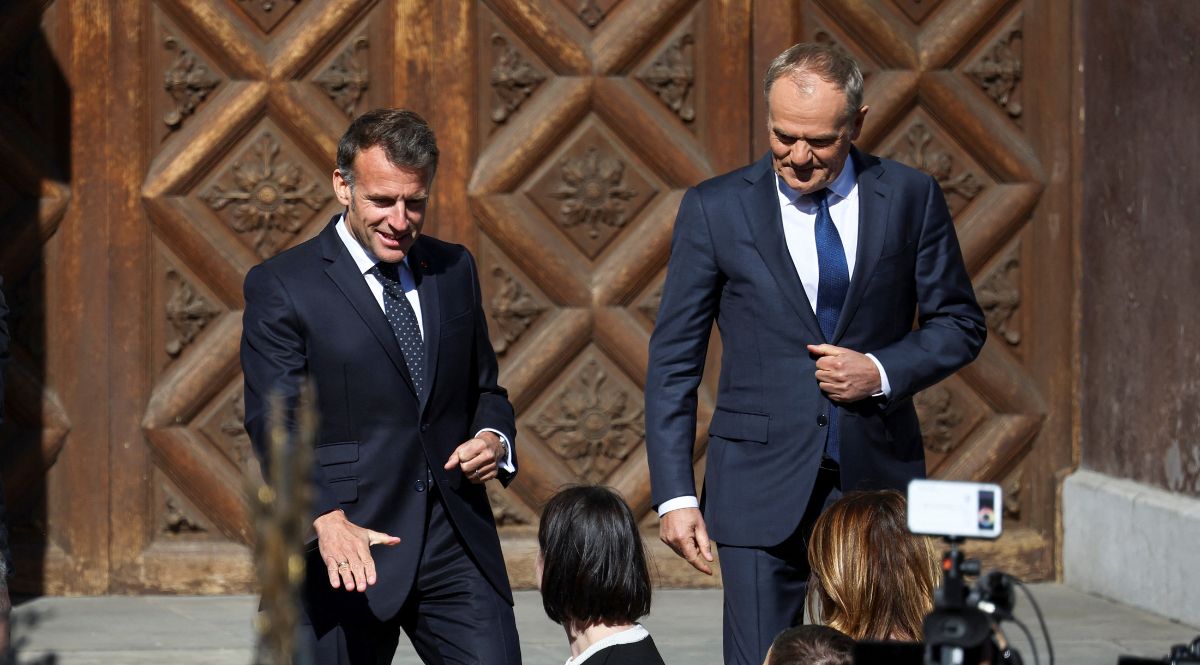
The organisation of such summits is laid out in the Treaty on Enhanced Cooperation and Friendship, which was signed on 9 May 2025 in Nancy. It provides for the establishment of permanent mechanisms for intergovernmental cooperation, including annual bilateral summits chaired by the Prime Minister of Poland and the President of France, attended by members of both governments. Meetings in this format are intended to provide the basic political framework for bilateral consultation and cooperation. The talks in Gdansk were hosted by Prime Minister Donald Tusk, while the French side was represented by President Emmanuel Macron. Government representatives from the ministries of defence, foreign affairs, culture and energy participated, alongside delegates from the business community. Beyond discussion of bilateral cooperation (notably on defence capabilities, conventional and nuclear deterrence, nuclear energy, space cooperation, semiconductors, cyber security, transport infrastructure and culture), the main topics included challenges to European security, the war in Ukraine, the threat from Russia, and transatlantic relations.
What were the key decisions on security and defence?
Prime Minister Tusk and President Macron adopted a joint declaration announcing the acceleration of efforts for European defence preparedness, the development of a European defence technological and industrial base and the strengthening of the European pillar of NATO. Defence Ministers Władysław Kosiniak-Kamysz and Catherine Vautrin signed a declaration of intent to cooperate in the area of satellite telecommunications, reiterating the desire of both parties to also develop partnerships in the domains of modern battlefields. Both countries are interested in joint military exercises and interaction of armed forces. A Plan of Bilateral Cooperation for 2026–2028 was adopted, detailing the joint activities of the Polish and French armed forces. The leaders’ declaration notes Poland’s first participation in the ORION exercise in France in 2026 and France’s renewed participation in the DRAGON exercise in Poland in 2027. Confirming the partnership's industrial dimension, the Polish company RADMOR signed an agreement with Thales and Airbus to develop next-generation communications systems.
What are the prospects for energy cooperation?
The talks focused on nuclear energy as an instrument of decarbonisation, security of supply, and industrial competitiveness for both countries. Wojciech Wrochna, Secretary of State at the Ministry of Energy and Government Plenipotentiary for Strategic Energy Infrastructure, and French Deputy Minister of Energy Maud Brégeon signed a declaration on energy cooperation. This declaration supports action towards developing more favourable regulatory and financial conditions for civil nuclear power in the EU. Poland and France have advocated for stable and predictable public policies, faster state aid procedures, greater use of EU funds, support for long-term contractual commitments, and closer cooperation within the European Nuclear Alliance. Bilateral cooperation is intended to encompass the entire European nuclear value chain—not only the construction of power plants, but also knowledge exchange, engineering services, corporate participation, and the safe operation and maintenance of nuclear infrastructure. France remains an active participant in talks on the construction of a second nuclear power plant in Poland. In addition, both countries intend to develop cooperation in the area of new nuclear technologies, including small modular reactors. Another important aspect is the inclusion in the declaration of the intention to develop an Important Project of Common European Interest (IPCEI) on innovative nuclear technologies, which could be tentatively notified to the European Commission in 2027.
What additional areas of cooperation are identified in the leaders’ declaration?
The declaration also covers other areas of cooperation. In the economic area, the parties supported the simplification of regulation, the deepening of the single market, the development of a savings and investment union, and targeted and proportionate European preferences in strategic sectors. This locates Polish-French relations within the broader process of the EU’s turn towards promoting economic security and a more active industrial policy. In practice, this means seeking to link defence, energy and infrastructure spending to European value chains and reducing strategic dependencies. The declaration envisages, among other things, cooperation in the area of semiconductors, especially components for nuclear energy, defence and space, including on the basis of cooperation between CEA-Leti and Poland’s CEZAMAT. It also points to cooperation in the development of charging infrastructure for electric vehicles, hydrogen refuelling, and cybersecurity for transport and energy systems. In the area of resilience, Poland and France announced cooperation against hybrid threats, foreign information manipulation, interference in democratic processes, cyberattacks, and organised crime. The declaration also provides for the possibility of further strengthening EU sanctions regimes.
What is the significance of the summit for Polish-French relations?
The intergovernmental summit was the first test of the institutionalisation of the treaty—moving from a political declaration to departmental plans, industrial projects and joint positioning in the EU. The partnership with Poland strengthens the credibility of French policy towards Central and Eastern Europe and the eastern flank of NATO, and enhances the EU’s ability to agree positions on defence, sanctions against Russia, support for Ukraine, industrial policy and economic security. Polish-French military cooperation can encompass a broader catalogue of capabilities relevant to European defence preparedness. With its extensive satellite and space capabilities, France is a partner capable of strengthening Poland’s technological competencies and meeting its modernisation needs. Poland is considered a partner for France that will guarantee the joint development of the European security architecture. The 2026–2028 bilateral cooperation plan can foster more regular military contact, better coordination of exercises, and deeper interoperability. Cooperation between defence industries will provide Poland with the opportunity to strengthen its national technological potential, develop its competence in military communications, and integrate into advanced supply chains with large European corporations. It will be important to translate the relationship with France into participation by Polish companies in design and production, and increasing technological autonomy. From the French perspective, this offers an opportunity for its industry to establish a presence in Poland and to develop joint projects within the framework of European defence instruments. Nuclear cooperation can increase Poland’s access to technological knowledge, regulatory experience and R&D facilities. The Polish-French rapprochement strengthens the EU coalition of countries advocating for treating nuclear energy as an element of decarbonisation, security of supply, and industrial competitiveness. This may translate into a stronger role for nuclear energy in future EU instruments.