Development of Russian long-range strike drones
Through technical modifications such as the use of jet engines, the Russian Geran-class attack drones are faster, more effective, and harder for Ukrainian forces to neutralise. By increasing the production of these drones, Russia can continue its massive airstrike campaign against Ukraine, saving its stockpile of ballistic missiles for use during the winter. The challenge for Ukraine is once again to adapt to new conditions by developing and deploying new anti-drone systems while conserving its stockpiles of specialised missiles for air-defence systems.
 Valentyn Ogirenko / Reuters / Forum
Escalation of Russian airstrikes
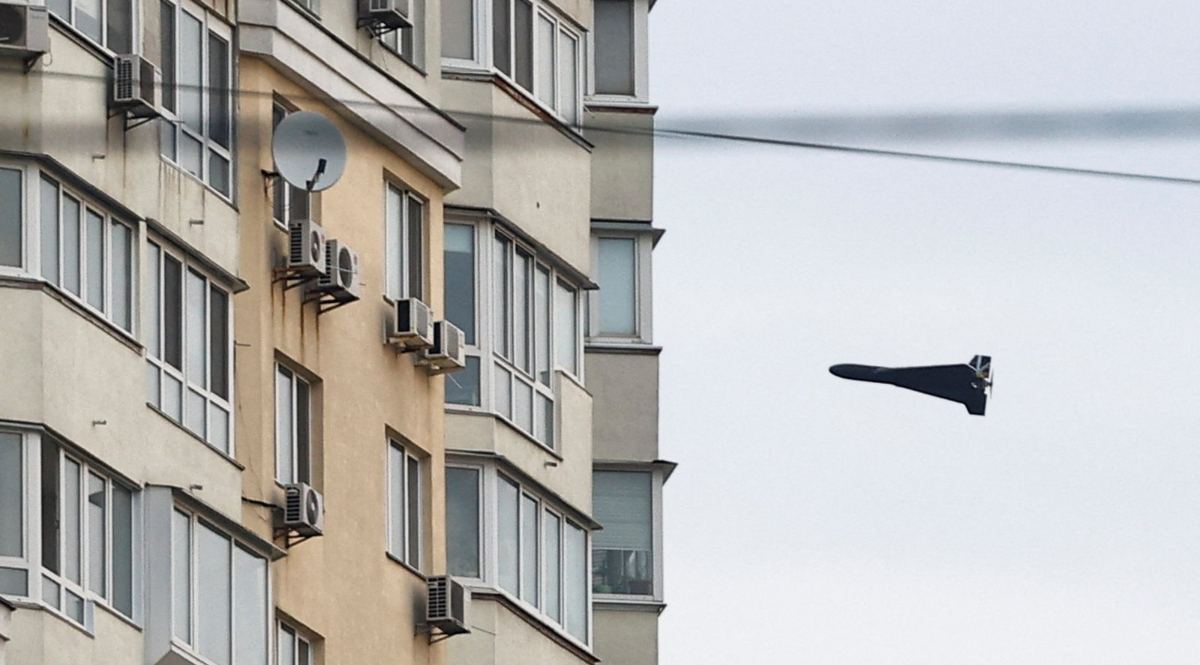
Since July of this year, Russia has intensified the scale and frequency of its airstrikes on Ukraine, increasingly relying on jet-powered drones (Geran-4/-5) for this purpose. According to data from the Ukrainian Air Force, Russian forces used about 450 drones of this type in June. A month later, that number increased fivefold to approximately 2,250, and in August sixfold to over 2,800. The primary targets of the Russian attacks include energy and transportation infrastructure (railways, locomotives, ports, bridges), data centres, government buildings (e.g., the headquarters of the Security Service of Ukraine), business centres, educational institutions (e.g., the National Academy of Sciences of Ukraine), as well as residential buildings. In early July, Russia carried out the largest airstrike on Kyiv since the start of the invasion, using 539 drones and 11 ballistic missiles in the attack. Constant air raid alerts are paralysing the capital and other cities and are having a psychological impact on the society. The frequency of the alerts is eroding residents’ determination to take shelter, leading to an increase in the number of civilian casualties and injuries. A single Russian attack on the night of October 6-7 alone killed 135 people (including at least five children). Calculated monthly, this amounts to about 2,000-3,000 casualties, about 45% of whom live far from the front lines.
Technological development of Russian drones
Since 2023, Russia has been manufacturing Geran-class attack drones in the Special Economic Zone in Yelabuga in Tatarstan. These drones are based on Iranian Shahed-class drone technology, which Russia has been importing since September 2022 for use in the war in Ukraine. Seeking to reduce its dependence on supplies from Iran, Russia negotiated a contract worth around $1.75 billion for the transfer of technology and components, enabling it to produce and develop subsequent versions of the Geran drones on its own. It has become a platform for testing new—often experimental—solutions for communications and guidance (e.g., improvised 4G modems, various SIM cards), propulsion (Chinese jet engines), and the use of various types of warheads (including fragmentation-high-explosive, shaped-charge, incendiary, and thermobaric). A breakthrough in the development of the Geran was the replacement of the classic piston engine with the Chinese-made Telefly jet engine (modelled after the Iranian Shahed-238, which features a copy of the Czech Toloue-10 jet engine). This allowed for an increase in speed from about 150-200 km/h to 500-600 km/h, enabling the drones to penetrate Ukrainian air defences more effectively and making them harder to intercept. Their latest versions are no longer simple copies of their Iranian prototypes. While the Geran-4 resembles the Shahed-238 in shape, the Geran-5 has a design similar to that of a cruise missile modelled after the Iranian Karrar. They also feature a new optoelectronic navigation system that transmits live video to operators to aid in target acquisition and damage assessment. They are also equipped with autonomous navigation components that allow for precise target acquisition despite jamming by electronic warfare (EW) systems. Russian forces employ a tactic of using certain drones as relays to amplify radio signals for strike drones. New versions may also be armed with a specialised warhead (cumulative-cutting) designed to destroy steel and concrete structures, which is intended to enable Russia to destroy Ukrainian bridges (which have been under attack in Kyiv since early October).
By the end of 2025, the factory in Yelabuga, operating on a three-shift schedule, was producing around 5,000 drones per month (60,000 per year). Currently, according to estimates by Ukrainian military intelligence (HUR), production stands at around 3,000 Geran 4/5 drones per month. The reduced scale may be due to the limited availability of the Chinese engines, which Russia is attempting to manufacture domestically. In addition, Russia is ramping up production of low-cost Parodiya and Gerbera reconnaissance drones used as decoys, as well as a strike variant (Gerbera-2) equipped with a warhead, and low-cost cruise missiles (e.g., Banderol S8000, Dan-T). According to HUR estimates, Russia plans to allocate $12 billion to the development of these types of air-attack weapons. This will enable it to reduce the costs of conducting massive airstrikes while simultaneously stockpiling the significantly more expensive ballistic missiles (an estimated 700 units), with a monthly production rate of 130-140 units. The Russians are also working to increase the warhead weight of low-cost cruise missiles to 300-600 kg (the so-called Geran-6), which will make their destructive power comparable to that of ballistic missiles.
Development and adaptation of Ukrainian anti-drone systems
Currently, Ukrainian forces intercept about 85-92% of drones with piston engines and 50-60% of those with jet engines. To accomplish this, they use, among other things, mobile fire teams equipped with machine guns (e.g., M2 Browning), anti-aircraft guns (e.g., ZU-23), and portable MANPADS-type anti-aircraft systems (e.g., Stinger, Piorun), as well as electronic warfare systems, interceptor drones, attack helicopters, and F-16 fighter jets (equipped with 20-mm Vulcan cannons and air-to-air missiles). To strengthen Kyiv’s defences, Ukraine has automated the operation of Sky Sentinel anti-drone turrets equipped with 12.7-mm machine guns, which, thanks to artificial intelligence algorithms, machine vision, and optoelectronics, accelerate and improve fire control. In addition, Ukraine is testing five types of jet-powered interceptor drones (e.g., Bars, LITAVR+, Sting 2.0, F-Jet 80) designed to improve the effectiveness of countering the Geran-4/5. Mass production of one of these interceptor models is set to begin by the end of October, while work on the others will continue.
Conclusions and outlook
Russia’s priority for its attack drones is to increase production while reducing its dependence on component supplies from Iran and China. Russia’s technological modifications are forcing Ukraine to continuously develop and adapt its anti-drone defences. To enhance the effectiveness of their own capabilities in this area, Poland and other NATO countries should strengthen cooperation with Ukraine in the development, production, and integration of anti-drone systems.
Russia’s relentless harassment of Ukraine with airstrikes is intended to paralyse the functioning of the state, exert psychological pressure on the population to break its resolve to continue resisting, weaken the economy, and deplete missile defence stockpiles (especially PAC missiles for Patriot systems capable of intercepting ballistic missiles). The use of relatively inexpensive airstrike capabilities while stockpiling ballistic missiles is most likely part of Russia’s preparations for massive attacks on energy and transportation infrastructure during the winter. The success of these attacks could lead to an increase in refugee migration from Ukraine to the EU via Poland, which Russia could exploit to intensify shelling of rail transport (as in the case of the Jagodzin-Dorohusk crossing) in order to provoke panic and a humanitarian crisis. An increased number of airstrikes on western Ukraine will impact Poland’s security. To improve its response to military threats, Poland should adapt its operational procedures by expanding the scope for the use of military means to neutralise such threats.
To increase public resilience to air threats, Polish authorities should accelerate the improvement of the public alert system using mobile phone apps, as well as conduct practical drills, especially for residents of provinces bordering Ukraine (Lublin and Podkarpackie Voivodeships). Guided by the experiences from Ukraine and out of concern for a possible escalation by Russia, Poland should begin developing its anti-drone systems (including the SAN system) now, adapting them to counter jet-powered drones. NATO member states should also invest in the production of low-cost strike drones, which, in the event of an armed conflict with Russia, would allow for overloading the adversary’s air defence systems.