Bayrou Government Struggles for Support in French Parliament
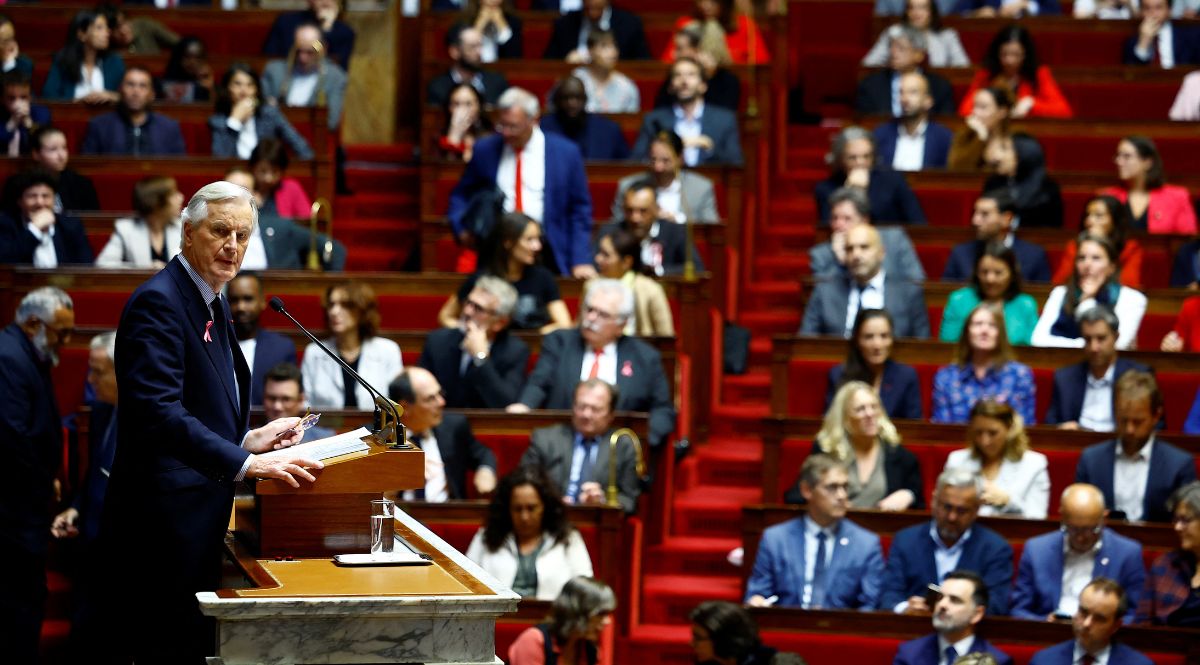
Despite not having an absolute majority in the French National Assembly (NA), François Bayrou’s government recently passed the symbolic 100-day mark. The lack of clear support in parliament makes it difficult for the new cabinet and for President Emmanuel Macron to pursue coherent domestic and foreign policy. Systemic factors, such as the shape of the French party scene, mean that this government and probably those following it will function without sufficient support until 2027, when Macron’s term ends.
(2).png) Gonzalo Fuentes / Reuters / Forum
Gonzalo Fuentes / Reuters / Forum
Legal and Political Considerations
The lack of an absolute parliamentary majority supporting the current prime minister (of the centrist MoDem party) is due to systemic factors. As a result of the constitutional reform in the year 2000, the president’s term of office was shortened from seven to five years. Its synchronisation with the five-year term of the NA was intended to result in the formation of parliamentary majorities originating from the president’s political camp. The aim was to avoid periods of so-called cohabitation, when the head of state and the prime minister represent different political currents. This situation occurred three times in the history of the Fifth Republic (after 1958), and the negative experiences associated with it were one of the reasons for the reform. Since the 2002 elections, both the president and the parliamentary majority have indeed come from the same political camp, but this sequence was broken in 2022 with the formation of the minority government of Élisabeth Borne. The main reason for this was the evolution of the French party system, which since 2017 has been split between the left, the centre-right, and the far-right (nationalist right). This trend peaked after the early elections in 2024 when each of these currents gained similar parliamentary representation. The demands of the three political blocs on key issues in the public debate (pension reform, migration, public finances) are mutually exclusive, which makes it impossible to form broad coalitions.
The semi-presidential constitutional system in France means that the lack of a stable majority in parliament also hinders the implementation of the head of state’s priorities. Although political practice has given rise to the concept of a so-called reserved domain, meaning competences which, in principle, belong to the president (in particular foreign and defence policy), the actual implementation of the president’s plans in this area often requires parliamentary approval.
The Situation of the Ruling Camp
The parties supporting the Bayrou government represent the centre-right: the presidential Renaissance, MoDem, Horizons, and the Republicans (LR). They have not entered into an official coalition agreement, but are united by similar views on key issues, such as support for Ukraine against Russian aggression and economic liberalism. Despite this convergence, there are numerous public disputes between them over the direction of government policy, such as the attitude towards a draft law on euthanasia, the ban on Muslim women wearing hijabs in sports competitions, and the introduction of low-emission zones in large cities.
The government’s cohesion is also weakened by the prospect of presidential elections in 2027. Among the Republicans with presidential ambitions are party leader Laurent Wauquiez and Interior Minister Bruno Retailleau, who are running for the LR leadership. This leads to criticism by the two politicians. For example, Wauquiez disapproved of the government’s lack of legislative proposals on migration, which is the responsibility of the Ministry of the Interior, headed by his party rival. This has deepened the impression of a lack of government cohesion and has led to a situation in which the parties comprising Bayrou's cabinet openly criticise its actions.
The current balance of power in parliament also weakens Macron. For example, his recent announcement of increased defence spending will require NA approval, as it is the body responsible for approving the budget. However, there is no agreement on the sources of funding for such changes—the parties supporting the government do not agree to additional taxes, while both the Socialists and the RN oppose cuts in social spending. Similar support would be necessary in the event of a potential deployment of peacekeeping forces in Ukraine, as proposed by the president. According to the constitution, the presence of French troops abroad for more than four months requires parliamentary approval.
The Opposition’s Attitude Towards the Government
The lack of opposition support for a motion of no confidence in the government is crucial for the survival of the minority cabinet. Despite criticism of the government’s policies, the far-right National Rally (RN) is the main party enabling it, motivated by the need to consolidate its image as a responsible party that cares about the stability of the state and to influence the cabinet’s actions. This does not mean, however, that the RN will not decide to dismiss the government if it considers it politically more advantageous. To maintain RN’s neutral stance towards the minority government, both its composition and parts of its programme reach out to the far-right. Retailleau was appointed the interior minister because his views are close to those of the RN, and he has announced, among other things, a tightening of migration policy. The government also initiated a debate between employers and trade unions on Macron’s socially controversial flagship reform that raised the retirement age from 62 to 64 (also opposed by the RN). Although the prime minister signalled openness to discussion, he stressed that reversing the main assumptions of the reform was impossible. In the prime minister’s exposé in January this year, Bayrou also supported changing the electoral system from a majoritarian to a proportional one, a demand important to the RN but also to the majority of the groups sitting in the NA. This would help smaller parties increase their presence in parliament, but could lead to even greater fragmentation.
An important difference in the political situation compared to the parliament under former Prime Minister Michel Barnier was the lack of support from the Socialist Party (PS) for a vote of no confidence linked to the adoption of the budget presented by Bayrou. The PS thus broke away from the New Popular Front (NFP), a coalition of left-wing groups formed before the 2024 elections. The other NFP parties—the far-left France Unbowed, the Ecologists, and the Communist Party—voted to dismiss the prime minister. The Socialists argued that they were guided by the desire to maintain the stability of the administration and that dismissing the government would mean that a new budget would not be adopted. This allowed them to obtain concessions from the prime minister, such as maintaining employment levels in education, abandoning plans to reduce subsidies for certain medicines, and renouncing cuts in spending on support for French overseas territories (in total, Bayrou renounced around €9 billion in planned budget cuts). They were also able to present themselves as a force capable of influencing the government’s proposals, making it not dependent solely on the far-right.
Conclusions and Outlook
The instability of parliamentary support for the cabinet has a negative impact on the functioning of the state, mainly by reducing the chances of necessary public finance reform and hindering the introduction of essential changes, such as increasing military spending.
This situation is likely to persist at least until July this year when, in accordance with the constitution, the president will again be able to dissolve parliament. However, another potential early election will not necessarily break the deadlock, given the similar level of support for each of the three main blocs since 2024. It is also uncertain whether the so-called Republican Front will be maintained in an upcoming vote—in previous elections when more than two candidates qualified for the second round, candidates with potentially lower support and not from the far-right (with the exception of the Republicans) withdrew from the race so as not to split the vote against the RN. This significantly reduced the parliamentary representation of Marine Le Pen’s party despite her high public support. However, the withdrawal of left-wing candidates in favour of centre-right candidates did not translate into a better negotiating position for this camp during the formation of Bayrou’s cabinet.
A change of president could give new momentum to the formation of majority support for the cabinet, but Macron has declared that he will remain in office until 2027. It is in Poland’s interest to have a more stable French government that shares a similar threat perception. This would give them the capacity to pursue common strategic goals, such as increasing defence spending in Europe and pursuing a firm policy of deterrence towards Russia.



.png)