A Watershed Moment: Denmark on the Russian Invasion of Ukraine
Faced with Russia’s attack on Ukraine, Denmark declared its intention to fulfil its NATO commitment to allocate 2% of GDP to defence spending. Due to the deteriorating security situation in Europe, the country also wants to add an EU component to its defence policy based on NATO membership and partnership with the U.S. It intends to become involved in the Union’s Common Security and Defence Policy, in which it has not participated so far.
 STATE EMERGENCY SERVICE/Reuters/Forum
What was the reaction of the Danish government to the invasion?
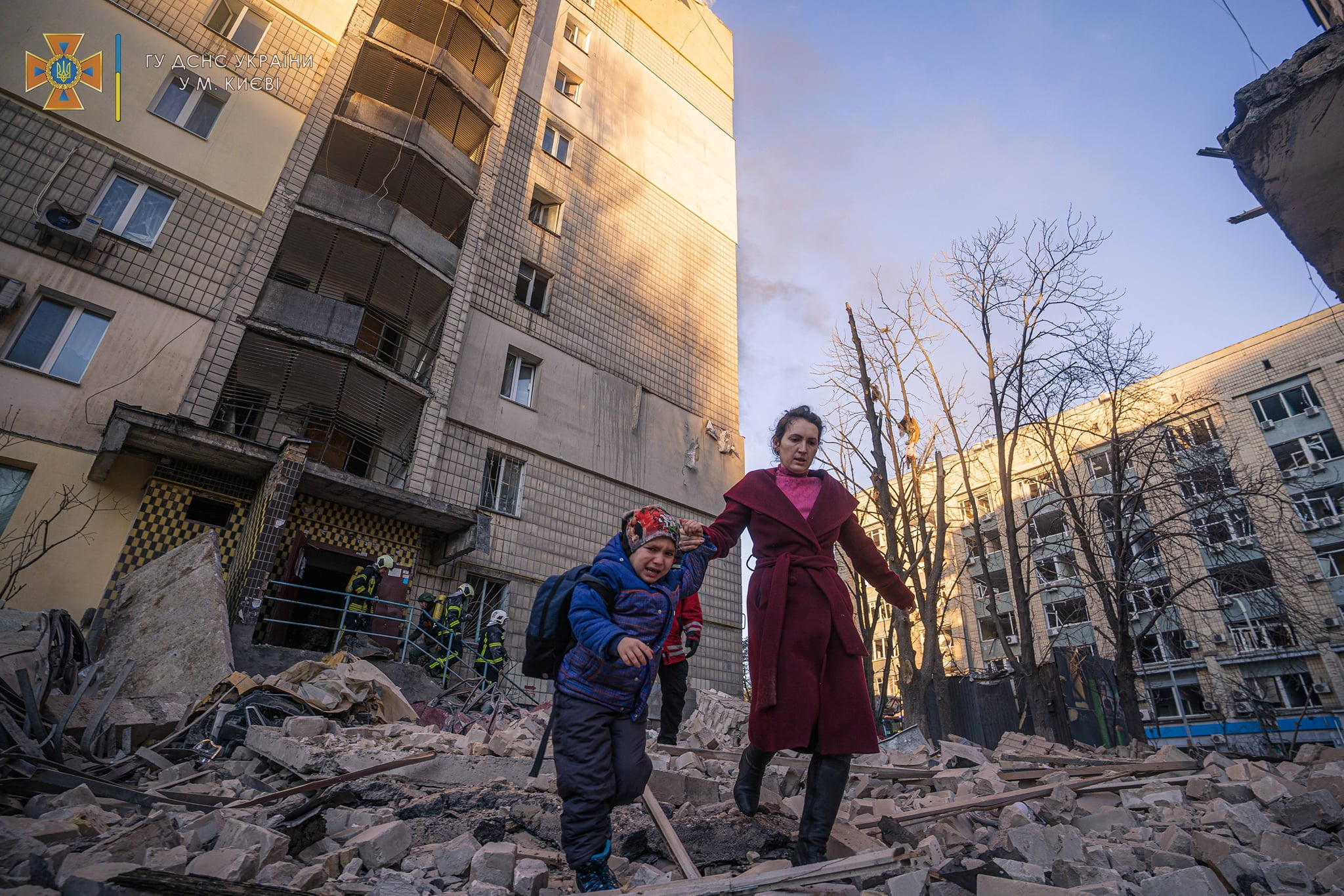
Prime Minister Mette Frederiksen called the Russian attack on Ukraine a terrifying and unprovoked act of aggression that is contrary to the UN Charter and international law. According to the Danish government, the aggression against Ukraine is an attack on peace in Europe and heralds a new era in the approach to security, including for Denmark. It condemned Russia’s actions and emphasised the importance of cooperation between democratic states that reject violations of international law. The prime minister announced the strengthening of Denmark’s alliances and “devastating” consequences for Russia. The government asked the Danish parliament (Folketing) for approval to increase Denmark’s contribution to the military capabilities of NATO’s collective defence. In the humanitarian dimension, the government supports municipalities accepting refugees from Ukraine and coordinates the allocations. It is also preparing a law on a residence permit in Denmark with special conditions. In addition, it urges local governments to liquidate their investments in Russian securities and for scientific and educational institutions to cease their contacts with Russian and Belarusian entities.
How does Denmark support Ukraine?
The Danish government already in January decided to allocate €22 million to help Ukraine in connection with the war in the east of the country and in the face of the build-up of Russian troops near its borders. At the beginning of February, Prime Minister Frederiksen indicated that Denmark was ready to support Ukraine militarily in the event of further Russian aggression. On 27 February, it gave Ukraine weapons, including 2,700 shoulder-fired anti-tank weapons and parts for Stinger missile systems. Denmark also provided Ukraine with medical equipment worth DKK 50 million (around €6.7 million) and an equivalent amount of humanitarian aid to be distributed by UN agencies and the International Red Cross.
What changes has the Russian invasion initiated in Danish security policy?
On the initiative of the ruling Social Democrats, the largest parliamentary parties agreed the main long-term actions in response to the Russian invasion. By consensus, Prime Minister Frederiksen announced on 6 March the “historic decision” to carry out a referendum in the country on Denmark’s participation in the EU’s Common Security and Defence Policy (CSDP), from which it has been excluded at its own request since the establishment of the framework by the Maastricht Treaty of 1992. It also announced an increase in defence and security spending to 2% of GDP by the end of 2033 (from the current level of 1.44%, which means an increase in the defence budget of about €2.4 billion per year) and the allocation of DKK 7 billion (around €940 million) in the next two years for increased defence readiness, operations, and humanitarian efforts. The government also wants to become independent of Russian gas “as soon as possible”, but did not give a specific deadline for implementing such a decision. The Danish energy company Ørsted imports up to 2 million m3 of gas annually from Russia (based on Russian data) under a contract concluded with Gazprom for 2011–2030. This gas is largely resold by Denmark since the country also has its own sources and a low share of this raw material in its total supply of primary energy (around 15%). This means that the dependence of the Danish energy sector on Russian gas is low. Despite this, the government has not announced that Ørsted will break the contract with Gazprom (the state holds a 50.1% stake in the Danish company).
What would Denmark’s participation in the CSDP mean?
In practical terms, it means participation in EU defence decisions and activities, in which now Denmark is the only Member State not to participate (this exclusion also covers foreign affairs with defence implications but does not apply to civilian missions and operations). More broadly, such a decision would represent a partial revision of Denmark’s unique status within the EU. The country enjoys exemptions not only in relation to the CSDP but also in the application of provisions of the Treaty on the Functioning of the EU related to the area of freedom, security, and justice. Denmark is exempted from participating in EU policies on border control, asylum, immigration, and judicial and police cooperation (however, it belongs to the Schengen area and applies EU visa regulations). Additionally, Denmark has no legal obligation to adopt the euro. However, all these derogations may be revoked upon the country’s request. In 2015, Danes rejected in a referendum the possibility of the state’s participation in EU cooperation in the field of justice and home affairs, but surveys from October 2020 indicated—probably as a result of the pandemic—that this field (along with the CSDP) is recognised by Danes as one of the most beneficial from the point of view of Denmark’s interests in the EU. In the face of a war in the immediate vicinity of the Union and uncertainties connected to cooperation within the rules-based international system, Danish restraint towards common policies may continue to wane in the perception of the EU.