Competition and Cooperation: Dualism in Turkey’s Policy Towards Iran
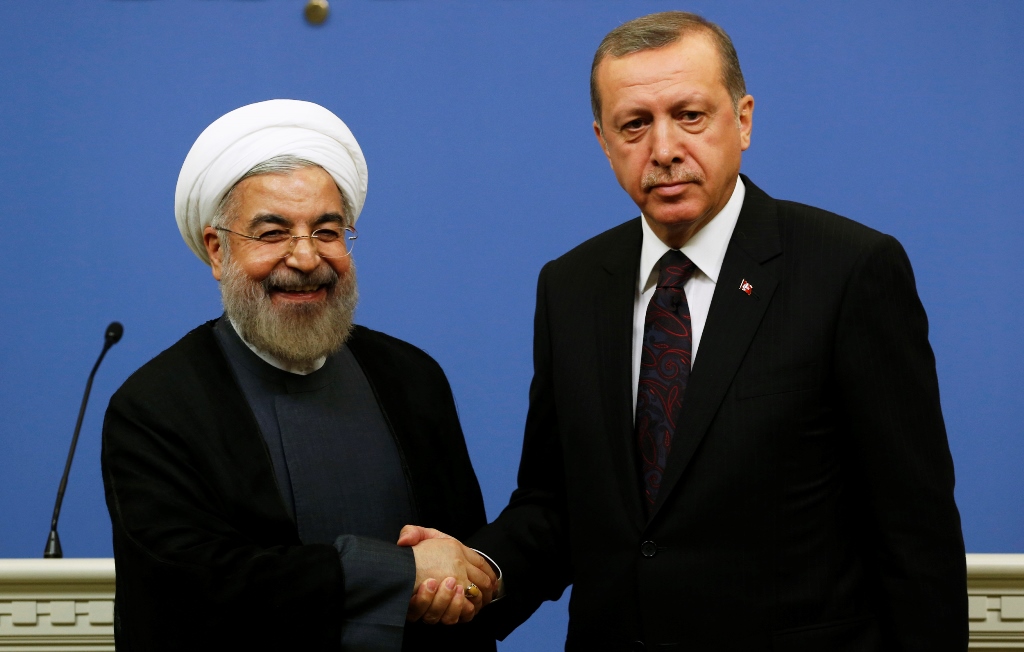
The ambiguity in Turkey’s policy towards Iran is marked by statements following the U.S. withdrawal from the JCPOA, the Iran nuclear agreement1. Turkish President Recep Tayyip Erdoğan criticised the U.S. decision, arguing that the region “does not need new crises” and that states should keep their commitments. Economy Minister Nihat Zeybekçi, in turn, stated that he perceives the U.S. president’s decision as an opportunity for Turkey because it does not intend to abandon commercial cooperation with Iran. He added that restrictions on cooperation could only come through UN sanctions, which would be enacted only if Iran resumes its nuclear programme. Turkey is interested in developing relations with its neighbour based on shared interests, although it still sees Iran as a regional rival and therefore supports international control over the Iranian nuclear programme.
Competition and Cooperation
At the beginning of this decade, relations between Turkey and Iran were strained. This was mainly due to the different approach of both countries to the Syrian civil war—Turkey supported the opposition to Bashar al-Assad while Iran counteracted it. Tensions have also strengthened as a result of Turkey’s efforts to improve relations with the U.S. For example, this included a 2011 decision to deploy a NATO radar element of the Allied missile defence system in Kürecik, Turkey. The decision was criticised by Iran, which argued that the installation’s main aim was to defend Israel. The Iranians even went so far as to say that the radar would be the first target of their retaliatory strikes in the event of Israeli attacks on Iranian nuclear installations.
However, in the last two years, there has been a rapprochement between Turkey and Iran as a result of a convergence of interests, especially on three issues. First, Turkey and Iran perceive the independence or autonomy of Kurds in Syria and Iraq as a threat. Second, the Syrian civil war has resulted in high costs for both countries. Hence, the joint efforts to end it through tripartite talks with Russia (the so-called Astana format)2. Third, in the recent crisis involving Qatar, both Turkey and Iran supported that state against the coalition of Arab states. A sign of improving political and military relations was the unprecedented visit of Iranian Chief of the General Staff Mohammad Bagheri to Turkey in August 2017, the first of its kind since the Islamic Revolution in 1979. The improving atmosphere in bilateral relations also translated into additional trade. In 2017, exchanged reached $10.7 billion and was the first year in the last five years when growth was recorded in their trade.
Challenges and Limitations
Despite visible rapprochement in 2017, Turkey and Iran have still not been able to overcome their most serious differences. Regardless of cooperation in the Astana format, Syria remains the biggest challenge. The Iranians are suspicious of the growing Turkish presence on Syrian territory (Turkey established two “security zones” inside Syria as part of its Euphrates Shield and Olive Branch operations). Iran fears the Turks have not given up forcing Assad out, so they argue that the Syrian territory where the Turkish army is located should be immediately transferred to Syrian government control. Other disagreements arise from the situation in Iraq, where the Turkish army has created a dozen bases from which it conducts activities aimed at the outlawed Kurdistan Workers’ Party (PKK), based in the Iraqi mountains of Kandil. At the same time, Turkish policymakers have been trying for at least a year to persuade Iran to take up a joint offensive against the PKK. The Iranians continuously refuse the request, claiming that Turkey is violating Iraq’s sovereignty. The tension around this issue increased after 11 June this year when the Turkish army began the next stage of its operation in Iraq. Iran’s criticism of Turkey’s actions indicates that the Iranians are concerned that Turkey will strengthen its position in the north of Iraq and, consequently, increase its influence on Iraqi politics.
Breaking the distrust in Iranian-Turkish relations is also difficult because of Iran’s missile programme. It was one of the reasons for Turkish politicians’ strong belief that Turkey must have its own missile defence system3. Also, ambiguous statements by Turkish politicians are not helpful in alleviating the tensions. On the one hand, the Turks declare their willingness to pragmatically cooperate with their neighbour and criticise the U.S. for withdrawing from the JCPOA, siding with Iran. On the other hand, since the beginning of Trump’s presidency, the Turks have repeatedly suggested to their American partners that the U.S. cannot effectively harden its policy towards Iran without Turkish support. Under such circumstances, it is difficult to bring about a permanent change in the mutual perception of Turkey and Iran as rivals.
Conclusions and Prospects
Turkey will most likely try to maintain a balance in its relations with Iran, but both countries will remain regional rivals. The nature and intensity of this rivalry will depend on two factors: Turkey’s actions in the region (especially in Syria and Iraq) and relations between Turkey and the U.S. (above all, their ability to find compromise on Syria). The presence of the Turkish army in Syria and Iraq is treated by Iran as a challenge, which may intensify competition. Probably, Turkish decision-makers, guided by economic interests, will distance themselves from the U.S. decision on JCPOA and will take a position in line with the views of the EU. At the same time, Turkey will probably also seek a waiver from U.S. sanctions on Iran.
However, the approach of Turkish politicians may become more flexible as a result of American actions in the region. If they are in line with Turkish interests—especially in Syria and Iraq—Turkey may be willing to harden its stance towards Iran. Yet, the implementation of this scenario would first require compliance with the Turkish-U.S. arrangements for the Syrian province of Manbij, discussed by Secretary of State Mike Pompeo and Foreign Minister Mevlüt Çavuşoğlu at the beginning of June this year. Later, it would be dependent on extending cooperation in eastern Syria and resolving other problems (e.g., meeting Turkey’s extradition request to the U.S. for Fethullah Gülen, whom Turkey blames for the recent coup attempt, the release of American citizens from Turkish prisons, and some compromise on Turkey’s announced purchase of an S-400 system from Russia).
Turkey’s policy towards Iran can also be influenced by Russia, which treats both countries instrumentally. While Turkey serves to balance the Iranian position in Syria, Iran plays a balancing role in relation to Turkey in the region. However, the withdrawal of the U.S. from the JCPOA may result in an intensification of Iranian-Russian cooperation and undermine this balance, weakening the inclination of Turkish decision-makers to manoeuvre between its NATO commitments and relations with Russia and Iran.
The dynamics of Turkish-Iranian relations may have an impact on Polish foreign policy as well, related to Turkey’s significance to the effectiveness of the American policy towards Iran. If Turkey acts in a way that undermines the Trump administration’s policy towards Iran, the U.S. may increase its pressure on Poland to not only clarify its position on the JCPOA but also limit cooperation with Turkey. The catalogue of difficulties in Turkish-Iranian relations may also be a hint to NATO countries. Differences in the regional interests of Turkey and Iran suggest that arguments for a reorientation of Turkish foreign policy towards Russia and Iran, popular since the unsuccessful coup of July 2016, have a shaky foundation.