
Home Page
Inauguration of the 7th Framework Scientific Project at PISM: Macro-Risk Assessment and Stabilisation Policies with New Early Warning Signals (“Rastanews”)
Inauguration of the 7th Framework Scientific Project at PISM: Macro-Risk Assessment and Stabilisation Policies with New Early Warning Signals (“Rastanews”)
25.06.2013, 00:00
25.06.2013, 00:00
25.06.2013, 00:00
The issue of the euro area enlargement to the CEE countries with special focus on Poland compared to Czech Republic, Hungarian approach was a subject of closed door scientific workshop “Membership in the Reforming Euro Area: The CEE Perspective”, organised at PISM on June 25th. The workshop gathered experienced economists, officials representing the European Central Bank and national central banks as well as public administration, think-tanks, and academia from all the Visegrad Countries.
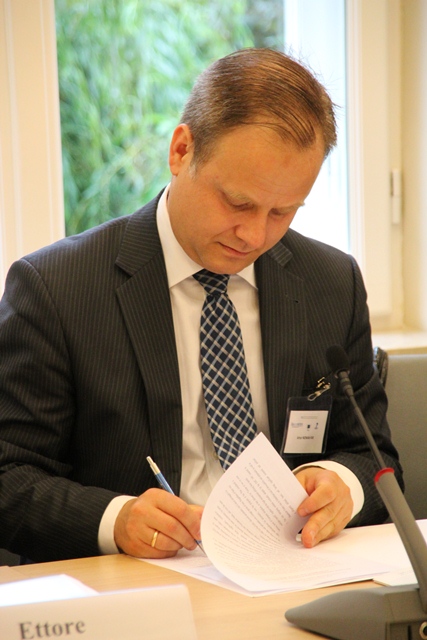
The issue of the euro area enlargement to the CEE countries with special focus on Poland compared to Czech Republic, Hungarian approach was a subject of closed door scientific workshop “Membership in the Reforming Euro Area: The CEE Perspective”, organised at PISM on June 25th. The workshop gathered experienced economists, officials representing the European Central Bank and national central banks as well as public administration, think-tanks, and academia from all the Visegrad Countries. The welcome speech was delivered by Prof. Artur Nowak-Far, Undersecretary of State for Legal Affairs and Treaties at the Poland’s Ministry of Foreign Affairs, author of numerous publications on legal and economic aspects of the Economic and Monetary Union. In his welcome address, Prof. Nowak-Far presented a broader, context of building a currency union, with the consequences for non-participating states. He also pointed to perfect timing and desirable discussions to be undertaken during the seminar. The text of Prof. Nowak-Far speech can be found under this link.
The scientific workshop was structured in three blocks. First concerned the general situation in the euro area, with the special focus on the situation in Germany before the September Bundestag elections. The second session focused on the assessment of the balance between the macroeconomic risks and benefits after the accession to the euro area. The panellists were analysing the consequences of entering into the third stage of the Economic and Monetary Union (EMU) for Slovak economy. Subsequently the discussion concerned the possible benefits and risks for Poland and Hungary. The panellists also raised the issue of new additional self-imposed convergence criteria to better reflect real convergence with the euro area of the acceding countries. The third session concerned the assessment of the on-going reform process in the European economic governance and possible implications for the non euro-area members. The panellists discussed also Czech and Polish political constraints concerning the euro area accession and their stance on the new system of economic governance in the EU. The conclusions and recommendations drawn during the seminar will be covered in the two reports to be delivered by PISM and accessible at the PISM and Rastanws project websites.
The event was the first deliverable of the 7th Framework programme collaborative project Rastanews: “Macro-Risk Assessment and Stabilisation Policies with New Early Warning Signals” (Call SSH.2012.1.3-1 The future of macro-economic and monetary integration in Europe). PISM participates in the project as a member of the scientific consortium composed of 12 institutions from 8 different countries, including Milano-Bicocca University, Science Po (France), University of Pécs (Hungary), ISPI (Italy), University of Heidelberg (Germany), KU Leuven (Belgium), Università Cattolica del Sacro Cuore (Italy), Università Politecnica Delle Marche (Italy), Queen Mary and Westfield College, (University of London) and Brunel University (UK). The Scientific Consortium is led by prof. Patrizio Tirelli from the Milano-Bicocca University. PISM participates in the Work Package 6, focusing on the euro area economic governance reforms, let by dr. Antonio Villafranca from ISPI. Both, prof. Tirelli and dr. Villafranca participated in the seminar. The project is coordinated by PISM by dr. Paweł Tokarski and project secretary Aleksander Szałański. The research in the framework of the project involves also participation of PISM director, dr. Marcin Zaborowski, Deputy Director, dr. Beata Wojna and analysts: Agata Gostyńska, Patryk Toporowski and dr. Anna Visvizi as external researcher.
Programme - Membership in the Reforming Euro Area
Ettore DORRUCCI - Enlarging the Euro Area: What did we learn?
Ognian Hishow - Debt crisis management in Europe: Germany’s approach
PISM Report: Membership in the Reforming Euro Area: a Central-Eastern European Perspective
Fot. Anna Kulikowska-Kasper, Jadwiga Winiarska
The scientific workshop was structured in three blocks. First concerned the general situation in the euro area, with the special focus on the situation in Germany before the September Bundestag elections. The second session focused on the assessment of the balance between the macroeconomic risks and benefits after the accession to the euro area. The panellists were analysing the consequences of entering into the third stage of the Economic and Monetary Union (EMU) for Slovak economy. Subsequently the discussion concerned the possible benefits and risks for Poland and Hungary. The panellists also raised the issue of new additional self-imposed convergence criteria to better reflect real convergence with the euro area of the acceding countries. The third session concerned the assessment of the on-going reform process in the European economic governance and possible implications for the non euro-area members. The panellists discussed also Czech and Polish political constraints concerning the euro area accession and their stance on the new system of economic governance in the EU. The conclusions and recommendations drawn during the seminar will be covered in the two reports to be delivered by PISM and accessible at the PISM and Rastanws project websites.
The event was the first deliverable of the 7th Framework programme collaborative project Rastanews: “Macro-Risk Assessment and Stabilisation Policies with New Early Warning Signals” (Call SSH.2012.1.3-1 The future of macro-economic and monetary integration in Europe). PISM participates in the project as a member of the scientific consortium composed of 12 institutions from 8 different countries, including Milano-Bicocca University, Science Po (France), University of Pécs (Hungary), ISPI (Italy), University of Heidelberg (Germany), KU Leuven (Belgium), Università Cattolica del Sacro Cuore (Italy), Università Politecnica Delle Marche (Italy), Queen Mary and Westfield College, (University of London) and Brunel University (UK). The Scientific Consortium is led by prof. Patrizio Tirelli from the Milano-Bicocca University. PISM participates in the Work Package 6, focusing on the euro area economic governance reforms, let by dr. Antonio Villafranca from ISPI. Both, prof. Tirelli and dr. Villafranca participated in the seminar. The project is coordinated by PISM by dr. Paweł Tokarski and project secretary Aleksander Szałański. The research in the framework of the project involves also participation of PISM director, dr. Marcin Zaborowski, Deputy Director, dr. Beata Wojna and analysts: Agata Gostyńska, Patryk Toporowski and dr. Anna Visvizi as external researcher.
Programme - Membership in the Reforming Euro Area
Ettore DORRUCCI - Enlarging the Euro Area: What did we learn?
Ognian Hishow - Debt crisis management in Europe: Germany’s approach
PISM Report: Membership in the Reforming Euro Area: a Central-Eastern European Perspective
  |
Fot. Anna Kulikowska-Kasper, Jadwiga Winiarska